

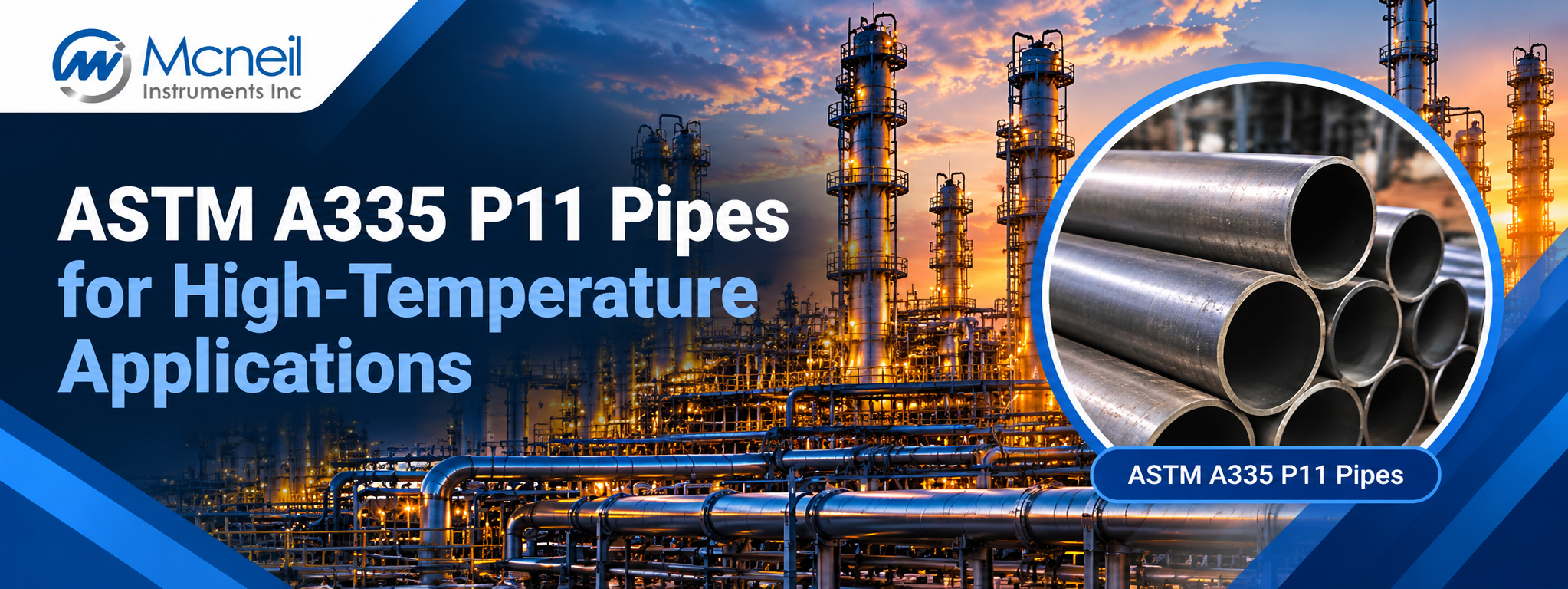
In extreme industrial environments—where scorching heat, high pressure, and relentless thermal stress are everyday conditions—choosing the right piping material isn’t just a technical decision; it’s a critical requirement for safety, operational efficiency, and long-term durability.
Among alloy steel materials, ASTM A335 P11 seamless pipe stands out as an industry standard. Thanks to its balanced Chromium-Molybdenum chemical composition, Grade P11 delivers the high-temperature strength, oxidation resistance, and structural stability required for demanding heavy-duty process systems.
At Mcneil Instrument, we specialize in supplying fully compliant, mill-certified alloy steel piping solutions tailored to project-specific requirements in power generation, petrochemical processing, and steam infrastructure.
What Are ASTM A335 P11 Pipes?
ASTM A335 Grade P11 (frequently dual-certified as ASME SA335 Grade P11) is a seamless ferritic alloy steel pipe specifically designed for high-temperature service.
Belonging to the low-alloy Chromium-Molybdenum (“chrome-moly”) family, P11 is engineered to maintain high tensile strength and structural integrity under prolonged thermal exposure. It serves as a go-to material grade for critical infrastructure including superheater lines, main steam lines, industrial boilers, and refinery process units.
Note: To ensure optimal performance and safety, material selection must always align with design calculations, maximum operating temperatures/pressures, and applicable engineering piping codes (such as ASME B31.1 or B31.3).
Key Mechanical Properties & Performance Advantages
Why is Grade P11 so widely specified? Its unique material balance provides several crucial engineering advantages:
- Balanced Chromium-Molybdenum Chemistry
Chromium (1.00% – 1.50%): Enhances oxidation resistance and corrosion protection at elevated operating temperatures.
Molybdenum (0.44% – 0.65%): Significantly boosts high-temperature yield strength and creep resistance under sustained stress. - High-Temperature Oxidation & Heat Resistance
Standard carbon steel begins to lose structural strength and scale rapidly when exposed to high temperatures over extended periods. P11’s alloy profile maintains structural stability across severe heating cycles. - Superior Creep Resistance
Creep refers to the slow, permanent deformation of metal when subjected to continuous high stress at elevated temperatures. Grade P11 is specifically compounded to resist thermal creep, extending system lifespan in high-pressure steam environments. - Reliable Weldability & Fabrication
P11 can be easily cut, formed, and welded using standard industry procedures. However, maintaining mechanical integrity requires adhering to proper preheating, approved welding consumables, post-weld heat treatment (PWHT), and mandatory non-destructive examination (NDE).
Core Industrial Applications of ASTM A335 P11 Pipes
Because of its balance of cost, strength, and thermal resistance, P11 is utilized across several core heavy industries:
Power Generation Plants: Ideal for main steam headers, reheat lines, boiler tube piping, and high-temperature auxiliary circuits.
Oil Refineries: Used in high-temp cracking units, hydrotreaters, and heat exchanger transfer piping where strength and thermal endurance are required.
Petrochemical & Chemical Processing: Essential for transporting aggressive organic or synthetic media operating under high temperature and pressure.
Boilers & Steam Systems: Frequently specified in high-pressure utility boilers, superheaters, and heat recovery steam generators (HRSGs).
ASTM A335 P11 vs. Ordinary Carbon Steel: When Should You Upgrade?
While carbon steel (such as ASTM A106 Grade B) is cost-effective and sufficient for ambient or mild temperature services, it hits clear operational limits as operating temperatures rise.
Feature Carbon Steel (e.g., A106 Gr B) Chrome-Moly Steel (ASTM A335 P11)
High-Temp Resistance Limited (tends to scale/degrade above $425^\circ\text{C}$ / $800^\circ\text{F}$) Excellent high-temperature mechanical stability
Creep Strength Low High sustained creep-rupture resistance
Oxidation Resistance Standard Superior resistance due to Chrome content
Best Application General fluid transport, mild utility lines Power boilers, steam lines, heat exchangers
When to choose P11: Upgrade to P11 when project design calculations show that carbon steel cannot safely meet the allowable stress limits, thermal expansion demands, or oxidation resistance required for your operating environment.
Important Specifications to Verify Before Purchasing
To prevent procurement delays and ensure strict site compliance, buyers and engineering teams should always confirm the following parameters prior to placing an order:
Standard & Grade: Specify ASTM A335 / A335M or ASME SA335 Grade P11 (Class 1 or Class 2 if applicable).
Dimensional Parameters: Nominal Pipe Size (NPS), outer diameter (OD), wall thickness, and Schedule rating (e.g., Sch 40, Sch 80, Sch 160, XXS).
Traceability & Documentation: Ensure full Mill Test Certificates (MTCs) to EN 10204 3.1 with heat number traceability matching the physical pipe stencil.
Testing & Inspection: Verify hydro-testing results or non-destructive ultrasonic / eddy-current testing in compliance with the standard.
Fabrication Needs: Define any custom length requirements, end preparation (beveled vs. plain ends), or specialized surface coating/protection.
Why Source ASTM A335 P11 Pipes from Mcneil Instrument?
At Mcneil Instrument, we bridge the gap between rigorous technical demands and seamless supply chain management. When you choose us for your alloy steel piping needs, you benefit from:
Comprehensive Inventory: Access to a wide spectrum of seamless pipe sizes, schedules, and custom cut lengths.
100% Traceable Quality: Complete mill test reports, material certs, and rigorous third-party inspection support.
Global Shipping & Technical Support: Expert assistance in navigating complex project requirements, documentation, and international shipping logistics.
👉 Ready to source certified Grade P11 piping for your next project?
ASTM A335 P11 Pipes for High-Temperature Applications
Explore our ASTM A335 P11 Alloy Steel Pipe Range or contact our sales engineering team today to discuss your exact sizing, schedule, and quantity needs.
Frequently Asked Questions (FAQs)
- What is an ASTM A335 P11 pipe?
ASTM A335 Grade P11 is a seamless alloy steel pipe formulated with chromium and molybdenum. It is specifically designed for high-temperature, high-pressure piping applications in power and process plants. - What is the chemical composition of ASTM A335 P11?
Grade P11 typically contains 1.00–1.50% Chromium and 0.44–0.65% Molybdenum, along with tightly controlled levels of carbon, manganese, silicon, phosphorus, and sulfur to optimize mechanical properties. - What is the difference between ASTM A335 P11 and P22 pipes?
Both are popular chrome-moly grades, but P22 contains higher levels of chromium (~2.25%) and molybdenum (~1.00%). P22 offers higher allowable stresses and creep resistance at elevated temperatures compared to P11, making it suitable for even higher thermal operating regimes. - Are ASTM A335 P11 pipes suitable for high-pressure service?
Yes. P11 seamless pipes are routinely specified for high-pressure systems, provided the selected wall thickness and pipe schedule comply with the required design pressure code at the operating temperature. - Do ASTM A335 P11 pipes require post-weld heat treatment (PWHT)?
In most structural and pressure piping codes (like ASME B31.3), welding P11 requires preheating and Post-Weld Heat Treatment (PWHT) to relieve thermal stresses and prevent cracking in the Heat-Affected Zone (HAZ). - Where can I buy certified ASTM A335 P11 pipes?
You can source fully certified, mill-tested ASTM A335 P11 seamless pipes “https://mcneilinstrument.com/p11-alloy-steel-pipes.html”Mcneil Instrument. Contact our team today for technical specs, custom schedules, and competitive pricing.


