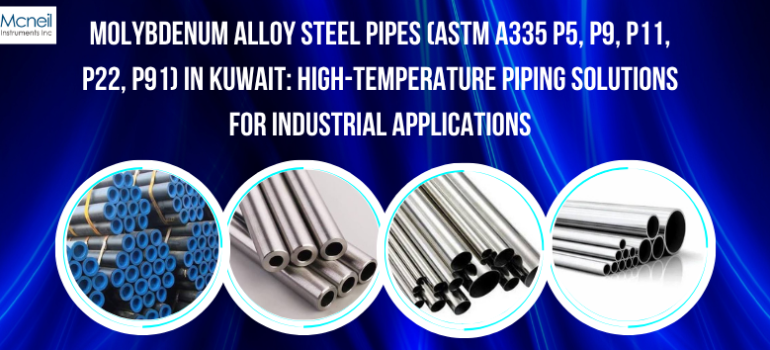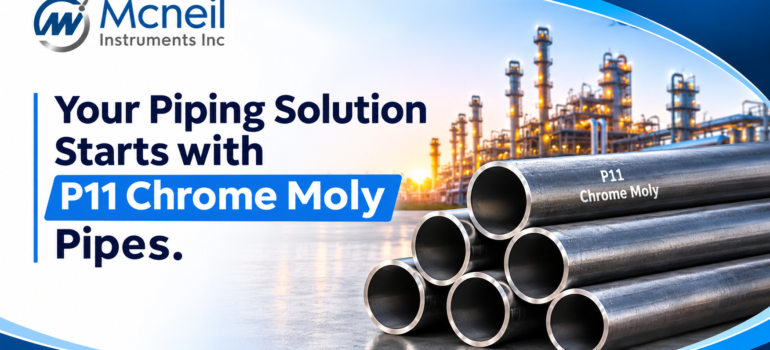
Mcneil Instruments Inc. P11 Chrome Moly alloy steel pipes for high-temperature and high-pressure industrial piping applications.

Your Piping Solution Starts with P11 Chrome Moly Pipes

Introduction

In industries where high temperatures, pressure, and demanding operating conditions are part of everyday operations, selecting the right piping material is essential. P11 chrome moly pipes are widely used in industrial applications that require high-temperature strength, oxidation resistance, and reliable performance.

Manufactured from chromium-molybdenum alloy steel, ASTM A335 P11 pipes are designed for elevated-temperature service. Their chemical composition provides a combination of strength, durability, and resistance to oxidation, making them suitable for critical piping systems.

From power generation plants to oil refineries and petrochemical facilities, P11 chrome moly pipes play an important role in maintaining efficient and dependable industrial operations.
At Mcneil Instrument, we understand the importance of selecting the right piping material for demanding applications. Our range of industrial alloy products supports businesses looking for reliable piping solutions.

What Are P11 Chrome Moly Pipes?

ASTM A335 P11 is a ferritic alloy steel pipe grade designed for high-temperature service.

These pipes contain chromium and molybdenum as their primary alloying elements. Chromium improves oxidation resistance, while molybdenum enhances strength and resistance to creep deformation at elevated temperatures.

P11 pipes are commonly used in applications involving steam, hot gases, and high-temperature fluids.

Their mechanical properties and chemical composition make them suitable for industrial environments where conventional carbon steel may not provide the required performance.

Key Features of ASTM A335 P11 Pipes

  1. Excellent High-Temperature Strength
    P11 chrome moly pipes are designed to maintain their mechanical properties under elevated-temperature conditions.
    Their chromium-molybdenum composition helps improve strength and resistance to deformation during prolonged exposure to heat.
    This makes them suitable for industrial piping systems that operate continuously at high temperatures.
  2. Improved Oxidation Resistance
    The chromium content in P11 pipes helps protect the material against oxidation in high-temperature environments.
    This property is particularly important in steam piping, power generation, and industrial heating applications.
  3. Good Creep Resistance
    Creep is the gradual deformation of a material under constant stress at elevated temperatures.
    P11 pipes offer improved resistance to creep compared with conventional carbon steel, making them suitable for selected high-temperature applications.
  4. Reliable Mechanical Properties
    P11 chrome moly pipes offer a combination of tensile strength, yield strength, and durability.
    These properties help support piping system integrity under demanding operating conditions.
  5. Compatibility with Alloy Steel Fittings
    ASTM A335 P11 pipes are commonly used with compatible alloy steel fittings, including ASTM A234 WP11.
    This compatibility helps maintain material consistency throughout high-temperature piping systems.

Applications of P11 Chrome Moly Pipes

Power Generation Industry
Power generation facilities require piping materials capable of handling elevated temperatures and pressure.
P11 chrome moly pipes are used in applications such as:
Steam distribution systems
Boiler piping
High-temperature feedwater systems
Thermal power plant piping
Industrial heating systems
Their high-temperature properties make them suitable for selected power generation applications.

Oil and Gas Industry
Oil and gas facilities require reliable piping materials for processing and transporting fluids under demanding operating conditions.
P11 pipes are commonly used in:
Refinery piping systems
Hydrocarbon processing units
High-temperature process lines
Steam piping systems
Industrial heating equipment
Their mechanical properties support dependable performance in appropriate high-temperature service conditions.

Petrochemical Industry
Petrochemical plants operate with complex processes involving high temperatures, pressure variations, and demanding fluid conditions.
P11 pipes are used in:
Petrochemical processing units
Heat exchanger piping
Industrial process lines
High-temperature transfer systems
Steam distribution networks
Selecting the right alloy steel grade helps improve piping system reliability and operational efficiency.

ASTM A335 P11 vs. Carbon Steel Pipes

P11 chrome moly pipes and carbon steel pipes are used in industrial piping systems, but their material properties differ.

Feature ASTM A335 P11 Carbon Steel Pipes
Material composition Chromium-molybdenum alloy steel Primarily iron and carbon
High-temperature strength Suitable for elevated-temperature service Depends on grade and operating conditions
Oxidation resistance Improved due to chromium content Generally lower at elevated temperatures
Creep resistance Improved for high-temperature applications Generally lower in comparable conditions
Common applications Power plants, refineries, petrochemical facilities General industrial piping

The choice between these materials depends on operating temperature, pressure, mechanical requirements, and applicable design codes.

How to Select the Right P11 Chrome Moly Pipe

Selecting the appropriate P11 pipe requires careful consideration of several factors.
Operating Temperature: Confirm that the material is suitable for the maximum operating temperature and expected temperature fluctuations.
Pressure Requirements: Select the appropriate pipe dimensions and wall thickness based on the system’s design pressure and applicable piping code.
Chemical Compatibility: Consider the type of fluid or gas being transported and its potential effect on the piping material.
Manufacturing Standards: Verify compliance with ASTM A335 and applicable project specifications.
Inspection and Documentation: Confirm material traceability, chemical composition, mechanical properties, and required inspection records.
These factors help ensure that the selected piping material meets the technical and operational requirements of the project.

Why Choose Mcneil Instrument for P11 Chrome Moly Pipes?

Mcneil Instrument supplies industrial alloy products for demanding applications across the oil and gas, petrochemical, and power generation industries.

When sourcing P11 chrome moly pipes, material quality, dimensional accuracy, and compliance with applicable specifications are important considerations.

Mcneil Instrument supports industrial buyers in identifying suitable alloy steel products based on their project requirements.

Whether you need P11 pipes for a refinery, power plant, or industrial processing facility, selecting the right material is essential for long-term performance.

Conclusion

ASTM A335 P11 chrome moly pipes are an important solution for industrial piping systems operating under elevated temperatures and demanding pressure conditions.

Their chromium-molybdenum composition provides improved high-temperature strength, oxidation resistance, and creep resistance, making them suitable for selected applications in power generation, oil and gas, and petrochemical processing.

Looking for reliable P11 chrome moly pipes for your industrial piping requirements?

Contact Mcneil Instrument today to discuss your specifications, dimensions, and project requirements.

Choose quality alloy steel piping solutions designed to support dependable performance in demanding industrial environments.

Frequently Asked Questions (FAQs)

  1. What are P11 chrome moly pipes?
    P11 chrome moly pipes are chromium-molybdenum alloy steel pipes manufactured according to ASTM A335. They are designed for high-temperature service in industrial piping systems.
  2. What are ASTM A335 P11 pipes used for?
    They are commonly used in power generation plants, oil refineries, petrochemical facilities, boiler piping, and high-temperature steam systems.
  3. What is the chemical composition of P11 pipes?
    ASTM A335 P11 pipes typically contain approximately 1.0–1.5% chromium and 0.44–0.65% molybdenum. Exact composition requirements depend on the applicable specification.
  4. What is the difference between P11 and P22 chrome moly pipes?
    P11 and P22 are both chromium-molybdenum alloy steel grades. P22 generally contains higher chromium and molybdenum levels, providing different high-temperature properties and suitability for specific operating conditions.
  5. Are P11 pipes suitable for high-pressure applications?
    Yes. P11 pipes can be used in high-pressure piping systems when the pipe dimensions, wall thickness, operating temperature, and pressure requirements meet the applicable design code.
  6. Which fittings are compatible with P11 chrome moly pipes?
    ASTM A234 WP11 alloy steel fittings are commonly used with ASTM A335 P11 pipes in compatible high-temperature piping systems.
  7. What industries use P11 chrome moly pipes?
    P11 pipes are commonly used in power generation, oil and gas, petrochemical processing, refineries, and industrial heating applications.
  8. What inspection documents should be checked when purchasing P11 pipes?
    Buyers should verify material test certificates, chemical composition reports, mechanical test results, dimensional inspection records, and heat treatment documentation as required by the project.
Read More
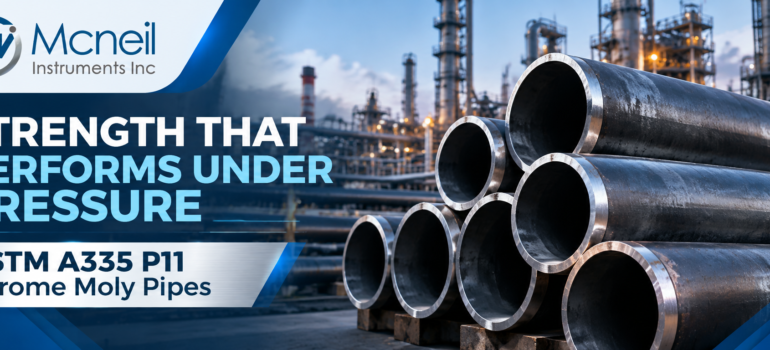
ASTM A335 P11 chrome moly steel pipes by Mcneil Instruments Inc., displayed in front of an industrial refinery.

Strength That Performs Under Pressure: ASTM A335 P11 Chrome Moly Pipes

Introduction

In industries where high temperatures, pressure, and demanding operating conditions are part of everyday operations, choosing the right piping material is essential. Power generation plants, refineries, petrochemical facilities, and industrial processing units require pipes that can maintain strength and reliability even under challenging conditions. This is where ASTM A335 P11 Chrome Moly Pipes play an important role.

Manufactured from chromium-molybdenum alloy steel, ASTM A335 P11 pipes are designed for high-temperature service. Their material composition offers a balance of strength, heat resistance, and durability, making them suitable for demanding piping systems. At Mcneil Instrument, we understand the importance of dependable piping solutions and help industrial buyers source products that meet their project specifications and operational requirements.

What Are ASTM A335 P11 Chrome Moly Pipes?

ASTM A335 P11 is a specification for seamless ferritic alloy-steel pipe intended for high-temperature service. P11 is a chromium-molybdenum grade containing approximately 1.0–1.5% chromium and 0.44–0.65% molybdenum, with the exact composition governed by the applicable ASTM specification.

Chromium contributes to oxidation resistance and high-temperature performance, while molybdenum helps improve strength at elevated temperatures. Together, these alloying elements make P11 pipes suitable for applications where ordinary carbon steel may not provide the required performance.

The final suitability of a P11 pipe depends on operating temperature, pressure, design conditions, heat treatment, and applicable engineering standards. Selecting the correct grade and specification is therefore an important part of any industrial piping project.

Why Choose ASTM A335 P11 Chrome Moly Pipes?

  1. Reliable Performance at Elevated Temperatures
    P11 pipes are used in piping systems that operate at elevated temperatures. Their alloy composition and specified manufacturing requirements help them maintain suitable mechanical properties under demanding service conditions.
  2. Strength for Demanding Applications
    Industrial piping systems must withstand operating pressure, temperature variations, and continuous service demands. ASTM A335 P11 pipes are selected for applications where the specified mechanical properties and design requirements call for chromium-molybdenum alloy steel.
  3. Oxidation Resistance at High Temperatures
    The chromium content of P11 alloy steel helps improve oxidation resistance compared with many conventional carbon steel grades. However, resistance to oxidation and corrosion depends on the operating environment, temperature, and service medium.
  4. Suitable for Power and Process Industries
    P11 pipes are commonly considered for high-temperature piping applications in power plants, refineries, petrochemical facilities, and other industrial installations. The grade must be selected according to the relevant design code and process conditions.
  5. Long-Term Operational Reliability
    Correct material selection, installation, inspection, and maintenance all contribute to piping system reliability. Using an appropriate alloy-steel grade such as ASTM A335 P11 can help support safe and dependable operation when the pipe is designed and installed for its intended service.

Applications of ASTM A335 P11 Pipes

ASTM A335 P11 Chrome Moly Pipes are used across several industries where elevated-temperature performance is an important consideration.

Power Generation Plants: Used in suitable steam and high-temperature piping systems, depending on plant design and operating conditions.
Oil and Gas Refineries: Applied in refinery process lines and other high-temperature services where the specified material grade is appropriate.
Petrochemical Plants: Used in selected process piping systems that require alloy-steel materials for elevated-temperature operation.
Boilers and Heat Exchangers: Considered for associated piping and equipment connections where the engineering design permits ASTM A335 P11.
Industrial Processing Facilities: Used in process installations that require a seamless alloy-steel pipe meeting the relevant material specification.
The exact application should always be confirmed against design pressure, operating temperature, fluid characteristics, and applicable codes.

ASTM A335 P11 Pipe: Key Material Considerations

When purchasing P11 pipes, buyers should evaluate more than the grade designation alone. Pipe dimensions, wall thickness, manufacturing route, heat treatment, inspection requirements, and material traceability are all important.

ASTM A335 covers seamless alloy-steel pipe for high-temperature service. Buyers should confirm the applicable specification edition, pipe size, schedule, dimensional tolerances, and required testing with their engineering or procurement team. Material Test Certificates and other inspection documents should be checked against the purchase order and project requirements.

Welding and fabrication also require attention. The correct welding procedure, filler material, preheating, and post-weld heat treatment requirements, where applicable, should be determined by qualified personnel based on the governing code and service conditions.

Why Source ASTM A335 P11 Pipes from Mcneil Instrument?

At Mcneil Instrument, we recognize that industrial procurement involves more than finding a pipe of the correct size. Buyers need products that match technical specifications, project documentation, and delivery requirements.

We support customers looking for piping solutions for power generation, oil and gas, petrochemical, and other industrial projects. Our team can assist with enquiries for ASTM A335 P11 Chrome Moly Pipes based on required dimensions, quantities, applicable standards, and documentation needs.

Whether you are planning a new installation, managing a maintenance shutdown, or sourcing materials for an ongoing project, clearly defined specifications help ensure the right product is selected. Availability, inspection documentation, and supply conditions should be confirmed at the time of enquiry.

Conclusion

ASTM A335 P11 Chrome Moly Pipes are an important material choice for suitable high-temperature industrial piping systems. Their chromium-molybdenum alloy composition, mechanical properties, and established specification make them relevant to power generation, refinery, and petrochemical applications.

Choosing the right pipe requires careful consideration of operating conditions, dimensions, quality documentation, and applicable engineering standards. Mcneil Instrument is ready to assist with your ASTM A335 P11 pipe enquiries and help you identify a supply solution aligned with your project requirements.

Looking for ASTM A335 P11 Chrome Moly Pipes for your next industrial project?

Connect with Mcneil Instrument for your piping requirements. Share your specifications, required quantities, and project documentation needs with our team to discuss suitable supply options for your high-temperature piping applications.
Contact Mcneil Instrument today to enquire about ASTM A335 P11 Chrome Moly Pipes.

Frequently Asked Questions

  1. What is ASTM A335 P11 pipe?
    ASTM A335 P11 is a seamless ferritic alloy-steel pipe grade intended for high-temperature service. It contains chromium and molybdenum to support the required material properties.
  2. What is the chemical composition of ASTM A335 P11?
    P11 typically contains approximately 1.0–1.5% chromium and 0.44–0.65% molybdenum. All chemical composition limits should be verified against the applicable ASTM A335 specification and material certificate.
  3. Are ASTM A335 P11 pipes seamless?
    Yes. ASTM A335 specifies seamless ferritic alloy-steel pipes for high-temperature service.
  4. Where are P11 Chrome Moly Pipes used?
    They are used in suitable high-temperature piping applications across power generation, refineries, petrochemical plants, and industrial processing facilities.
  5. What is the difference between P11 and P22 pipes?
    Both are chromium-molybdenum alloy-steel grades, but their chemical compositions and specified properties differ. P22 generally contains higher chromium and molybdenum levels than P11. The appropriate grade depends on design conditions, applicable codes, and project specifications.
  6. What information is needed to order ASTM A335 P11 pipes?
    Buyers should provide the required outside diameter, wall thickness or schedule, length, quantity, specification edition, inspection requirements, and material certification needs.
  7. What documents should accompany P11 pipes?
    Depending on the purchase order and project requirements, documentation may include Material Test Certificates, heat-number traceability, dimensional inspection reports, and applicable non-destructive or other test records.
  8. Can ASTM A335 P11 pipes be welded?
    Yes, but welding must follow an approved procedure appropriate to the material, thickness, and service conditions. Preheating and post-weld heat treatment may be required by the applicable code or project specification.
  9. How do I select the correct P11 pipe thickness?
    Wall thickness should be determined by the project engineer based on design pressure, temperature, allowable stress, corrosion allowance where applicable, mechanical loads, and the governing design code.
  10. How can I enquire about ASTM A335 P11 Chrome Moly Pipes from Mcneil Instrument?
    Contact Mcneil Instrument with your required dimensions, quantity, technical specification, delivery location, and documentation requirements so the team can review your enquiry and confirm available supply options.
Read More
ASTM A335 P11 alloy steel pipes for high-temperature industrial applications, featuring alloy steel piping and a petrochemical refinery at sunset.

ASTM A335 P11 Pipes for High-Temperature Applications: A Buyer’s & Engineer’s Guide

In extreme industrial environments—where scorching heat, high pressure, and relentless thermal stress are everyday conditions—choosing the right piping material isn’t just a technical decision; it’s a critical requirement for safety, operational efficiency, and long-term durability.

Among alloy steel materials, ASTM A335 P11 seamless pipe stands out as an industry standard. Thanks to its balanced Chromium-Molybdenum chemical composition, Grade P11 delivers the high-temperature strength, oxidation resistance, and structural stability required for demanding heavy-duty process systems.

At Mcneil Instrument, we specialize in supplying fully compliant, mill-certified alloy steel piping solutions tailored to project-specific requirements in power generation, petrochemical processing, and steam infrastructure.

What Are ASTM A335 P11 Pipes?

ASTM A335 Grade P11 (frequently dual-certified as ASME SA335 Grade P11) is a seamless ferritic alloy steel pipe specifically designed for high-temperature service.

Belonging to the low-alloy Chromium-Molybdenum (“chrome-moly”) family, P11 is engineered to maintain high tensile strength and structural integrity under prolonged thermal exposure. It serves as a go-to material grade for critical infrastructure including superheater lines, main steam lines, industrial boilers, and refinery process units.

Note: To ensure optimal performance and safety, material selection must always align with design calculations, maximum operating temperatures/pressures, and applicable engineering piping codes (such as ASME B31.1 or B31.3).

Key Mechanical Properties & Performance Advantages

Why is Grade P11 so widely specified? Its unique material balance provides several crucial engineering advantages:

  1. Balanced Chromium-Molybdenum Chemistry
    Chromium (1.00% – 1.50%): Enhances oxidation resistance and corrosion protection at elevated operating temperatures.
    Molybdenum (0.44% – 0.65%): Significantly boosts high-temperature yield strength and creep resistance under sustained stress.
  2. High-Temperature Oxidation & Heat Resistance
    Standard carbon steel begins to lose structural strength and scale rapidly when exposed to high temperatures over extended periods. P11’s alloy profile maintains structural stability across severe heating cycles.
  3. Superior Creep Resistance
    Creep refers to the slow, permanent deformation of metal when subjected to continuous high stress at elevated temperatures. Grade P11 is specifically compounded to resist thermal creep, extending system lifespan in high-pressure steam environments.
  4. Reliable Weldability & Fabrication
    P11 can be easily cut, formed, and welded using standard industry procedures. However, maintaining mechanical integrity requires adhering to proper preheating, approved welding consumables, post-weld heat treatment (PWHT), and mandatory non-destructive examination (NDE).

Core Industrial Applications of ASTM A335 P11 Pipes

Because of its balance of cost, strength, and thermal resistance, P11 is utilized across several core heavy industries:

Power Generation Plants: Ideal for main steam headers, reheat lines, boiler tube piping, and high-temperature auxiliary circuits.
Oil Refineries: Used in high-temp cracking units, hydrotreaters, and heat exchanger transfer piping where strength and thermal endurance are required.
Petrochemical & Chemical Processing: Essential for transporting aggressive organic or synthetic media operating under high temperature and pressure.
Boilers & Steam Systems: Frequently specified in high-pressure utility boilers, superheaters, and heat recovery steam generators (HRSGs).

ASTM A335 P11 vs. Ordinary Carbon Steel: When Should You Upgrade?

While carbon steel (such as ASTM A106 Grade B) is cost-effective and sufficient for ambient or mild temperature services, it hits clear operational limits as operating temperatures rise.

Feature Carbon Steel (e.g., A106 Gr B) Chrome-Moly Steel (ASTM A335 P11)
High-Temp Resistance Limited (tends to scale/degrade above $425^\circ\text{C}$ / $800^\circ\text{F}$) Excellent high-temperature mechanical stability
Creep Strength Low High sustained creep-rupture resistance
Oxidation Resistance Standard Superior resistance due to Chrome content
Best Application General fluid transport, mild utility lines Power boilers, steam lines, heat exchangers

When to choose P11: Upgrade to P11 when project design calculations show that carbon steel cannot safely meet the allowable stress limits, thermal expansion demands, or oxidation resistance required for your operating environment.

Important Specifications to Verify Before Purchasing

To prevent procurement delays and ensure strict site compliance, buyers and engineering teams should always confirm the following parameters prior to placing an order:

Standard & Grade: Specify ASTM A335 / A335M or ASME SA335 Grade P11 (Class 1 or Class 2 if applicable).
Dimensional Parameters: Nominal Pipe Size (NPS), outer diameter (OD), wall thickness, and Schedule rating (e.g., Sch 40, Sch 80, Sch 160, XXS).
Traceability & Documentation: Ensure full Mill Test Certificates (MTCs) to EN 10204 3.1 with heat number traceability matching the physical pipe stencil.
Testing & Inspection: Verify hydro-testing results or non-destructive ultrasonic / eddy-current testing in compliance with the standard.
Fabrication Needs: Define any custom length requirements, end preparation (beveled vs. plain ends), or specialized surface coating/protection.

Why Source ASTM A335 P11 Pipes from Mcneil Instrument?

At Mcneil Instrument, we bridge the gap between rigorous technical demands and seamless supply chain management. When you choose us for your alloy steel piping needs, you benefit from:

Comprehensive Inventory: Access to a wide spectrum of seamless pipe sizes, schedules, and custom cut lengths.
100% Traceable Quality: Complete mill test reports, material certs, and rigorous third-party inspection support.
Global Shipping & Technical Support: Expert assistance in navigating complex project requirements, documentation, and international shipping logistics.

👉 Ready to source certified Grade P11 piping for your next project?

ASTM A335 P11 Pipes for High-Temperature Applications

Explore our ASTM A335 P11 Alloy Steel Pipe Range or contact our sales engineering team today to discuss your exact sizing, schedule, and quantity needs.

Frequently Asked Questions (FAQs)

  1. What is an ASTM A335 P11 pipe?
    ASTM A335 Grade P11 is a seamless alloy steel pipe formulated with chromium and molybdenum. It is specifically designed for high-temperature, high-pressure piping applications in power and process plants.
  2. What is the chemical composition of ASTM A335 P11?
    Grade P11 typically contains 1.00–1.50% Chromium and 0.44–0.65% Molybdenum, along with tightly controlled levels of carbon, manganese, silicon, phosphorus, and sulfur to optimize mechanical properties.
  3. What is the difference between ASTM A335 P11 and P22 pipes?
    Both are popular chrome-moly grades, but P22 contains higher levels of chromium (~2.25%) and molybdenum (~1.00%). P22 offers higher allowable stresses and creep resistance at elevated temperatures compared to P11, making it suitable for even higher thermal operating regimes.
  4. Are ASTM A335 P11 pipes suitable for high-pressure service?
    Yes. P11 seamless pipes are routinely specified for high-pressure systems, provided the selected wall thickness and pipe schedule comply with the required design pressure code at the operating temperature.
  5. Do ASTM A335 P11 pipes require post-weld heat treatment (PWHT)?
    In most structural and pressure piping codes (like ASME B31.3), welding P11 requires preheating and Post-Weld Heat Treatment (PWHT) to relieve thermal stresses and prevent cracking in the Heat-Affected Zone (HAZ).
  6. Where can I buy certified ASTM A335 P11 pipes?
    You can source fully certified, mill-tested ASTM A335 P11 seamless pipes “https://mcneilinstrument.com/p11-alloy-steel-pipes.html”Mcneil Instrument. Contact our team today for technical specs, custom schedules, and competitive pricing.
Read More

Alloy Steel Pipes in Nigeria: P5, P9, P11, P22 & P91 for High-Temperature Applications

Alloy steel pipes are essential components in industrial piping systems where high temperature, pressure, mechanical stress, oxidation, and long-term service reliability are critical. In Nigeria, industries such as oil and gas, refineries, power generation, petrochemicals, fertilizer manufacturing, and heavy engineering require piping materials capable of performing under demanding operating conditions.

Mcneil Instrument manufactures, supplies, and exports ASTM A335 / ASME SA335 Alloy Steel Pipes in grades P5, P9, P11, P22, and P91. These chromium-molybdenum alloy steel grades are designed for high-temperature and high-pressure applications and are used in boilers, steam systems, refineries, heat exchangers, petrochemical facilities, and power-generation projects.

What Are Alloy Steel Pipes?

Alloy steel pipes are steel pipes containing alloying elements such as chromium and molybdenum to improve their performance compared with conventional carbon steel.

The ASTM A335 / ASME SA335 family includes ferritic alloy steel pipes intended for high-temperature service. The addition of chromium and molybdenum contributes to:

  • High-temperature strength
  • Creep resistance
  • Oxidation and scaling resistance
  • Improved mechanical stability
  • Resistance to thermal degradation
  • Reliable performance under pressure

Mcneil Instrument’s P5, P9, P11, P22, and P91 pipes are primarily supplied as seamless alloy steel pipes for demanding industrial applications.

Why Alloy Steel Pipes Are Important for Nigerian Industries

Nigeria has major industrial sectors that depend on high-temperature and high-pressure piping systems. Refineries, power plants, petrochemical facilities, fertilizer plants, and oil and gas installations can expose piping to elevated temperatures, steam, hydrocarbons, pressure, and continuous thermal cycling.

Alloy steel pipes can provide the material performance required for these environments.

Key benefits include:

  • Excellent high-temperature performance
  • High mechanical strength
  • Good creep resistance
  • Resistance to oxidation and scaling
  • Long-term thermal stability
  • High-pressure service capability
  • Reliable performance under continuous operation
  • Suitability for critical process piping

Mcneil Instrument specifically identifies oil and gas, power generation, petrochemical, fertilizer, refinery, and mining applications in Nigeria for its alloy steel pipe range.

ASTM A335 Alloy Steel Pipe Grades

Mcneil Instrument offers five major grades within its alloy steel pipe range:

  • ASTM A335 P5
  • ASTM A335 P9
  • ASTM A335 P11
  • ASTM A335 P22
  • ASTM A335 P91

Each grade has different alloy chemistry and performance characteristics, so the correct grade should be selected according to operating temperature, pressure, process conditions, allowable stress, welding requirements, and applicable engineering specifications.

ASTM A335 P5 Alloy Steel Pipes

P5 is a chromium-molybdenum alloy steel grade designed for elevated-temperature applications.

Its chromium and molybdenum content contributes to oxidation resistance, thermal stability, and high-temperature performance.

Typical Applications

P5 pipes can be used in:

  • Refinery heater systems
  • Steam pipelines
  • Petrochemical units
  • Heat exchangers
  • Boilers
  • High-temperature process piping

For Nigerian refinery and petrochemical projects, P5 can be considered where the system requires its specific combination of temperature capability and mechanical properties.

ASTM A335 P9 Alloy Steel Pipes

P9 contains higher chromium and molybdenum levels than P5 and is intended for more demanding high-temperature service.

Its properties make it suitable for applications involving thermal loads, oxidation, and high-pressure process conditions.

Typical Applications

  • Heat exchangers
  • Furnace components
  • High-pressure boilers
  • Petrochemical process lines
  • High-temperature steam systems
  • Refinery equipment

P9 is particularly relevant to Nigerian refinery and high-temperature process applications.

ASTM A335 P11 Alloy Steel Pipes

P11 is a widely used chromium-molybdenum alloy steel grade for high-temperature piping systems.

It provides a balance of strength, oxidation resistance, thermal performance, and fabrication characteristics.

Applications

P11 alloy steel pipes are commonly associated with:

  • Thermal power plants
  • Steam lines
  • Boilers
  • Superheater systems
  • Reheater systems
  • Heat exchangers

For Nigerian power and industrial projects, P11 can be specified where the design conditions require its particular mechanical and high-temperature properties.

ASTM A335 P22 Alloy Steel Pipes

P22 provides enhanced high-temperature and creep performance and is widely associated with demanding steam and thermal systems.

Typical Applications

  • Superheaters
  • Reheaters
  • High-pressure steam circuits
  • Boilers
  • Power-generation systems
  • Pressure vessels
  • Chemical plants

P22 is especially relevant where long-term exposure to elevated temperature and pressure requires improved creep performance.

ASTM A335 P91 Alloy Steel Pipes

P91 is a creep-strength-enhanced chromium-molybdenum alloy steel grade developed for demanding high-temperature and high-pressure service.

Its alloying system includes chromium and molybdenum together with strengthening additions such as vanadium and niobium.

Typical Applications

  • Supercritical boilers
  • High-pressure steam pipelines
  • Steam turbine systems
  • Thermal power plants
  • High-temperature steam headers
  • Critical power-generation piping

Mcneil Instrument identifies P91 as a premium grade for critical high-pressure applications and high-efficiency power projects.

P5 vs P9 vs P11 vs P22 vs P91

GradeGeneral CharacteristicsTypical Nigerian Applications
P5Chromium-molybdenum alloy with oxidation and scaling resistanceRefinery heaters, steam systems
P9Higher chromium and molybdenum contentHeat exchangers, furnaces, petrochemical systems
P11Balanced strength and high-temperature performanceBoilers, steam lines, thermal power
P22Enhanced creep and thermal performanceSuperheaters, reheaters, high-pressure steam
P91Creep-strength-enhanced alloy for critical servicePower stations, steam headers, critical piping

The highest grade is not automatically the best choice. Material selection should be based on the actual operating temperature, pressure, process medium, design code, welding procedure, and required service life.

Technical Specifications of Alloy Steel Pipes

Mcneil Instrument’s published alloy steel pipe information identifies ASTM A335 / ASME SA335 as the applicable standards and includes P5, P9, P11, P22, and P91 grades.

ParameterSpecification
ProductAlloy Steel Pipes
StandardASTM A335 / ASME SA335
GradesP5, P9, P11, P22, P91
ConstructionSeamless
Published Size Range1/8″ NB to 24″ NB
Published Schedule RangeSCH 20 to SCH XXS
ApplicationsBoilers, refineries, petrochemical plants, power generation
ServiceHigh-temperature and high-pressure applications

The company’s Nigeria-focused information also lists larger/custom size options and different manufacturing forms on related alloy-steel content. Exact dimensions, wall thickness, heat treatment, testing, and pressure requirements should be confirmed against the project purchase specification and selected grade.

Seamless Alloy Steel Pipes for Nigerian Industrial Projects

Seamless construction is particularly valuable in critical pressure-piping applications because the pipe does not contain a longitudinal welded seam.

Key characteristics include:

  • Uniform wall structure
  • High structural integrity
  • Reliable pressure handling
  • Good fatigue resistance
  • Suitability for high-temperature service
  • Reduced concerns associated with longitudinal weld seams

Mcneil Instrument lists seamless alloy steel pipes across its P5, P9, P11, P22, and P91 product range.

Applications of Alloy Steel Pipes in Nigeria

1. Oil and Gas Industry

Nigeria’s oil and gas industry requires piping systems capable of operating under demanding process conditions.

Alloy steel pipes can be used in suitable applications involving:

  • Refinery process systems
  • Hydrocarbon processing
  • High-temperature process lines
  • Steam systems
  • Heat-transfer systems
  • Boiler systems
  • Petrochemical units

Material selection should always consider the specific process medium, pressure, temperature, and corrosion conditions.

2. Nigerian Refineries

Refineries contain heaters, furnaces, steam networks, heat exchangers, and high-temperature process units.

P5 and P9 are associated with refinery and high-temperature process applications, while P11, P22, and P91 can be specified for suitable steam and power-related systems.

For refinery projects in areas such as Lagos, Port Harcourt, and Warri, engineers need to evaluate temperature, pressure, thermal cycling, process chemistry, and project specifications when selecting the pipe grade.

3. Power Generation

Power plants rely heavily on high-temperature steam piping.

Alloy steel pipes can be used in:

  • Boilers
  • Superheaters
  • Reheaters
  • Steam pipelines
  • Turbine-related systems
  • Steam headers
  • Economizers

P11, P22, and P91 can be considered for appropriate high-temperature power-generation applications depending on the design requirements.

4. Petrochemical Plants

Petrochemical facilities operate process systems under elevated temperatures and pressures.

Alloy steel pipes may be used for:

  • Process pipelines
  • Heat exchangers
  • Reactor systems
  • Furnace systems
  • Steam networks
  • High-temperature process units

P9, P11, and P22 are relevant grades for selected petrochemical applications.

5. Fertilizer Industry

Fertilizer plants require reliable piping for high-pressure process and utility systems.

Potential applications include:

  • Utility pipelines
  • Steam systems
  • High-pressure process lines
  • Heat-transfer systems
  • Boiler systems

The appropriate alloy grade should be selected according to the process chemistry and operating conditions.

6. Mining and Heavy Engineering

Mining and heavy-engineering facilities can also require high-strength piping for thermal and pressure-intensive applications.

Alloy steel pipes can support:

  • High-pressure process lines
  • Industrial equipment
  • Pressure systems
  • Thermal processing systems
  • Heavy engineering projects

How to Select the Right Alloy Steel Pipe Grade

Selecting an ASTM A335 pipe should involve a detailed review of the complete operating environment.

Operating Temperature

Determine both normal and maximum design temperature.

Higher-temperature applications may require P22 or P91 rather than a lower-alloy grade, depending on the design conditions.

Operating Pressure

Confirm the design pressure and required wall thickness. Pipe schedule should be selected based on engineering calculations rather than simply choosing a thicker pipe.

Process Medium

Identify whether the pipe will carry steam, hydrocarbons, chemicals, or another process fluid.

Creep Requirements

For systems operating continuously at elevated temperatures, long-term creep strength is an important material-selection factor.

Welding Requirements

The selected grade, especially higher-alloy grades such as P91, requires appropriate welding procedures, preheating, post-weld heat treatment, and qualified fabrication practices where specified by the applicable code and project requirements.

Pipe Dimensions

Confirm:

  • Nominal bore
  • Outside diameter
  • Wall thickness
  • Schedule
  • Pipe length
  • End finish
  • Required tolerances

Applicable Standards

Specify the required ASTM, ASME, project, and engineering standards before procurement.

Quality and Documentation

For critical industrial piping, material traceability and inspection documentation are important parts of procurement.

Depending on the project specification, buyers may require documentation such as:

  • Mill Test Certificates
  • Chemical composition reports
  • Mechanical test results
  • Hydrostatic test reports
  • PMI reports
  • Non-destructive testing records
  • Dimensional inspection reports
  • Heat-treatment records
  • Compliance certificates
  • Third-party inspection documentation

Mcneil Instrument’s Nigeria-focused alloy pipe information references documentation including MTCs, NDT reports, hydrostatic tests, PMI results, and compliance certificates for applicable projects.

Why Choose Mcneil Instrument for Alloy Steel Pipes in Nigeria?

Mcneil Instrument offers ASTM A335 / ASME SA335 P5, P9, P11, P22, and P91 Alloy Steel Pipes for demanding industrial applications.

The company positions its alloy steel pipe range for:

  • Oil and gas
  • Refineries
  • Power generation
  • Petrochemical plants
  • Fertilizer facilities
  • Boilers
  • Heat exchangers
  • High-pressure process systems
  • Heavy engineering

Its published product information also identifies Nigeria as a supply market for these alloy steel pipes.

Mcneil Instrument’s broader Nigeria-focused content discusses industrial supply across locations and sectors including refinery, power, petrochemical, fertilizer, and mining applications.

Benefits of ASTM A335 Alloy Steel Pipes

The main advantages of P5, P9, P11, P22, and P91 alloy steel pipes include:

  • High-temperature strength
  • Good creep resistance
  • Oxidation resistance
  • Scaling resistance
  • High mechanical strength
  • Thermal stability
  • High-pressure capability
  • Long service life
  • Suitability for critical industrial piping
  • Reliable performance under thermal stress

These properties make chromium-molybdenum alloy steel pipes suitable for applications where ordinary carbon steel may not provide the required high-temperature performance.

Frequently Asked Questions

What are ASTM A335 Alloy Steel Pipes?

ASTM A335 Alloy Steel Pipes are ferritic alloy steel pipes intended for high-temperature service. Mcneil Instrument’s range includes P5, P9, P11, P22, and P91 grades.

Which alloy steel pipe grades does Mcneil Instrument supply in Nigeria?

Mcneil Instrument’s published range includes P5, P9, P11, P22, and P91 alloy steel pipes.

Which ASTM A335 grade is used for high-temperature power applications?

P11, P22, and P91 can be used in appropriate power-generation applications, depending on the design temperature, pressure, allowable stress, and applicable code.

Where are alloy steel pipes used in Nigeria?

They are used in oil and gas, refineries, power plants, petrochemical facilities, fertilizer plants, boilers, heat exchangers, and other high-temperature process systems.

Are ASTM A335 P5, P9, P11, P22 and P91 carbon steel pipes?

No. These are chromium-molybdenum alloy steel grades, with alloying additions that provide enhanced high-temperature and mechanical performance compared with ordinary carbon steel.

Are Mcneil Instrument alloy steel pipes seamless?

Yes. Mcneil Instrument’s published product range identifies seamless alloy steel pipes in P5, P9, P11, P22, and P91 grades.

What is the difference between P5, P9, P11, P22 and P91?

The grades differ primarily in their alloy chemistry and resulting high-temperature, oxidation, creep, and mechanical properties. P5 and P9 are widely associated with refinery and high-temperature process applications, P11 and P22 with boilers and steam systems, and P91 with critical high-temperature power and steam applications.

Conclusion

ASTM A335 / ASME SA335 Alloy Steel Pipes provide a reliable piping solution for Nigerian industries operating under high temperatures, pressures, and continuous thermal stress.

The P5, P9, P11, P22, and P91 grades offer different levels of high-temperature strength, oxidation resistance, creep performance, and mechanical stability. Selecting the correct grade requires consideration of operating temperature, pressure, process medium, creep requirements, welding procedures, dimensions, and applicable engineering standards.

For Nigeria’s oil and gas, refinery, petrochemical, power-generation, fertilizer, and heavy-engineering sectors, Mcneil Instrument provides a range of alloy steel pipes designed for demanding industrial service.

Read More
ASTM A335 alloy steel pipes P5 P9 P11 P22 and P91 for high-temperature applications in the USA

ASTM A335 Alloy Steel Pipes in USA: Choosing the Right P5, P9, P11, P22 & P91 Grade for High-Temperature Applications

High-temperature piping systems in the United States demand materials that can maintain mechanical strength, dimensional stability and resistance to oxidation and creep under demanding operating conditions. Power plants, refineries, petrochemical facilities, boiler systems, heat-recovery units and other process industries rely on specialized alloy steel piping for services where conventional carbon steel may not provide the required performance.
ASTM A335 / ASME SA335 alloy steel pipes are designed for elevated-temperature service and include grades such as P5, P9, P11, P22 and P91. Each grade contains a different combination of chromium, molybdenum and, in the case of P91, additional alloying elements, giving the material different high-temperature characteristics.
Mcneil Instrument supplies and exports ASTM A335 / ASME SA335 seamless alloy steel pipes for industrial applications in the USA. Its published product range includes P5, P9, P11, P22 and P91 grades, with applications covering power generation, refineries, petrochemical plants, steam systems, boilers and advanced energy facilities.

Why ASTM A335 Alloy Steel Pipes Matter in the USA

Industrial facilities across the United States operate a wide range of high-temperature and high-pressure systems. Steam generation, thermal processing, refinery heating and petrochemical operations can expose piping to continuous thermal loading, pressure fluctuations and long-term creep conditions.
ASTM A335 alloy steel pipes are particularly relevant where the piping system requires elevated-temperature performance and appropriate resistance to oxidation and creep.
Mcneil Instrument’s USA-specific information identifies ASTM A335 P5, P9, P11 and P22 as commonly used chrome-moly alloy pipe grades for high-temperature environments, particularly in power and petrochemical applications.
The choice of grade, however, should never be based only on the name of the material. Engineers and procurement teams should evaluate:
Operating temperature
Design pressure
Process medium
Required creep resistance
Pipe dimensions
Wall thickness
Applicable ASTM/ASME requirements
Project specifications
Inspection and documentation requirements
Fabrication and welding requirements

ASTM A335 P5 Pipes for High-Temperature Industrial Service

ASTM A335 P5 is a chromium-molybdenum alloy steel pipe grade used for elevated-temperature applications where oxidation resistance and thermal stability are important.
Mcneil Instrument’s published specifications list approximately 4–6% chromium and 0.45–0.65% molybdenum for P5, with a listed temperature range of up to approximately 600°C.
Typical P5 Pipe Applications
ASTM A335 P5 pipes can be considered for applications such as:
Refineries
Heat exchangers
Boilers
Petrochemical facilities
Industrial heating systems
High-temperature process piping
Steam-related systems
P5 is particularly useful where the piping system requires improved high-temperature and oxidation performance compared with conventional carbon steel piping.
P5 Pipe Specifications
Parameter ASTM A335 P5
Standard ASTM A335 / ASME SA335
Chromium 4–6%
Molybdenum 0.45–0.65%
Listed temperature range Up to 600°C
Tensile strength ≥ 415 MPa
Yield strength ≥ 205 MPa
Form Seamless alloy steel pipe
Specifications should always be confirmed against the applicable material standard and project requirements before procurement.

ASTM A335 P9 Pipes for Power and Petrochemical Applications

ASTM A335 P9 contains higher chromium and molybdenum levels than P5, giving it strong high-temperature and oxidation resistance.
Mcneil Instrument lists approximately 8–10% chromium and 0.90–1.10% molybdenum for P9.
Where P9 Pipes Are Used
P9 pipes can be selected for:
Power stations
Petrochemical plants
Steam systems
Industrial heaters
High-temperature process piping
Heat exchangers
Refinery applications
The higher chromium content makes P9 suitable for applications where thermal performance and oxidation resistance are important considerations.

ASTM A335 P11 Pipes for Boiler and Steam Systems

ASTM A335 P11 is one of the widely recognized chromium-molybdenum alloy steel grades for high-temperature piping.
Mcneil Instrument’s published information gives P11 approximately 1–1.5% chromium and 0.44–0.65% molybdenum.
P11 is commonly considered for systems where a balance of strength, thermal performance and fabrication characteristics is required.
P11 Pipe Applications
Typical applications include:
Industrial boilers
Power plants
Steam lines
Heat exchangers
Process piping
Chemical processing facilities
High-temperature piping systems
P11 can be an effective choice for steam and boiler-related applications when its properties match the project’s design conditions.

ASTM A335 P22 Pipes for High-Temperature and Creep Service

ASTM A335 P22 is a chromium-molybdenum alloy steel pipe grade used where elevated-temperature strength and creep resistance are important.
Mcneil Instrument lists approximately 1.9–2.6% chromium and 0.87–1.13% molybdenum for P22.
Common P22 Applications
P22 pipes are considered for:
Fossil-fuel power plants
Boiler systems
Reheaters
Steam distribution
Heat-recovery systems
Petrochemical plants
High-temperature process piping
Heat exchangers
P22 is particularly relevant for applications involving prolonged exposure to elevated temperatures where creep and long-term mechanical performance must be considered.

ASTM A335 P91 Pipes for Critical High-Temperature Applications

ASTM A335 P91 represents a higher-performance alloy steel grade intended for demanding high-temperature and high-pressure applications.
Mcneil Instrument’s published specifications identify approximately 8–9.5% chromium and 0.85–1.05% molybdenum, together with additional alloying elements associated with P91. The published mechanical values include a minimum tensile strength of 620 MPa and minimum yield strength of 440 MPa.
Where P91 Pipes Are Used
P91 can be considered for critical applications such as:
Ultra-supercritical power plants
High-pressure steam pipelines
Advanced energy systems
Selected nuclear power applications
Critical high-temperature piping
High-temperature boiler systems
Turbine-related systems
P91 is generally considered when long-term high-temperature strength and creep resistance are particularly important.

P5 vs P9 vs P11 vs P22 vs P91: Which Grade Should You Choose?

The five grades should not be treated as interchangeable materials. Their alloy compositions and performance characteristics differ, making each grade suitable for different operating conditions.
Grade Approx. Chromium Approx. Molybdenum Primary Characteristic Typical Applications
P5 4–6% 0.45–0.65% High-temperature and oxidation resistance Refineries, heat exchangers
P9 8–10% 0.90–1.10% High chromium and thermal resistance Power, petrochemical
P11 1–1.5% 0.44–0.65% Balanced strength and thermal performance Boilers, steam systems
P22 1.9–2.6% 0.87–1.13% High-temperature and creep resistance Power plants, steam systems
P91 8–9.5% 0.85–1.05% Very high creep and high-temperature performance Critical energy systems
These composition ranges and application descriptions are based on Mcneil Instrument’s published ASTM A335 information.
The right grade should be selected according to actual operating temperature, pressure, process medium, design code, creep requirements and project specifications.

ASTM A335 Pipe Specifications for USA Projects

Mcneil Instrument’s published ASTM A335 range is identified as seamless alloy steel pipe manufactured to ASTM A335 / ASME SA335 requirements.
The published product information lists:
Specification Mcneil Instrument Range
Standard ASTM A335 / ASME SA335
Grades P5, P9, P11, P22, P91
Product form Seamless
Size range 1/8″ NB to 36″ NB
Wall thickness SCH 10 to SCH XXS
Shape Round
Standards ASTM / ASME
Exact dimensions, schedules, lengths, end preparation and availability should be confirmed according to the specific purchase requirement.

How to Select Alloy Steel Pipes for a USA Industrial Project

Selecting the appropriate ASTM A335 pipe grade requires more than comparing chromium and molybdenum percentages.

  1. Determine the Operating Temperature
    Start with the normal operating temperature and maximum design temperature.
    Higher-temperature services may require grades with improved creep and thermal performance.
  2. Confirm the Design Pressure
    Pressure affects required wall thickness and pipe selection. The pipe specification should be matched with the engineering design and applicable code requirements.
  3. Evaluate the Process Medium
    The fluid or gas being transported can affect material selection. Consider temperature, pressure and chemical characteristics together.
  4. Evaluate Creep Requirements
    Long-term exposure to elevated temperatures can make creep resistance a major design consideration.
    This is particularly relevant for power-generation and steam systems.
  5. Select the Appropriate Grade
    P5, P9, P11, P22 and P91 provide different combinations of alloy content and high-temperature performance.
    Choosing P91 simply because it is a higher-performance grade is not necessarily the correct engineering approach. The material should match the actual service conditions and project specification.
  6. Confirm Pipe Dimensions
    USA projects may require detailed dimensional specifications including:
    Nominal pipe size
    Outside diameter
    Wall thickness
    Schedule
    Pipe length
    End preparation
    Seamless construction
    Pressure requirements
  7. Verify Documentation
    For industrial procurement, material documentation and traceability can be important parts of the purchase requirement.
    Mcneil Instrument states that its product offering includes material traceability and MTC certification, along with export-ready packaging.

Applications of ASTM A335 Alloy Steel Pipes in the USA

Power Generation
Power-generation facilities use high-temperature piping for steam, boilers, superheaters, reheaters and associated systems.
P11, P22 and P91 can be considered for different services depending on the design conditions. Mcneil Instrument identifies power plants and advanced energy systems among the applications for its ASTM A335 range.
Refineries
Refinery processes can involve elevated temperatures and pressure.
P5 and P9 may be considered for suitable high-temperature refinery services where their material characteristics meet the engineering requirements.
Petrochemical Plants
Petrochemical facilities require piping capable of maintaining mechanical integrity during continuous thermal and pressure loading.
ASTM A335 P5, P9, P11, P22 and P91 can be specified for different services depending on process conditions.
Boiler and Steam Systems
Boilers and steam networks require materials capable of maintaining strength during prolonged high-temperature operation.
P11 and P22 are commonly associated with boiler and steam applications, while P91 can be considered for more demanding high-temperature systems.
Heat Recovery Systems
Heat-recovery equipment can expose piping to repeated thermal loading and elevated temperatures. Appropriate chrome-moly grades can help meet the material requirements of these systems when correctly specified.
Advanced Energy Applications
Higher-performance grades such as P91 can be used in selected critical energy applications where elevated-temperature strength and creep resistance are important.

Mcneil Instrument ASTM A335 Alloy Steel Pipes for the USA

Mcneil Instrument manufactures, supplies and exports ASTM A335 / ASME SA335 P5, P9, P11, P22 and P91 seamless alloy steel pipes.
The company publishes a dedicated USA market page for its pipe range and identifies the United States among its international markets. Its USA-focused information highlights high-temperature applications in power-generation and petrochemical industries.
For US buyers, EPC contractors, engineering companies, distributors and industrial procurement teams, Mcneil Instrument’s range can be evaluated according to:
Required ASTM/ASME specification
Pipe grade
Nominal size
Schedule
Operating temperature
Operating pressure
Application
Inspection requirements
Material certification
Project documentation
Delivery requirements
Explore Related Mcneil Instrument Products
For projects requiring compatible piping components, explore Mcneil Instrument’s related [ASTM A335 P5, P9, P11, P22 & P91 Alloy Steel Pipes] product range and [ASTM A182 / A234 Alloy Steel Fittings] for corresponding high-temperature piping systems.

Why Choose Mcneil Instrument for Alloy Steel Pipes?

Mcneil Instrument’s published product information highlights several supply and quality features:
ASTM A335 / ASME SA335 P5, P9, P11, P22 and P91 grades
Seamless alloy steel pipe construction
Precision dimensional control
Custom wall thickness and pressure requirements
Material traceability
MTC certification
Quality inspection
Export-ready packaging
International supply capability
For USA projects, the most important consideration remains matching the pipe material and dimensions with the engineering specification and applicable codes.

Conclusion

For high-temperature and high-pressure industrial piping in the United States, ASTM A335 / ASME SA335 alloy steel pipes provide a range of material options for demanding services.
P5, P9, P11, P22 and P91 each offer different combinations of chromium, molybdenum and high-temperature performance. P5 and P9 can be considered for suitable refinery and thermal applications, P11 is widely associated with boiler and steam services, P22 provides stronger creep-oriented performance for demanding high-temperature systems, and P91 is intended for more critical high-temperature and high-pressure applications.
Mcneil Instrument supplies these grades in seamless construction for industrial applications across power generation, refineries, petrochemical plants, boilers, steam systems and advanced energy facilities.
For USA projects, selecting the correct ASTM A335 grade should always begin with the actual service conditions and project specification—not simply the material grade name.

Frequently Asked Questions About ASTM A335 Pipes in the USA

What are ASTM A335 alloy steel pipes used for?
ASTM A335 pipes are designed for elevated-temperature service and are used in applications such as power plants, boilers, refineries, petrochemical facilities, steam systems and high-temperature process piping.
Which ASTM A335 grades does Mcneil Instrument offer?
Mcneil Instrument’s published range includes P5, P9, P11, P22 and P91 seamless alloy steel pipes.
Are P5, P9, P11, P22 and P91 carbon steel pipes?
These grades are commonly marketed using various terminology, but technically ASTM A335 P5, P9, P11, P22 and P91 are ferritic alloy steel / chromium-molybdenum alloy steel pipe grades, rather than ordinary carbon steel grades. For technical procurement, ASTM A335 / ASME SA335 and the specified grade should be used to define the material.
What is the difference between P5 and P9?
P9 has a higher chromium and molybdenum content than P5. Mcneil Instrument identifies P9 at approximately 8–10% chromium and 0.90–1.10% molybdenum, compared with P5 at approximately 4–6% chromium and 0.45–0.65% molybdenum.
What is ASTM A335 P11 used for?
P11 is commonly considered for boilers, steam lines, heat exchangers, power plants and process piping where a combination of strength and thermal performance is required.
What is ASTM A335 P22 used for?
P22 is used for applications requiring elevated-temperature strength and creep resistance, including power plants, boilers, reheaters, steam systems and high-temperature process piping.
Why is P91 used in demanding applications?
P91 is a higher-performance chromium-molybdenum alloy steel grade with additional alloying elements. It is intended for demanding high-temperature and high-pressure services where long-term strength and creep resistance are important.
Are ASTM A335 pipes seamless?
Yes. Mcneil Instrument identifies its ASTM A335 P5, P9, P11, P22 and P91 product range as seamless alloy steel pipes.
What sizes are available from Mcneil Instrument?
The published range lists sizes from 1/8″ NB to 36″ NB, with wall thicknesses from SCH 10 to SCH XXS. Exact availability should be confirmed against the project requirement.
Does Mcneil Instrument supply ASTM A335 pipes to the USA?
Yes. Mcneil Instrument publishes a dedicated USA pipe page and identifies the USA among its international markets for its pipe products.
Which ASTM A335 grade is best for a USA project?
There is no single best grade for every application. P5, P9, P11, P22 and P91 should be evaluated according to operating temperature, pressure, process medium, creep requirements, dimensions, applicable codes and project specifications.

Read More
ASTM A335 P11 alloy steel pipes shown in various industrial pipe configurations with Mcneil Instruments Inc. branding.

ASTM A335 P11 Pipes: Properties, Applications & Benefits of P11 Alloy Steel Pipes

ASTM A335 P11 pipes are chromium-molybdenum alloy steel pipes designed for elevated-temperature and high-pressure service. They are widely used in power generation, petrochemical plants, refineries, boilers, steam systems, and heat-transfer applications where ordinary carbon steel may not provide the required high-temperature performance.
P11 is one of the most commonly specified Cr-Mo grades because it offers a practical balance of high-temperature strength, creep resistance, oxidation resistance, weldability, and cost.

What Is ASTM A335 P11 Pipe?

ASTM A335 P11 is a seamless ferritic alloy steel pipe grade intended for high-temperature service.
The material is commonly identified as:
ASTM A335 Grade P11
ASME SA335 Grade P11
P11 Alloy Steel Pipe
Chrome Moly P11 Pipe
1.25Cr-0.5Mo Pipe
The chromium-molybdenum chemistry gives P11 properties that make it suitable for piping systems exposed to elevated temperatures for extended periods.
P11 is particularly important in applications where piping must maintain mechanical integrity while exposed to heat, pressure, and thermal cycling.

ASTM A335 P11 Chemical Composition

The defining feature of P11 is its chromium-molybdenum alloy composition.
A typical ASTM A335 P11 chemical composition includes approximately:
Element P11 Composition
Carbon 0.05–0.15%
Manganese 0.30–0.60%
Silicon 0.50–1.00%
Chromium 1.00–1.50%
Molybdenum 0.44–0.65%
Phosphorus Max. 0.025%
Sulfur Max. 0.025%
The balance is iron.
The exact chemical limits should always be verified against the applicable edition of ASTM A335/A335M and the project’s material specification.
Why Chromium and Molybdenum Matter
Chromium contributes to oxidation resistance and high-temperature stability.
Molybdenum contributes to high-temperature strength and resistance to softening and creep.
Together, these elements make P11 more suitable for elevated-temperature service than many conventional carbon steel grades.

Mechanical Properties of ASTM A335 P11

P11 is designed to retain useful mechanical properties under elevated-temperature service.
Typical minimum room-temperature mechanical requirements associated with ASTM A335 P11 include:
Property Typical Minimum Requirement
Tensile Strength 415 MPa
Yield Strength 205 MPa
Elongation 30%*
*Elongation requirements can vary with pipe dimensions and applicable specification provisions.
The combination of strength and ductility makes P11 suitable for pressure-containing piping systems.
However, room-temperature tensile properties alone do not determine whether P11 is appropriate for a particular high-temperature application. Design temperature, allowable stress, creep behavior, thermal cycling, and fabrication requirements also need to be considered.

Heat Resistance of P11 Alloy Steel Pipes

One of the primary reasons P11 is used in industrial piping is its performance at elevated temperatures.
Carbon steel can lose strength as operating temperatures increase. The chromium-molybdenum alloying in P11 improves its ability to withstand elevated-temperature service.
P11 can provide:
Improved high-temperature strength
Better oxidation resistance
Greater resistance to thermal degradation
Improved creep resistance compared with conventional carbon steel
Stable performance during prolonged thermal exposure
This makes P11 particularly useful in steam, boiler, refinery, and petrochemical piping systems.

Creep Resistance of P11

Creep is the gradual deformation of a material under sustained stress at elevated temperature.
For power plants, refineries, and other high-temperature facilities, piping can remain under pressure and temperature for thousands of operating hours.
P11’s chromium-molybdenum composition provides improved resistance to creep and stress-related deformation compared with ordinary carbon steel in suitable temperature ranges.
This is one reason P11 is used in systems where long-term elevated-temperature service is expected.

Oxidation Resistance

High-temperature piping can experience oxidation and scaling when exposed to elevated temperatures.
The chromium in P11 helps improve oxidation resistance compared with plain carbon steel.
This does not mean P11 is immune to oxidation or corrosion. The actual performance depends on:
Temperature
Process medium
Exposure time
Atmosphere
Surface condition
Operating environment
For highly corrosive services, a different alloy may be required.

Why P11 Is Widely Used

P11 has become a popular alloy steel pipe grade because it provides a useful balance between performance and practicality.

  1. Good High-Temperature Strength
    P11 retains useful strength under elevated-temperature conditions.
  2. Improved Creep Resistance
    The Cr-Mo composition helps P11 resist long-term deformation under heat and stress.
  3. Good Oxidation Resistance
    Its chromium content provides improved resistance to oxidation at elevated temperatures.
  4. Suitable Weldability
    P11 can be welded using qualified procedures, although appropriate preheating, heat treatment, consumables, and post-weld requirements must be considered.
  5. Broad Industrial Availability
    P11 is a well-established material used throughout power and process industries.
  6. Practical Material Selection
    For many high-temperature applications, P11 provides a useful middle ground between conventional carbon steel and higher-alloy materials.

ASTM A335 P11 Pipes in Power Generation

Power generation is one of the most important application areas for P11 pipes.
Power plants contain numerous systems operating under elevated temperature and pressure.
P11 can be used in suitable applications involving:
Boiler piping
Steam lines
Superheater systems
Reheater systems
Heat-transfer piping
High-temperature utility systems
The specific grade must be selected according to the plant’s design temperature, pressure, applicable construction code, and service requirements.

P11 Pipes for Boilers

Boiler systems require materials that can withstand sustained exposure to elevated temperatures and pressures.
P11 is used in selected boiler and steam applications because its Cr-Mo chemistry provides improved high-temperature performance.
Potential applications include:
Boiler tubes and piping
Steam connections
High-temperature headers
Superheater-related piping
Reheater systems
For boiler applications, material selection must also consider the applicable boiler and pressure-vessel code, fabrication procedure, heat treatment, inspection, and service conditions.

P11 Pipes in Petrochemical Plants

Petrochemical facilities operate numerous high-temperature process systems.
P11 can be used for suitable:
Process piping
Steam lines
Furnace-related piping
Heat-transfer systems
High-temperature utility lines
Refinery piping
Its resistance to elevated-temperature degradation makes it useful in applications where the piping remains exposed to heat for long periods.
However, the process chemistry must always be reviewed before selecting P11.

P11 Pipes for Refineries

Refineries contain high-temperature equipment and piping throughout crude processing and downstream operations.
P11 can be considered for applications involving:
Steam
Hot process fluids
High-temperature utility systems
Heat exchangers
Furnace systems
Process piping
For refinery service, material selection should account for temperature, pressure, hydrogen exposure, sulfur-containing environments, process chemistry, and applicable refinery specifications.

P11 vs Carbon Steel Pipes

One of the reasons P11 is selected is its improved high-temperature capability compared with conventional carbon steel.
Property P11 Alloy Steel Carbon Steel
Chromium Approx. 1–1.5% Generally very low
Molybdenum Approx. 0.44–0.65% Generally very low
High-Temperature Strength Higher for suitable service Lower
Oxidation Resistance Improved Lower
Creep Resistance Improved Lower
Typical High-Temperature Use Boilers, steam, refinery General process and utility piping
Relative Cost Higher Lower
This does not mean P11 should replace carbon steel everywhere. If the service conditions do not require alloy steel, carbon steel can remain the more economical choice.

P11 vs P22 Pipes

P11 and P22 are both chromium-molybdenum alloy steel grades.
However, P22 contains higher chromium and molybdenum levels.
Feature P11 P22
Chromium 1.00–1.50% 1.90–2.60%
Molybdenum 0.44–0.65% 0.87–1.13%
Alloy Level Lower Higher
Typical Applications Boilers, steam, process piping Higher-demand power and process applications
The choice between P11 and P22 should be based on the actual design conditions and applicable engineering requirements rather than simply choosing the higher-alloy grade.

P11 Pipe Manufacturing

ASTM A335 P11 pipes are seamless alloy steel pipes.
The manufacturing process generally involves:
Steelmaking
Billet preparation
Hot working
Piercing
Rolling or drawing
Heat treatment
Sizing
Straightening
Surface inspection
Dimensional inspection
Testing
Marking and documentation
The exact manufacturing route depends on the pipe size, production method, and manufacturer’s process.
Heat treatment is particularly important for Cr-Mo alloy steel because it influences the final microstructure and mechanical properties.

Heat Treatment of P11 Pipes

Proper heat treatment is essential for ASTM A335 P11 pipes.
Depending on the applicable specification and manufacturing route, heat treatment may involve normalizing and tempering or other permitted heat-treatment conditions.
The objective is to obtain the required metallurgical structure and mechanical properties.
For critical applications, buyers should verify:
Heat-treatment temperature
Holding time
Cooling method
Heat-treatment records
Furnace traceability
Mechanical test results

ASTM A335 P11 Pipe Sizes

P11 pipes can be manufactured in a wide range of nominal sizes and wall thicknesses.
Depending on the supplier and project, specifications may include:
Nominal Pipe Size
Outside Diameter
Wall Thickness
Schedule
Length
End Finish
Seamless construction
Common end preparations include:
Plain ends
Beveled ends
Threaded ends where applicable
The exact available dimensions should be confirmed against the purchase specification and applicable dimensional standard.

ASTM A335 P11 Standards

When purchasing P11 pipes, several standards may be relevant depending on the application.
ASTM A335
Covers seamless ferritic alloy steel pipe intended for high-temperature service.
ASME SA335
The ASME specification corresponding to ASTM A335 for applications covered by the ASME Boiler and Pressure Vessel Code.
ASME B36.10
May be relevant for dimensional requirements for steel pipe where applicable.
The buyer should specify the complete standard and edition required by the project rather than relying only on the term “P11 pipe.”

Testing of ASTM A335 P11 Pipes

High-temperature pressure piping requires appropriate quality control.
Depending on the purchase specification, testing can include:
Chemical Analysis
Confirms the alloy composition meets the specified chemistry.
Tensile Testing
Determines tensile strength and yield strength.
Hardness Testing
Confirms hardness requirements.
Hydrostatic Testing
Checks pressure integrity where required.
Ultrasonic Testing
Can be used to identify certain internal or surface discontinuities.
Visual and Dimensional Inspection
Confirms surface condition, dimensions, straightness, and workmanship.
PMI
Positive Material Identification can be used to verify alloy chemistry, particularly for critical projects.
Heat-Treatment Verification
Ensures the pipe received the specified thermal treatment.

How to Select ASTM A335 P11 Pipes

Before purchasing P11 pipes, evaluate the complete service requirement.
Operating Temperature
Determine normal, maximum, and design temperatures.
Operating Pressure
Identify the design pressure and required wall thickness.
Process Medium
Understand the chemical composition of the fluid or gas.
Corrosion Environment
Check for conditions involving:
Sulfur
Hydrogen
Chlorides
Acids
Moisture
Other corrosive contaminants
Thermal Cycling
Frequent heating and cooling can affect material performance and should be considered.
Welding Requirements
Review the welding procedure, preheating, post-weld heat treatment, filler material, and applicable code requirements.
Inspection Requirements
Determine whether the project requires:
Hydrotesting
NDE
PMI
Third-party inspection
MTCs
Heat-treatment records

Benefits of ASTM A335 P11 Pipes

The major benefits of P11 can be summarized as follows:
High-temperature capability: Suitable for elevated-temperature pressure service.
Creep resistance: Better long-term resistance to deformation than conventional carbon steel in appropriate service ranges.
Oxidation resistance: Chromium improves resistance to high-temperature oxidation.
Mechanical strength: Provides the strength required for many industrial pressure applications.
Weldability: Can be fabricated using qualified procedures.
Versatility: Used across power, petrochemical, refinery, boiler, and steam applications.
Established industry grade: P11 is a widely recognized Cr-Mo material with established fabrication and procurement practices.

Limitations of P11 Pipes

P11 is not the correct material for every application.
Potential limitations include:
Higher cost than carbon steel
Requires controlled welding procedures
Heat treatment requirements can increase fabrication complexity
Not suitable for every corrosive environment
Higher-alloy grades may be required for more severe temperatures or process conditions
Material selection must account for long-term creep performance
The correct pipe grade should therefore be determined by engineering analysis rather than by material name alone.

Conclusion

ASTM A335 P11 pipes are widely used chromium-molybdenum alloy steel pipes for elevated-temperature and pressure applications.
Their combination of approximately 1–1.5% chromium and 0.44–0.65% molybdenum provides improved high-temperature strength, oxidation resistance, and creep performance compared with conventional carbon steel.
These characteristics make P11 suitable for many applications in power generation, boilers, steam systems, refineries, petrochemical plants, heat-transfer equipment, and high-temperature process piping.
The biggest advantage of P11 is its balance. It provides enhanced high-temperature performance without moving immediately to a much higher-alloy material.
For successful application, however, the grade must be evaluated alongside temperature, pressure, process chemistry, creep requirements, welding procedure, heat treatment, inspection requirements, and the applicable ASTM/ASME code.

Frequently Asked Questions

What is ASTM A335 P11 pipe?
ASTM A335 P11 is a seamless ferritic chromium-molybdenum alloy steel pipe intended for high-temperature service.
What is the composition of P11?
P11 typically contains approximately 1–1.5% chromium and 0.44–0.65% molybdenum, along with controlled amounts of carbon, manganese, silicon, phosphorus, and sulfur.
What are P11 pipes used for?
P11 pipes are commonly used in power plants, boilers, steam systems, refineries, petrochemical plants, heat-transfer systems, and high-temperature process piping.
Is P11 suitable for high-temperature applications?
Yes. P11 is specifically designed for elevated-temperature service and offers improved high-temperature strength and creep resistance compared with conventional carbon steel.
What is the difference between P11 and P22?
P22 contains higher chromium and molybdenum than P11, providing different high-temperature performance characteristics. The appropriate grade depends on the application’s design conditions.
Is ASTM A335 P11 seamless?
Yes. ASTM A335 covers seamless ferritic alloy steel pipe intended for high-temperature service.
Is P11 weldable?
Yes, but welding requires an appropriate qualified procedure. Preheating, filler selection, post-weld heat treatment, and inspection requirements should be determined according to the applicable code and project specification.
Which industries use P11 pipes?
Major industries include power generation, oil and gas, petrochemical, refining, chemical processing, and industrial steam systems.
Why is P11 preferred over carbon steel for some applications?
P11 provides better high-temperature strength, oxidation resistance, and creep resistance for suitable elevated-temperature applications.
What standard covers P11 pipes?
The primary material specification is ASTM A335, with ASME SA335 used where required by ASME code applications.

Read More

ASTM A335 Alloy Steel Pipes: Why P5, P9, P11, P22 & P91 Pipes Are the Industry Standard for High-Temperature Applications

Introduction

Industrial piping systems used in power plants, refineries, petrochemical facilities, fertilizer plants, offshore platforms, and heavy engineering projects are constantly exposed to high temperatures, elevated pressures, and demanding operating conditions. Selecting the right pipe material is critical to maintaining plant safety, operational efficiency, and long-term reliability.

ASTM A335 Alloy Steel Pipes are specifically designed for these challenging environments. Manufactured from chromium-molybdenum alloy steel, these seamless pipes provide outstanding creep strength, oxidation resistance, thermal stability, and pressure-handling capability. Their superior performance has made them the preferred choice for boilers, steam pipelines, superheaters, reheaters, heat exchangers, and high-pressure process piping.

Mcneil Instrument is a leading manufacturer, supplier, exporter, and stockist of ASTM A335 Alloy Steel Pipes in India. The company manufactures premium-quality P5, P9, P11, P22, and P91 Alloy Steel Pipes in accordance with ASTM A335 and ASME SA335 standards, serving industries worldwide with reliable piping solutions.

What Are ASTM A335 Alloy Steel Pipes?

ASTM A335 Alloy Steel Pipes are seamless ferritic alloy steel pipes developed for high-temperature and high-pressure service. The addition of chromium enhances oxidation and corrosion resistance, while molybdenum significantly improves creep resistance and mechanical strength.

These pipes are commonly used for transporting:

• High-pressure steam

• Hot process fluids

• Petroleum products

• Chemical media

• Industrial gases

• Thermal fluids

Because of their excellent thermal stability and pressure resistance, ASTM A335 pipes are widely used in critical industrial applications.

Benefits of ASTM A335 Alloy Steel Pipes

ASTM A335 Alloy Steel Pipes offer several advantages, including:

• Excellent high-temperature strength

• Superior creep resistance

• Outstanding oxidation resistance

• Excellent thermal stability

• High-pressure capability

• Superior weldability

• Long operational service life

• Reduced maintenance requirements

These characteristics make ASTM A335 pipes ideal for continuous industrial operation under severe service conditions.

Mcneil Instrument – Trusted Manufacturer of ASTM A335 Alloy Steel Pipes

Mcneil Instrument manufactures a comprehensive range of alloy steel pipes suitable for demanding industrial applications.

The product range includes:

• ASTM A335 P5 Alloy Steel Pipes

• ASTM A335 P9 Alloy Steel Pipes

• ASTM A335 P11 Alloy Steel Pipes

• ASTM A335 P22 Alloy Steel Pipes

• ASTM A335 P91 Alloy Steel Pipes

• ASME SA335 Alloy Steel Pipes

• Chrome Moly Pipes

• Seamless Alloy Steel Pipes

• High Pressure Boiler Pipes

• Heat Exchanger Pipes

• Superheater Pipes

• Reheater Pipes

Every pipe is manufactured using advanced production processes and undergoes stringent quality inspections to ensure excellent dimensional accuracy, mechanical strength, and long-term performance.

ASTM A335 P5 Alloy Steel Pipes

Reliable Performance in Elevated Temperature Applications

P5 pipes contain approximately 5% chromium and 0.5% molybdenum, providing excellent oxidation resistance and thermal stability.

Applications

• Heat Exchangers

• Refineries

• Boilers

• Petrochemical Plants

Benefits

• Excellent oxidation resistance

• High mechanical strength

• Good weldability

• Long service life

ASTM A335 P9 Alloy Steel Pipes

Superior Heat Resistance for Critical Process Systems

P9 pipes offer enhanced creep resistance and thermal performance due to their higher chromium and molybdenum content.

Applications

• Steam Pipelines

• Industrial Furnaces

• Power Stations

• Petrochemical Facilities

Advantages

• Superior thermal stability

• Excellent pressure capability

• Outstanding oxidation resistance

ASTM A335 P11 Alloy Steel Pipes

Industry Standard for High-Pressure Steam Systems

P11 alloy steel pipes provide an excellent balance of strength, weldability, and corrosion resistance.

Applications

• Boilers

• Pressure Vessels

• Steam Systems

• Chemical Plants

Features

• Excellent fabrication properties

• Reliable pressure resistance

• Outstanding durability

ASTM A335 P22 Alloy Steel Pipes

Long-Term Strength Under High Temperatures

P22 pipes are designed for continuous service under elevated temperatures and pressure.

Applications

• Superheaters

• Reheaters

• Thermal Power Plants

• Refinery Equipment

Benefits

• Excellent creep resistance

• Superior fatigue strength

• Extended service life

ASTM A335 P91 Alloy Steel Pipes

Premium Grade for Advanced Power Generation

P91 is one of the highest-performing ASTM A335 grades, offering exceptional creep strength and thermal stability due to the addition of chromium, molybdenum, vanadium, and niobium.

Applications

• Supercritical Boilers

• Steam Turbines

• High-Pressure Steam Lines

• Nuclear & Thermal Power Plants

Advantages

• Outstanding creep resistance

• Excellent oxidation resistance

• Superior pressure performance

• Exceptional high-temperature durability

Seamless Alloy Steel Pipes

Mcneil Instrument supplies seamless ASTM A335 alloy steel pipes that provide:

• Uniform wall thickness

• Excellent structural integrity

• Leak-free construction

• High-pressure capability

• Long operational life

Seamless manufacturing improves safety and reliability in critical industrial systems.

Technical Specifications

ParameterSpecification
ProductASTM A335 Alloy Steel Pipes
StandardASTM A335 / ASME SA335
GradesP5, P9, P11, P22, P91
TypeSeamless
Size Range1/8″ NB to 24″ NB
ScheduleSCH 20 to SCH XXS
ApplicationsBoilers, Refineries, Petrochemical Plants, Power Generation

Industrial Applications

Mcneil Instrument ASTM A335 Alloy Steel Pipes are widely used in:

Power Generation

• Boilers

• Steam Pipelines

• Turbine Systems

• Superheaters

Oil & Gas

• Refineries

• Process Pipelines

• Offshore Installations

Petrochemical Industry

• Heat Exchangers

• Reactor Systems

• Process Equipment

Chemical Processing

• High-Temperature Fluid Transfer

• Utility Networks

• Pressure Systems

Fertilizer Industry

• Steam Distribution

• High-Pressure Process Lines

• Utility Piping

Heavy Engineering

• EPC Projects

• Industrial Fabrication

• Pressure Vessel Manufacturing

Quality Assurance

Every ASTM A335 Alloy Steel Pipe manufactured by Mcneil Instrument undergoes strict quality inspections, including:

• Positive Material Identification (PMI)

• Hydrostatic Testing

• Ultrasonic Testing

• Mechanical Testing

• Chemical Analysis

• Hardness Testing

• Dimensional Inspection

• Visual Inspection

• Third-Party Inspection

These inspections ensure compliance with ASTM A335 and ASME SA335 standards before every shipment.

Why Choose Mcneil Instrument?

Customers worldwide rely on Mcneil Instrument because of:

• Complete ASTM A335 product range

• Precision seamless pipe manufacturing

• International ASTM & ASME compliance

• Premium-quality alloy steel raw materials

• Advanced manufacturing and testing facilities

• Ready stock for urgent project requirements

• Global export capability

• Experienced technical support

Mcneil Instrument continues to deliver high-performance alloy steel piping solutions for power generation, petrochemical, refinery, and heavy industrial projects worldwide.

Conclusion

When industrial operations require superior resistance to heat, pressure, and long-term mechanical stress, ASTM A335 Alloy Steel Pipes are the ideal solution. Their outstanding creep strength, oxidation resistance, and seamless construction make them indispensable for critical industrial piping systems.

Whether your project requires ASTM A335 P5 Alloy Steel Pipes, P9 Alloy Steel Pipes, P11 Alloy Steel Pipes, P22 Alloy Steel Pipes, P91 Alloy Steel Pipes, ASME SA335 Pipes, Chrome Moly Pipes, Seamless Alloy Steel Pipes, High Pressure Boiler Pipes, Superheater Pipes, Reheater Pipes, or Heat Exchanger Pipes, Mcneil Instrument delivers precision-engineered piping solutions manufactured to international standards for reliable performance across the world’s most demanding industrial environments.

Read More

Top Industrial Applications of Molybdenum Steel Pipes Grades P5, P9, P11, P22 & P91

Introduction

Modern industries demand piping systems capable of operating under extreme temperatures, high pressures, and harsh working conditions. Selecting the right piping material is critical to ensuring plant safety, maximizing operational efficiency, and minimizing downtime. This is where Molybdenum Steel Pipes Grades P5, P9, P11, P22 & P91 stand out as one of the most reliable choices for industrial applications.

Manufactured from chromium-molybdenum alloy steel, these pipes offer excellent resistance to heat, oxidation, creep, and pressure, making them ideal for industries where conventional carbon steel pipes cannot withstand severe operating environments. Their superior mechanical strength and long service life have made them indispensable across power generation, petrochemical, refinery, chemical processing, and heavy engineering sectors.

Mcneil Instrument is a trusted manufacturer, supplier, and exporter of premium-quality Molybdenum Steel Pipes Grades P5, P9, P11, P22 & P91, delivering precision-engineered alloy steel piping solutions that comply with international ASTM and ASME standards.


Why Molybdenum Steel Pipes Are Preferred for Industrial Applications

Industrial plants often transport superheated steam, corrosive process fluids, gases, and chemicals through high-pressure pipelines. Molybdenum Steel Pipes are engineered to maintain their strength and structural integrity even under continuous exposure to elevated temperatures.

Key Benefits

✔ Excellent high-temperature resistance

✔ Superior creep strength

✔ Outstanding oxidation resistance

✔ High tensile and yield strength

✔ Excellent pressure handling capability

✔ Good weldability and fabrication

✔ Long operational lifespan

✔ Reduced maintenance costs

✔ Reliable performance in demanding industrial environments


Top Industrial Applications of Molybdenum Steel Pipes

1. Thermal Power Plants

Power plants require piping systems capable of carrying high-pressure steam at elevated temperatures without deformation or failure.

Molybdenum Steel Pipes Grades P22 and P91 are extensively used in thermal power stations due to their excellent creep resistance and long-term thermal stability.

Common Applications

  • Boiler piping
  • Main steam pipelines
  • Superheater tubes
  • Reheater systems
  • Steam headers

Benefits

  • Improved plant efficiency
  • High pressure resistance
  • Long service life
  • Lower maintenance costs

2. Oil & Gas Industry

Oil and gas facilities operate under demanding conditions involving high temperatures, corrosive hydrocarbons, and elevated pressures.

Molybdenum Steel Pipes provide dependable performance throughout upstream, midstream, and downstream operations.

Applications

  • Crude oil transportation
  • Refinery piping
  • Offshore platforms
  • Gas processing plants
  • Pipeline systems

3. Petrochemical Processing Plants

Petrochemical industries require alloy steel pipes capable of handling aggressive chemicals and continuous thermal cycling.

Grades P11, P22 & P91 provide superior oxidation resistance and excellent mechanical strength for critical process piping.

Advantages

  • Excellent thermal stability
  • High corrosion resistance
  • Improved process reliability
  • Extended equipment life

4. High-Pressure Boiler Systems

Industrial boilers operate under continuous steam pressure where safety and reliability are essential.

Molybdenum Steel Pipes are widely used because they retain their strength under prolonged exposure to elevated temperatures.

Suitable Grades

  • P11
  • P22
  • P91

5. Heat Exchanger Manufacturing

Heat exchangers require pipes capable of handling fluctuating temperatures while maintaining dimensional stability.

Molybdenum Steel Pipes provide excellent heat resistance, oxidation protection, and mechanical durability.

Benefits

  • Better heat transfer efficiency
  • Excellent thermal fatigue resistance
  • Reduced maintenance
  • Longer equipment lifespan

6. Chemical Processing Plants

Chemical plants operate under harsh conditions involving corrosive chemicals, high temperatures, and pressurized systems.

Molybdenum Steel Pipes deliver reliable performance in chemical transfer lines and processing equipment.

Common Uses

  • Process piping
  • Chemical reactors
  • Pressure vessels
  • Fluid transfer systems

7. Petroleum Refineries

Refineries involve high-temperature refining processes where piping systems must withstand severe operating environments.

Molybdenum Steel Pipes provide outstanding durability for refinery applications.

Typical Applications

  • Distillation units
  • Hydrocracking units
  • Catalytic cracking systems
  • Furnace piping
  • Process transfer lines

8. Fertilizer Manufacturing Plants

Fertilizer production facilities expose piping systems to corrosive compounds and thermal stress.

Alloy Steel Pipes Grades P11 and P22 offer reliable performance while minimizing plant shutdowns.


9. Industrial Furnace Systems

Industrial furnaces require materials capable of maintaining strength at elevated temperatures.

Grades P5 and P9 provide excellent oxidation resistance, making them suitable for furnace piping and heat treatment equipment.


10. Pressure Vessel Manufacturing

Pressure vessels require high-strength piping capable of handling continuous internal pressure without compromising structural integrity.

Molybdenum Steel Pipes Grade P91 is widely selected for critical pressure vessel applications.


Comparison of Molybdenum Steel Pipe Grades

GradeKey FeaturesBest Industrial Applications
P5Excellent oxidation resistanceIndustrial furnaces, refinery heaters
P9High-temperature performanceSteam pipelines, petrochemical plants
P11Good creep resistance and weldabilityBoilers, heat exchangers
P22Excellent pressure handling capabilityPower plants, pressure vessels
P91Superior mechanical strength and thermal stabilitySupercritical power plants, high-pressure steam systems

Why Choose Mcneil Instrument?

Mcneil Instrument manufactures premium-quality Molybdenum Steel Pipes Grades P5, P9, P11, P22 & P91 that meet global quality standards and deliver dependable performance in demanding industrial environments.

Our Advantages

✔ Premium alloy steel raw materials

✔ ASTM & ASME compliant manufacturing

✔ Seamless and welded pipe options

✔ Precision dimensional accuracy

✔ Custom sizes and schedules

✔ Advanced quality testing

✔ Competitive pricing

✔ Global export capability

✔ Timely delivery

✔ Technical support from experienced professionals


Industries That Benefit from Molybdenum Steel Pipes

Our Alloy Steel Pipes are widely used in:

  • Thermal Power Plants
  • Oil & Gas Industry
  • Petrochemical Plants
  • Petroleum Refineries
  • Chemical Processing Plants
  • Fertilizer Manufacturing
  • Boiler Manufacturing
  • Heat Exchanger Industry
  • Steel Plants
  • Nuclear Power Plants
  • Heavy Engineering
  • Marine Industry
  • Energy & Power Generation

Types of Molybdenum Steel Pipes Available

Mcneil Instrument supplies:

  • Seamless Molybdenum Steel Pipes
  • Welded Alloy Steel Pipes
  • ERW Alloy Steel Pipes
  • EFW Alloy Steel Pipes
  • Round Pipes
  • Square Pipes
  • Rectangular Pipes
  • Heavy Wall Pipes
  • Thin Wall Pipes
  • Custom Fabricated Alloy Steel Pipes

Why Industries Choose Molybdenum Steel Pipes

Compared with standard carbon steel piping systems, Molybdenum Steel Pipes offer:

  • Superior heat resistance
  • Higher pressure tolerance
  • Excellent creep resistance
  • Outstanding oxidation resistance
  • Improved equipment reliability
  • Longer service life
  • Lower maintenance expenses
  • Enhanced plant safety
  • Reduced lifecycle costs

Conclusion

Industries operating under high temperatures and extreme pressures require piping systems that offer exceptional strength, reliability, and durability. Molybdenum Steel Pipes Grades P5, P9, P11, P22 & P91 have become the preferred solution for power plants, oil and gas facilities, refineries, petrochemical industries, fertilizer plants, and chemical processing units due to their excellent mechanical properties and superior heat resistance.

Whether your application requires Grade P5 for furnace systems, Grade P22 for boiler piping, or Grade P91 for ultra-high-pressure steam lines, Mcneil Instrument delivers premium-quality alloy steel piping solutions engineered to meet international standards and provide long-lasting performance across critical industrial applications.


Frequently Asked Questions (FAQs)

1. What are Molybdenum Steel Pipes used for?

Molybdenum Steel Pipes are widely used in thermal power plants, refineries, petrochemical industries, boilers, pressure vessels, heat exchangers, and chemical processing plants operating under high temperatures and pressures.

2. Which Molybdenum Steel Pipe grade is best for power plants?

Grade P91 is commonly preferred for supercritical and ultra-supercritical power plants due to its exceptional creep strength and thermal stability, while P22 is widely used in conventional boiler systems.

3. What is the difference between P11, P22, and P91 pipes?

P11 offers good weldability and moderate heat resistance, P22 provides improved oxidation resistance and pressure handling, while P91 delivers the highest strength and creep resistance for critical high-temperature applications.

4. Does Mcneil Instrument manufacture customized Molybdenum Steel Pipes?

Yes. Mcneil Instrument manufactures seamless, welded, ERW, EFW, heavy wall, thin wall, and custom-fabricated Molybdenum Steel Pipes in various sizes, schedules, and specifications.

5. Why choose Mcneil Instrument for Alloy Steel Pipes?

Mcneil Instrument supplies internationally certified alloy steel pipes manufactured from premium raw materials with strict quality control, competitive pricing, custom manufacturing options, global exports, and dependable delivery schedules.

Read More
Mcneil Instruments banner featuring ASTM A335 alloy steel pipes (P5, P9, P11, P22, and P91) for high-temperature and high-pressure industrial applications.

ASTM A335 Alloy Steel Pipes: Complete Guide to P5, P9, P11, P22 & P91 Pipes for High-Temperature and High-Pressure Applications

Introduction

Industries operating under extreme temperatures and high-pressure conditions require piping systems that deliver exceptional mechanical strength, long-term durability, and resistance to creep and oxidation. In power generation, oil & gas, petrochemicals, refineries, chemical processing, and thermal power plants, selecting the correct pipe material is essential for maintaining operational safety and maximizing plant efficiency.
ASTM A335 Alloy Steel Pipes are specifically engineered for these demanding environments. Manufactured from chromium-molybdenum alloy steel, these seamless pipes provide outstanding thermal stability, corrosion resistance, and high-pressure performance. Their superior metallurgical properties make them the preferred choice for steam lines, boilers, superheaters, reheaters, and process piping systems.
Mcneil Instrument is a leading manufacturer, supplier, exporter, and stockist of ASTM A335 Alloy Steel Pipes, offering premium-quality P5, P9, P11, P22, and P91 Alloy Steel Pipes manufactured in accordance with ASTM A335 and ASME SA335 standards for critical industrial applications worldwide.

What Are ASTM A335 Alloy Steel Pipes?

ASTM A335 Alloy Steel Pipes are seamless ferritic alloy steel pipes designed for elevated-temperature and high-pressure service. These pipes contain chromium and molybdenum, which significantly improve oxidation resistance, creep strength, and mechanical performance.
They are widely used for transporting:

  • High-pressure steam
  • Hot process fluids
  • Petroleum products
  • Chemical media
  • High-temperature gases
  • Industrial utilities
    Their excellent resistance to thermal fatigue and pressure makes them ideal for continuous industrial service.

Advantages of ASTM A335 Alloy Steel Pipes

Industries choose alloy steel pipes because they provide:

  • Excellent creep resistance
  • Superior high-temperature strength
  • Outstanding oxidation resistance
  • Excellent pressure handling capability
  • Reliable weldability
  • Long operational life
  • High mechanical strength
  • Reduced maintenance requirements
    These advantages improve plant reliability while reducing lifecycle costs.

Mcneil Instrument – Leading Manufacturer of Alloy Steel Pipes

Mcneil Instrument manufactures a comprehensive range of alloy steel pipes for industrial applications.
The product portfolio includes:

  • ASTM A335 P5 Alloy Steel Pipes
  • ASTM A335 P9 Alloy Steel Pipes
  • ASTM A335 P11 Alloy Steel Pipes
  • ASTM A335 P22 Alloy Steel Pipes
  • ASTM A335 P91 Alloy Steel Pipes
  • ASME SA335 Alloy Steel Pipes
  • Chrome Moly Pipes
  • Seamless Alloy Steel Pipes
  • Boiler Pipes
  • Superheater Pipes
  • Heat Exchanger Pipes
  • High-Pressure Process Pipes
    Each product is manufactured using premium raw materials with stringent quality control procedures to ensure long-term reliability.

ASTM A335 P5 Alloy Steel Pipes

Reliable Solution for Moderate High-Temperature Applications

P5 alloy steel pipes contain approximately 5% chromium and molybdenum, offering excellent oxidation resistance and thermal stability.
Applications

  • Heat Exchangers
  • Refineries
  • Boilers
  • Petrochemical Plants
    Benefits
  • Excellent oxidation resistance
  • Reliable thermal performance
  • Good weldability
  • Long service life

ASTM A335 P9 Alloy Steel Pipes

Enhanced Strength for Elevated Temperature Service

P9 pipes provide higher chromium and molybdenum content, improving heat resistance and creep strength.
Applications

  • Power Stations
  • Steam Systems
  • Industrial Furnaces
  • Petrochemical Facilities
    Advantages
  • Superior oxidation resistance
  • Excellent pressure capability
  • Improved thermal stability

ASTM A335 P11 Alloy Steel Pipes

Industry Standard for Boilers and Steam Pipelines

P11 pipes combine high strength with excellent weldability and are widely used in power generation.
Applications

  • Industrial Boilers
  • Steam Pipelines
  • Pressure Vessels
  • Process Plants
    Features
  • Excellent toughness
  • Reliable pressure resistance
  • Good fabrication properties

ASTM A335 P22 Alloy Steel Pipes

Long-Term Performance Under High Temperature

P22 alloy steel pipes are designed for continuous operation in elevated-temperature environments.
Applications

  • Superheaters
  • Reheaters
  • Thermal Power Plants
  • Refinery Equipment
    Benefits
  • Excellent creep resistance
  • Superior fatigue strength
  • Long operating life

ASTM A335 P91 Alloy Steel Pipes

Premium Grade for Critical High-Pressure Applications

P91 is one of the most advanced chrome moly grades, offering exceptional mechanical strength and thermal stability.
Applications

  • Supercritical Boilers
  • Steam Turbine Systems
  • High-Pressure Steam Pipelines
  • Nuclear & Thermal Power Plants
    Advantages
  • Outstanding creep strength
  • Excellent oxidation resistance
  • Superior pressure performance
  • High-temperature stability up to approximately 700°C

Seamless Alloy Steel Pipes

Mcneil Instrument primarily supplies seamless alloy steel pipes that provide:

  • Uniform wall thickness
  • High structural integrity
  • Excellent pressure handling
  • Leak-free performance
  • Superior fatigue resistance
    These properties make seamless pipes the preferred choice for critical industrial installations.

Technical Specifications

Parameter Specification
Product Alloy Steel Pipes
Standard ASTM A335 / ASME SA335
Grades P5, P9, P11, P22, P91
Type Seamless
Size Range 1/8″ NB to 24″ NB
Schedule SCH 20 to SCH XXS
Applications Boilers, Refineries, Petrochemical Plants, Power Generation
These pipes are manufactured to international specifications for demanding industrial environments.

Industrial Applications

Mcneil Instrument Alloy Steel Pipes are extensively used in:

Power Generation

  • Boilers
  • Superheaters
  • Steam Pipelines
  • Turbine Systems

Oil & Gas

  • Refineries
  • Process Pipelines
  • Offshore Installations

Petrochemical Industry

  • Chemical Processing Units
  • Heat Exchangers
  • Reactor Systems

Thermal Power Plants

  • Reheaters
  • Economizers
  • Steam Distribution Systems

Fertilizer Industry

  • Utility Pipelines
  • High-Pressure Process Lines

Heavy Engineering

  • Pressure Vessels
  • EPC Projects
  • Industrial Fabrication

Quality Assurance

Every Alloy Steel Pipe manufactured by Mcneil Instrument undergoes rigorous quality inspections, including:

  • PMI Testing
  • Hydrostatic Testing
  • Ultrasonic Testing
  • Mechanical Testing
  • Chemical Analysis
  • Hardness Testing
  • Dimensional Inspection
  • Visual Inspection
  • Third-Party Inspection
    These quality procedures ensure compliance with ASTM and ASME standards before dispatch.

Why Choose Mcneil Instrument?

Customers across the globe trust Mcneil Instrument because of:

  • Complete ASTM A335 grade availability
  • Precision seamless pipe manufacturing
  • International quality compliance
  • Premium alloy steel raw materials
  • Advanced inspection facilities
  • Ready stock for urgent projects
  • Worldwide export capability
  • Technical engineering support
    Mcneil Instrument delivers reliable piping solutions that meet the demanding requirements of power, refinery, petrochemical, and heavy industrial sectors.

Conclusion

When industrial piping systems must perform under extreme temperatures, high pressures, and demanding operating conditions, ASTM A335 Alloy Steel Pipes provide the strength, durability, and long-term reliability required for safe and efficient operations.
Whether your project requires ASTM A335 P5 Alloy Steel Pipes, P9 Alloy Steel Pipes, P11 Alloy Steel Pipes, P22 Alloy Steel Pipes, P91 Alloy Steel Pipes, ASME SA335 Pipes, Chrome Moly Pipes, Seamless Alloy Steel Pipes, Boiler Pipes, Superheater Pipes, or Heat Exchanger Pipes, Mcneil Instrument delivers precision-engineered products manufactured to international standards for superior performance across the world’s most demanding industrial applications.

Read More

Molybdenum Alloy Steel Pipes (ASTM A335 P5, P9, P11, P22, P91) in Kuwait: High-Temperature Piping Solutions for Industrial Applications

Introduction: Why Chrome Moly Pipes Are Critical in Industrial Systems

In industries where pipelines operate under extreme heat, pressure, and corrosive environments, material failure isn’t just costly—it’s dangerous. Standard carbon steel often cannot handle such demanding conditions over long periods.

That’s where molybdenum alloy steel pipes (Chrome Moly pipes) come in. These pipes are engineered with chromium and molybdenum to deliver high strength, oxidation resistance, and long-term durability under thermal stress.

In Kuwait, a region heavily driven by oil & gas, petrochemicals, and energy production, ASTM A335 P5, P9, P11, P22, and P91 pipes are widely used for high-temperature and high-pressure applications. These pipes are especially critical in refineries, offshore systems, and power plants where reliability is non-negotiable.

What Are ASTM A335 Chrome Moly Pipes?

ASTM A335 pipes are seamless ferritic alloy steel pipes designed specifically for high-temperature service applications. They are commonly referred to as Chrome Moly pipes due to the presence of chromium (Cr) and molybdenum (Mo).

These pipes are manufactured under ASTM A335 / ASME SA335 standards, ensuring performance in extreme industrial environments.

Key Features

• Designed for high-pressure and high-temperature systems
• Suitable for bending, welding, and flanging operations
• Available in multiple grades like P5, P9, P11, P22, P91
• Used in critical industrial piping systems

These pipes are widely used where strength, heat resistance, and durability are essential.

Chemical Composition of Chrome Moly Pipes

The superior performance of these pipes comes from their alloy composition.

Key Elements

ElementFunction
Chromium (Cr)Improves oxidation and corrosion resistance
Molybdenum (Mo)Enhances high-temperature strength
Carbon (C)Provides hardness and strength
Manganese (Mn)Improves toughness

Chromium increases resistance to oxidation, while molybdenum significantly improves creep strength and durability under heat.

Mechanical Properties of ASTM A335 Pipes

Chrome Moly pipes are built to perform under extreme mechanical and thermal stress.

PropertyTypical Value
Tensile Strength≥ 415 MPa
Yield Strength≥ 205 MPa
Temperature ResistanceUp to 600–750°C
Creep ResistanceExcellent

Grades like P91 are specifically designed to maintain strength even at very high temperatures, making them ideal for critical power applications.

Key Advantages of Chrome Moly Pipes

High Temperature Resistance

These pipes can withstand temperatures exceeding 400°C, making them suitable for extreme environments.

Excellent Mechanical Strength

Maintains integrity under high pressure and stress.

Superior Creep Resistance

Prevents deformation during prolonged high-temperature exposure.

Corrosion and Oxidation Resistance

Chromium content protects against environmental damage.

Long Service Life

Reduces maintenance and replacement costs in industrial systems.

Technical Specifications of ASTM A335 Pipes

SpecificationDetails
StandardASTM A335 / ASME SA335
GradesP5, P9, P11, P22, P91
Pipe TypeSeamless Alloy Steel Pipe
Size Range½″ to 36″ NB
Wall ThicknessSCH 20 to SCH XXS
Manufacturing ProcessHot Rolled / Cold Drawn
End TypePlain End / Beveled End / Threaded

These specifications ensure compatibility with global piping standards and industrial systems.

Industrial Applications of Chrome Moly Pipes in Kuwait

Kuwait’s economy is heavily driven by oil refining, petrochemical processing, and energy production. These industries require materials that can perform under extreme operating conditions.

Oil and Gas Industry

Used in refinery pipelines, offshore rigs, and hydrocarbon processing.

Petrochemical Plants

Handles high-temperature and corrosive chemical fluids.

Power Generation Plants

Used in boilers, superheaters, and steam pipelines.

Chemical Processing Industry

Ideal for transporting aggressive chemicals safely.

Marine and Offshore Systems

Resistant to harsh environmental conditions.

Chrome Moly pipes are widely used in power plants, petrochemical plants, and refineries due to their strength and resistance to high temperatures and pressure.

Major ASTM A335 Pipe Grades

ASTM A335 P5 Pipes

P5 pipes offer good oxidation resistance and are widely used in refinery environments.

Applications

• Oil refineries
• Chemical plants
• High-temperature pipelines

ASTM A335 P9 Pipes

P9 pipes provide enhanced heat resistance and mechanical strength.

Applications

• Petrochemical industries
• Industrial heating systems

ASTM A335 P11 Pipes

One of the most widely used grades for industrial applications.

Key Characteristics

• High strength
• Good wear resistance
• Excellent durability

Applications

• Boilers
• Heat exchangers
• Power plants

ASTM A335 P22 Pipes

Known for excellent creep resistance and high-pressure performance.

Applications

• Pressure vessels
• Steam pipelines
• Heat exchangers

ASTM A335 P91 Pipes

Advanced alloy steel designed for extreme temperature and pressure conditions.

Key Characteristics

• Exceptional creep resistance
• High tensile strength
• Long service life

Applications

• Thermal power plants
• Nuclear facilities
• High-pressure steam systems

Comparison of ASTM A335 Grades

GradeAlloy CompositionKey AdvantageTypical Applications
P5Cr-Mo alloyOxidation resistanceRefineries
P9High chromiumHeat resistancePetrochemical plants
P111.25Cr-0.5MoStrength & durabilityBoilers
P222.25Cr-1MoCreep resistancePower plants
P91Advanced Cr-MoExtreme temperature performanceNuclear & energy plants

Quality Testing of Chrome Moly Pipes

To ensure safety and reliability, these pipes undergo strict quality control procedures:

• Chemical composition testing
• Mechanical strength testing
• Hydrostatic pressure testing
• Ultrasonic testing
• Radiographic inspection
• Positive Material Identification (PMI)
• Dimensional inspection

These tests ensure compliance with international standards and long-term performance.

Conclusion

Molybdenum alloy steel pipes (ASTM A335 P5, P9, P11, P22, P91) are essential for industries operating under extreme temperature and pressure conditions. Their chromium-molybdenum composition provides exceptional strength, corrosion resistance, and thermal stability.

In Kuwait, where oil & gas, petrochemicals, and power generation dominate, Chrome Moly pipes are a critical part of reliable industrial infrastructure.

With their ability to withstand harsh environments and deliver consistent performance, these pipes remain one of the most trusted solutions for modern high-performance piping systems.

Read More

Carbon Steel Pipes (ASTM A335 P5, P9, P11, P22, P91) in Mexico: High-Temperature Piping Solutions for Industrial Applications

Introduction: Why Alloy Carbon Steel Pipes Matter in Industrial Systems

Industrial piping systems operating under high pressure and temperature need materials that don’t weaken, crack, or corrode over time. In sectors like oil refining, power generation, and chemical processing, failure isn’t an option.

This is where ASTM A335 carbon steel pipes (chrome moly alloy steel pipes) come into play. These pipes are specifically designed for high-temperature and high-pressure service, offering excellent strength, durability, and resistance to thermal stress.

In Mexico, industries such as oil & gas, petrochemicals, and power plants rely heavily on ASTM A335 P5, P9, P11, P22, and P91 pipes because they can perform reliably in extreme environments.

These pipes are widely used in steam pipelines, boilers, heat exchangers, and refinery systems, where maintaining structural integrity is critical.

What Are ASTM A335 Carbon Steel Pipes?

ASTM A335 pipes are seamless ferritic alloy steel pipes designed for high-temperature service. They are commonly referred to as chrome moly pipes because they contain chromium and molybdenum as primary alloying elements.

These pipes are manufactured according to ASTM A335 / ASME SA335 standards, ensuring high performance in extreme conditions.

Key Characteristics

• Designed for high-temperature and high-pressure applications
• Suitable for bending, welding, and flanging
• Available in multiple grades like P5, P9, P11, P22, P91
• Used in critical industrial piping systems

These pipes are widely used in industries where durability and thermal resistance are essential.

Chemical Composition of ASTM A335 Pipes

The strength and performance of these pipes come from their alloy composition, especially chromium and molybdenum.

Key Elements

ElementFunction
Chromium (Cr)Improves oxidation and corrosion resistance
Molybdenum (Mo)Enhances high-temperature strength
Carbon (C)Provides hardness and strength
Manganese (Mn)Improves toughness

For example, P5 grade pipes typically contain 4–6% chromium and 0.45–0.65% molybdenum, which improves resistance to oxidation and high-temperature stress.

Mechanical Properties of ASTM A335 Pipes

These pipes are engineered to maintain strength even under extreme thermal and mechanical stress.

PropertyTypical Value
Tensile StrengthHigh (varies by grade)
Yield StrengthModerate to High
Heat ResistanceUp to ~750°C
Creep ResistanceExcellent

ASTM A335 pipes maintain their mechanical properties even at elevated temperatures, making them suitable for long-term industrial use.

Key Advantages of ASTM A335 Carbon Steel Pipes

High Temperature Resistance

Designed to perform in extreme heat environments like boilers and steam pipelines.

Excellent Mechanical Strength

Maintains structural integrity under high pressure.

Creep and Oxidation Resistance

Prevents deformation and failure over time in high-temperature conditions.

Long Service Life

Durable even in aggressive industrial environments.

Versatile Industrial Use

Suitable for power plants, refineries, and chemical industries.

Technical Specifications of ASTM A335 Pipes

SpecificationDetails
StandardASTM A335 / ASME SA335
GradesP5, P9, P11, P22, P91
Pipe TypeSeamless Alloy Steel Pipe
Size Range½″ to 36″ NB
Wall ThicknessSCH 40 to SCH XXS
Manufacturing ProcessHot Rolled / Cold Drawn
End TypePlain End / Beveled / Threaded

These pipes are manufactured to meet global industrial standards for high-performance piping systems.

Industrial Applications of ASTM A335 Pipes in Mexico

Mexico has a strong industrial base with major investments in oil refining, petrochemicals, and power generation. These industries demand piping systems that can handle extreme conditions.

Oil and Gas Industry

Used in refinery pipelines and hydrocarbon processing systems.

Petrochemical Plants

Transport high-temperature and corrosive fluids.

Power Generation Plants

Used in boilers, superheaters, and steam pipelines.

Chemical Processing Industry

Handles aggressive chemicals and high-pressure systems.

Industrial Equipment

Used in heat exchangers, pressure vessels, and process piping.

ASTM A335 pipes are widely used in power plants and petrochemical industries due to their ability to withstand high temperature and pressure.

Major ASTM A335 Pipe Grades

ASTM A335 P5 Pipes

P5 pipes are chromium-molybdenum alloy steels used in high-temperature environments.

Key Characteristics

• Good oxidation resistance
• Suitable for refinery applications
• High durability

Applications

• Oil refineries
• Chemical plants
• High-temperature pipelines

ASTM A335 P9 Pipes

P9 pipes contain higher chromium content, improving heat resistance.

Applications

• Petrochemical plants
• Industrial heating systems
• High-temperature pipelines

ASTM A335 P11 Pipes

P11 is one of the most widely used grades in industrial piping.

Key Characteristics

• High strength
• Good wear resistance
• Reliable performance

Applications

• Power plants
• Boilers
• Heat exchangers

ASTM A335 P22 Pipes

P22 offers excellent creep resistance and is used in high-pressure systems.

Applications

• Boilers
• Pressure vessels
• Steam pipelines

ASTM A335 P91 Pipes

P91 is a high-performance grade designed for extreme environments.

Key Characteristics

• Exceptional creep strength
• High temperature resistance
• Long service life

Applications

• Thermal power plants
• Nuclear plants
• High-pressure steam systems

Comparison of ASTM A335 Grades

GradeAlloy CompositionKey AdvantageTypical Applications
P5Cr-Mo alloyOxidation resistanceRefineries
P9High chromiumHeat resistancePetrochemical plants
P11Cr-Mo steelStrength & durabilityBoilers
P222.25Cr-1MoCreep resistancePower plants
P91Advanced alloyExtreme temperature performanceNuclear & thermal plants

Quality Testing of ASTM A335 Pipes

To ensure performance and safety, these pipes undergo strict quality testing.

Common Testing Methods

• Chemical composition testing
• Mechanical strength testing
• Hydrostatic pressure testing
• Ultrasonic testing
• Radiographic inspection
• Positive Material Identification (PMI)
• Dimensional inspection

These tests ensure compliance with international standards and reliable industrial performance.

Conclusion

ASTM A335 carbon steel pipes (P5, P9, P11, P22, P91) are essential for industries that operate under extreme temperature and pressure conditions. Their chrome-moly composition provides superior strength, durability, and resistance to thermal stress.

In Mexico, industries like oil & gas, petrochemicals, and power generation depend on these pipes for safe and efficient operations.

With their ability to withstand harsh environments and deliver long-term performance, ASTM A335 pipes remain a critical component in modern industrial piping systems.

Read More
Chrome Moly pipes (ASTM A335 P5, P9, P11, P22, and P91) are among the most reliable piping materials used in high-temperature and high-pressure industrial environments. Their chromium-molybdenum alloy composition provides exceptional strength, corrosion resistance, and thermal stability.

Chrome Moly Pipes (ASTM A335 P5, P9, P11, P22, P91) for High-Temperature Industrial Piping in Singapore

Introduction: Why Chrome Moly Pipes Are Critical for Industrial Piping Systems

Industrial pipelines that operate under high temperature and pressure require materials that can maintain strength, resist corrosion, and withstand long-term thermal stress. In sectors such as oil refineries, petrochemical plants, power stations, and marine infrastructure, standard carbon steel pipes often cannot handle these extreme operating conditions.

This is where Chrome Moly pipes become essential. These pipes are manufactured from chromium-molybdenum alloy steel, a material specifically designed for high-temperature and high-pressure applications. The combination of chromium and molybdenum improves oxidation resistance, mechanical strength, and durability in harsh environments.

The most widely used grades include ASTM A335 P5, P9, P11, P22, and P91, each designed to perform under different levels of temperature, pressure, and corrosion exposure. These pipes are commonly used in steam lines, boilers, heat exchangers, and refinery pipelines because they maintain structural integrity even at elevated temperatures.

Industries across Singapore, particularly petrochemical complexes, offshore engineering facilities, and energy plants, depend on Chrome Moly alloy steel pipes for reliable and long-lasting pipeline systems.

This article explains Chrome Moly pipes, their chemical composition, mechanical properties, applications, and the differences between major ASTM A335 grades.

What Are Chrome Moly Pipes?

Chrome Moly pipes are alloy steel pipes manufactured using chromium and molybdenum as the primary alloying elements. These pipes are typically produced according to the ASTM A335 / ASME SA335 specification, which defines seamless ferritic alloy steel pipes designed for high-temperature service.

Because of their high chromium and molybdenum content, these pipes are commonly referred to as Chrome Moly pipes in industrial piping systems.

The ASTM A335 standard covers several P-grade alloys including:

• P5
 • P9
 • P11
 • P22
 • P91

These pipes are suitable for bending, welding, and flanging operations, making them versatile components in complex piping systems.

Chemical Composition of Chrome Moly Pipes

The performance of ASTM A335 Chrome Moly pipes depends on the alloying elements present in the material. Chromium and molybdenum are the primary elements responsible for their superior mechanical and corrosion-resistant properties.

Typical Alloy Elements

ElementFunction in Alloy Steel
Chromium (Cr)Improves oxidation and corrosion resistance
Molybdenum (Mo)Enhances high-temperature strength
Carbon (C)Improves hardness and tensile strength
Manganese (Mn)Increases toughness
Silicon (Si)Improves oxidation resistance

For example, ASTM A335 P5 pipes typically contain around 4–6% chromium and 0.45–0.65% molybdenum, which provides excellent oxidation resistance and long-term stability at high temperatures.

Mechanical Properties of Chrome Moly Pipes

Chrome Moly alloy steels are known for their excellent mechanical strength and resistance to thermal stress.

PropertyTypical Value
Tensile Strength≥ 415 MPa
Yield Strength≥ 205 MPa
Elongation≥ 20%
Temperature ResistanceUp to 540–750°C (depending on grade)

ASTM A335 alloy steel pipes can operate in high-temperature environments where materials must resist creep deformation and oxidation.

Key Advantages of Chrome Moly Pipes

High Temperature Resistance

Chrome Moly pipes are specifically designed for elevated temperature service, making them ideal for boilers, heat exchangers, and steam pipelines.

Excellent Mechanical Strength

The alloy composition enhances tensile strength and durability under high pressure.

Improved Corrosion and Oxidation Resistance

Chromium improves resistance to oxidation and corrosion in industrial environments.

Long-Term Structural Stability

Molybdenum enhances creep strength and prevents structural deformation at high temperatures.

Reliable Performance in Extreme Conditions

These pipes maintain structural integrity even under prolonged heat exposure.

Technical Specifications of ASTM A335 Chrome Moly Pipes

SpecificationDetails
StandardASTM A335 / ASME SA335
GradesP5, P9, P11, P22, P91
Pipe TypeSeamless Alloy Steel Pipe
Size Range½″ to 36″ NB
Wall ThicknessSCH 20 to SCH XXS
Manufacturing ProcessHot Rolled / Cold Drawn
End TypePlain End / Beveled End / Threaded

These pipes are commonly used for high-pressure and high-temperature industrial piping systems.

Industrial Applications of Chrome Moly Pipes in Singapore

Singapore is one of Asia’s major petrochemical and marine engineering hubs. Industries operating in these sectors require piping systems that can withstand high temperatures and corrosive environments.

Oil and Gas Industry

Chrome Moly pipes are widely used in refinery pipelines and offshore platforms.

Petrochemical Plants

These pipes transport high-temperature chemicals and process fluids.

Power Generation Plants

Used in boilers, superheaters, and steam pipelines.

Marine and Offshore Infrastructure

Chrome Moly alloys resist oxidation and corrosion in harsh marine environments.

Chemical Processing Industry

Used in pipelines carrying aggressive chemicals and solvents.

Chrome Moly pipes are commonly used in power generation, refineries, and petrochemical plants because of their ability to operate reliably under high temperature and pressure conditions.

Major Chrome Moly Pipe Grades

ASTM A335 P5 Alloy Steel Pipes

P5 pipes contain chromium and molybdenum alloying elements that improve corrosion resistance and mechanical strength.

Key Characteristics

• Excellent oxidation resistance
 • Good strength at high temperatures
 • Suitable for refinery environments

Applications

• Oil refineries
 • Petrochemical plants
 • High-temperature process pipelines

ASTM A335 P9 Alloy Steel Pipes

P9 pipes contain higher chromium content, which improves oxidation resistance and high-temperature stability.

Key Characteristics

• High strength and corrosion resistance
 • Good performance at elevated temperatures

Applications

• Petrochemical processing units
 • Industrial boilers
 • High-temperature pipelines

ASTM A335 P11 Alloy Steel Pipes

P11 pipes are chromium-molybdenum alloys commonly used in industrial heating and power systems.

Key Characteristics

• High toughness and durability
 • Excellent wear resistance

Applications

• Power plant piping systems
 • Industrial boilers
 • Heat exchangers

ASTM A335 P22 Alloy Steel Pipes

P22 pipes are known for excellent creep strength and oxidation resistance.

Key Characteristics

• High pressure resistance
 • Good high-temperature performance

Applications

• Boilers and pressure vessels
 • Heat exchangers
 • Steam pipelines

ASTM A335 P91 Alloy Steel Pipes

P91 is one of the most advanced chrome-moly steels used for extremely high temperature and pressure environments.

Key Characteristics

• Exceptional creep strength
 • Excellent thermal stability
 • High mechanical strength

Applications

• Thermal power plants
 • Nuclear power plants
 • High-pressure steam pipelines

Comparison of Chrome Moly Pipe Grades

GradeAlloy CompositionKey AdvantageTypical Applications
P5Chromium + MolybdenumOxidation resistanceRefineries
P9High ChromiumHigh temperature strengthPetrochemical plants
P111.25Cr-0.5MoGood mechanical strengthBoilers
P222.25Cr-1MoExcellent creep resistancePower plants
P91Advanced Cr-Mo alloyExtreme temperature performanceNuclear and thermal plants

Quality Testing of Chrome Moly Pipes

To ensure reliability and compliance with international standards, Chrome Moly pipes undergo multiple quality inspections.

Common testing methods include:

• Chemical composition testing
 • Mechanical strength testing
 • Hydrostatic pressure testing
 • Ultrasonic testing
 • Radiographic inspection
 • Positive Material Identification (PMI)
 • Dimensional inspection

These testing procedures ensure the pipes meet strict engineering standards required for industrial applications.

Conclusion

Chrome Moly pipes (ASTM A335 P5, P9, P11, P22, and P91) are among the most reliable piping materials used in high-temperature and high-pressure industrial environments. Their chromium-molybdenum alloy composition provides exceptional strength, corrosion resistance, and thermal stability.

Industries across Singapore, including petrochemical processing, offshore engineering, and power generation, rely on Chrome Moly alloy steel pipes for safe and efficient pipeline operations.

With their ability to perform in extreme conditions, Chrome Moly pipes remain a critical component in modern industrial piping systems.

Read More

ASTM A335 Carbon Steel Pipes (Grades P5, P9, P11, P22 & P91): The Complete Guide for Ghana’s High-Temperature Industrial Applications

Ghana’s industrial sectors — including power generation, oil & gas, mining, thermal energy, chemical processing, and infrastructure development — rely on high-performance piping materials that can endure extreme temperature, pressure, and long operating hours. Among the most trusted materials for these demanding conditions are the ASTM A335 Carbon Steel Alloy Grades P5, P9, P11, P22, and P91.

Mcneil Instrument  supplies these premium alloy steel pipes to Ghana’s industries, ensuring long-lasting performance, reliability, and compliance with international quality standards.

What Are ASTM A335 P-Grade Pipes?

ASTM A335 pipes (also known as ASME SA335) are seamless ferritic alloy-steel pipes engineered for high-temperature service.
The “P-Grade” classification differentiates the alloy composition and performance levels of each material.

These pipes offer:

  • High resistance to oxidation and corrosion
  • Strong creep and stress resistance
  • Long-term durability in power and refinery systems
  • Excellent mechanical strength at elevated temperatures

In Ghana, these properties make A335 pipes essential for use in thermal power plants, refinery expansions, gold processing plants, steam lines, and industrial boilers.

Detailed Breakdown of All Carbon Pipe Grades

Below is a combined overview of all major P-grades used across Ghana’s industrial sectors.

1. ASTM A335 P5 Pipes

Characteristics:

P5 alloy steel pipes contain chromium and molybdenum, offering reliable performance in moderate to high temperatures.

Key Properties

  • Good strength during continuous heat exposure
  • Strong resistance to oxidation
  • Stable performance in refinery and process piping

Common Applications in Ghana

  • Oil refinery lines (Tema, Takoradi)
  • Heat exchangers in food & chemical plants
  • Steam distribution in industrial parks

2. ASTM A335 P9 Pipes

Characteristics:

P9 offers higher strength and creep resistance compared to P5, making it ideal for high-pressure steam systems.

Key Properties

  • Excellent oxidation resistance
  • Strong mechanical stability at high temperature
  • Suitable for continuous, heavy-duty operation

Common Applications in Ghana

  • Boiler systems in energy plants
  • Heat recovery units in manufacturing
  • Heavy-duty steam pipeline networks

3. ASTM A335 P11 Pipes

Characteristics:

P11 is known for its balance of strength, weldability, and cost-effectiveness — a popular choice across developing industrial zones.

Key Properties

  • Superior tensile strength
  • Excellent weldability
  • Stable under thermal cycling

Common Applications in Ghana

  • Steam lines in mining processing plants
  • Chemical handling systems
  • Petroleum distillation units

4. ASTM A335 P22 Pipes

Characteristics:

P22 is widely adopted across Ghana’s power and energy sectors due to its durability and versatility.

Key Properties

  • High creep and corrosion resistance
  • Long-term performance under thermal stress
  • Ideal for steam generation environments

Common Applications in Ghana

  • Power plant steam lines (Bui, Kpone, Aboadze)
  • Industrial furnaces and boilers
  • High-temperature pipelines in heavy industries

5. ASTM A335 P91 Pipes

Characteristics:

P91 is the most technologically advanced grade of the group, offering exceptional strength and thermal endurance.

Key Properties

  • Highest creep-rupture strength
  • Ideal for ultra-high-temperature environments
  • Excellent resistance to thermal fatigue

Common Applications in Ghana

  • High-pressure turbine piping
  • Superheater & reheater tubing
  • Advanced power sector infrastructure projects

Mechanical & Chemical Strength Advantages of ASTM A335 Pipes

1. Outstanding High-Temperature Performance

Each grade is engineered for continuous operation in Ghana’s industrial heat-intensive environments.

2. Superior Creep & Stress Resistance

Ensures long life in steam-based operations common in power plants and heavy industry.

3. Excellent Corrosion Protection

Ideal for environments with moisture, chemicals, and heat — typical in Ghana’s coastal regions and refinery areas.

4. Seamless Construction for High Safety

Seamless design ensures:

  • No weld failure
  • Higher pressure capacity
  • Uniform mechanical performance

5. Long-Term Durability

Reduces downtime, maintenance costs, and operational risks.

Where Are A335 P5, P9, P11, P22 & P91 Pipes Used in Ghana?

These grades serve as critical components in sectors such as:

  • Power Plants (Kpone, Aboadze, Bui)
  • Oil & Gas Refineries (Tema Oil Refinery and private depots)
  • Mining Industry (Obuasi, Tarkwa, Ahafo)
  • Petrochemical and Gas Processing Units
  • Food & Beverage Manufacturing Plants
  • Industrial Boiler Systems
  • Steam & Heat Distribution Networks

Their ability to handle high pressure and temperature makes them ideal for Ghana’s rapidly expanding industrial and energy infrastructure.

Why Ghanaian Industries Prefer Mcneil Instrument 

Mcneil Instrument  is a trusted global supplier offering:

Industry-Leading Advantages

  • 100% seamless ASTM A335 pipes
  • Strict dimensional accuracy
  • Heat-treated & hydro-tested products
  • Custom sizes and wall thickness options
  • Export-ready packaging for Ghana shipments
  • Fast delivery to Tema and Takoradi ports

Quality Standards

All pipes comply with:

  • ASTM A335 / ASME SA335
  • International pressure-temperature ratings
  • Third-party inspections if requested

Selecting the Correct P-Grade for Ghana’s Industrial Needs

GradeStrengthTemperature RangeIdeal for
P5ModerateMedium-HighRefinery & Heat Exchangers
P9StrongHighPower & Steam Systems
P11BalancedMedium-HighChemical Lines & Boilers
P22HighHighPower Plants & Steam Pipelines
P91Very HighUltra-HighAdvanced Energy Infrastructure

Choosing the right grade ensures safety, efficiency, and long-term system performance in Ghana’s industrial landscape.

Conclusion

ASTM A335 Carbon Steel Pipes in Grades P5, P9, P11, P22, and P91 are engineered for the most demanding high-temperature and high-pressure applications across Ghana’s energy, oil & gas, mining, and industrial manufacturing sectors. Their unmatched strength, reliability, and durability make them the top choice for long-term operational excellence.

With Mcneil Instrument  as a trusted supplier, Ghana’s industries gain access to world-class alloy steel pipes that support infrastructure growth, energy expansion, and sustainable industrial development.

Read More

ASTM A335 Carbon Steel Pipes (Grades P5, P9, P11, P22 & P91): The Complete Guide for Ghana’s High-Temperature Industrial Applications

Ghana’s industrial sectors — including power generation, oil & gas, mining, thermal energy, chemical processing, and infrastructure development — rely on high-performance piping materials that can endure extreme temperature, pressure, and long operating hours. Among the most trusted materials for these demanding conditions are the ASTM A335 Carbon Steel Alloy Grades P5, P9, P11, P22, and P91.

Mcneil Instruments supplies these premium alloy steel pipes to Ghana’s industries, ensuring long-lasting performance, reliability, and compliance with international quality standards.

What Are ASTM A335 P-Grade Pipes?

ASTM A335 pipes (also known as ASME SA335) are seamless ferritic alloy-steel pipes engineered for high-temperature service.
The “P-Grade” classification differentiates the alloy composition and performance levels of each material.

These pipes offer:

● High resistance to oxidation and corrosion

● Strong creep and stress resistance

● Long-term durability in power and refinery systems

● Excellent mechanical strength at elevated temperatures

In Ghana, these properties make A335 pipes essential for use in thermal power plants, refinery expansions, gold processing plants, steam lines, and industrial boilers.

Detailed Breakdown of All Carbon Pipe Grades

Below is a combined overview of all major P-grades used across Ghana’s industrial sectors.

1. ASTM A335 P5 Pipes

Characteristics:

P5 alloy steel pipes contain chromium and molybdenum, offering reliable performance in moderate to high temperatures.

Key Properties

● Good strength during continuous heat exposure

● Strong resistance to oxidation

● Stable performance in refinery and process piping

Common Applications in Ghana

● Oil refinery lines (Tema, Takoradi)

● Heat exchangers in food & chemical plants

● Steam distribution in industrial parks

2. ASTM A335 P9 Pipes

Characteristics:

P9 offers higher strength and creep resistance compared to P5, making it ideal for high-pressure steam systems.

Key Properties

● Excellent oxidation resistance

● Strong mechanical stability at high temperature

● Suitable for continuous, heavy-duty operation

Common Applications in Ghana

● Boiler systems in energy plants

● Heat recovery units in manufacturing

● Heavy-duty steam pipeline networks

3. ASTM A335 P11 Pipes

Characteristics:

P11 is known for its balance of strength, weldability, and cost-effectiveness — a popular choice across developing industrial zones.

Key Properties

● Superior tensile strength

● Excellent weldability

● Stable under thermal cycling

Common Applications in Ghana

● Steam lines in mining processing plants

● Chemical handling systems

● Petroleum distillation units

4. ASTM A335 P22 Pipes

Characteristics:

P22 is widely adopted across Ghana’s power and energy sectors due to its durability and versatility.

Key Properties

● High creep and corrosion resistance

● Long-term performance under thermal stress

● Ideal for steam generation environments

Common Applications in Ghana

● Power plant steam lines (Bui, Kpone, Aboadze)

● Industrial furnaces and boilers

● High-temperature pipelines in heavy industries

5. ASTM A335 P91 Pipes

Characteristics:

P91 is the most technologically advanced grade of the group, offering exceptional strength and thermal endurance.

Key Properties

● Highest creep-rupture strength

● Ideal for ultra-high-temperature environments

● Excellent resistance to thermal fatigue

Common Applications in Ghana

● High-pressure turbine piping

● Superheater & reheater tubing

● Advanced power sector infrastructure projects

Mechanical & Chemical Strength Advantages of ASTM A335 Pipes

1. Outstanding High-Temperature Performance

Each grade is engineered for continuous operation in Ghana’s industrial heat-intensive environments.

2. Superior Creep & Stress Resistance

Ensures long life in steam-based operations common in power plants and heavy industry.

3. Excellent Corrosion Protection

Ideal for environments with moisture, chemicals, and heat — typical in Ghana’s coastal regions and refinery areas.

4. Seamless Construction for High Safety

Seamless design ensures:

● No weld failure

● Higher pressure capacity

● Uniform mechanical performance

5. Long-Term Durability

Reduces downtime, maintenance costs, and operational risks.

Where Are A335 P5, P9, P11, P22 & P91 Pipes Used in Ghana?

These grades serve as critical components in sectors such as:

● Power Plants (Kpone, Aboadze, Bui)

● Oil & Gas Refineries (Tema Oil Refinery and private depots)

● Mining Industry (Obuasi, Tarkwa, Ahafo)

● Petrochemical and Gas Processing Units

● Food & Beverage Manufacturing Plants

● Industrial Boiler Systems

● Steam & Heat Distribution Networks

Their ability to handle high pressure and temperature makes them ideal for Ghana’s rapidly expanding industrial and energy infrastructure.

Why Ghanaian Industries Prefer Mcneil Instruments

Mcneil Instruments is a trusted global supplier offering:

Industry-Leading Advantages

● 100% seamless ASTM A335 pipes

● Strict dimensional accuracy

● Heat-treated & hydro-tested products

● Custom sizes and wall thickness options

● Export-ready packaging for Ghana shipments

● Fast delivery to Tema and Takoradi ports

Quality Standards

All pipes comply with:

● ASTM A335 / ASME SA335

● International pressure-temperature ratings

● Third-party inspections if requested

Selecting the Correct P-Grade for Ghana’s Industrial Needs

GradeStrengthTemperature RangeIdeal for
P5ModerateMedium-HighRefinery & Heat Exchangers
P9StrongHighPower & Steam Systems
P11BalancedMedium-HighChemical Lines & Boilers
P22HighHighPower Plants & Steam Pipelines
P91Very HighUltra-HighAdvanced Energy Infrastructure

Choosing the right grade ensures safety, efficiency, and long-term system performance in Ghana’s industrial landscape.

Conclusion

ASTM A335 Carbon Steel Pipes in Grades P5, P9, P11, P22, and P91 are engineered for the most demanding high-temperature and high-pressure applications across Ghana’s energy, oil & gas, mining, and industrial manufacturing sectors. Their unmatched strength, reliability, and durability make them the top choice for long-term operational excellence.

With Mcneil Instruments as a trusted supplier, Ghana’s industries gain access to world-class alloy steel pipes that support infrastructure growth, energy expansion, and sustainable industrial development.

Read More