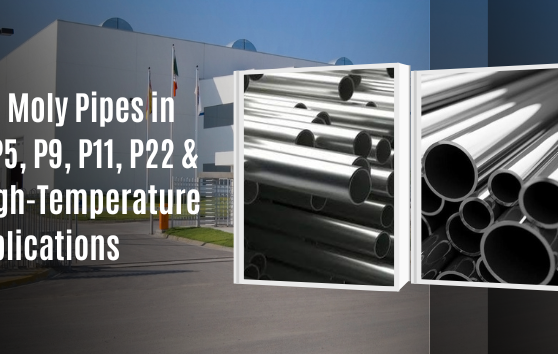
Nigeria’s oil & gas, refining, petrochemical, power generation, fertilizer, and industrial sectors rely on piping systems capable of operating under high temperatures, pressure, and continuous thermal stress. For these demanding applications, molybdenum alloy steel pipes offer a combination of high-temperature strength, creep resistance, oxidation resistance, and mechanical stability.
Mcneil Instrument manufactures, supplies, and exports molybdenum alloy steel pipes in ASTM A335 / ASME SA335 grades P5, P9, P11, P22, and P91, serving industrial projects in Nigeria. These grades are particularly relevant to high-temperature piping used in refineries, power plants, petrochemical facilities, boilers, steam systems, and process plants.
What Are Molybdenum Pipes?
Molybdenum pipes are alloy steel pipes containing molybdenum along with other alloying elements, particularly chromium in the commonly used Chrome Moly grades.
Molybdenum contributes to high-temperature strength and long-term stability, while chromium improves oxidation and scaling resistance. Together, these alloying elements make the material suitable for demanding pressure-piping applications.
For Nigerian industrial projects, common grades include:
- ASTM A335 P5
- ASTM A335 P9
- ASTM A335 P11
- ASTM A335 P22
- ASTM A335 P91
These grades are covered under ASTM A335 / ASME SA335, which specifies seamless ferritic alloy steel pipes intended for high-temperature service.
Why Use Molybdenum Pipes in Nigeria?
Industrial facilities in Nigeria can place significant demands on piping systems. Refineries, power stations, petrochemical plants, fertilizer facilities, and other process industries may involve elevated temperatures, high pressures, steam, hydrocarbons, and corrosive process environments.
Molybdenum alloy steel pipes provide important performance characteristics such as:
- High-temperature strength
- Creep resistance
- Resistance to oxidation and scaling
- Good mechanical stability
- Long-term performance under thermal stress
- Suitability for high-pressure applications
Mcneil Instrument specifically identifies Nigerian oil & gas, power generation, petrochemical, fertilizer, refinery, and mining industries as application areas for its alloy steel pipe range.
ASTM A335 P5 Molybdenum Pipes
P5 is a chromium-molybdenum alloy steel grade designed for elevated-temperature service.
Mcneil Instrument describes P5 as offering good resistance to high-temperature corrosion and scaling. Typical applications include:
- Refinery heater systems
- Steam pipelines
- Petrochemical units
- High-temperature process piping
For Nigerian refinery projects, P5 can be considered where the design conditions call for its specific combination of temperature capability and mechanical properties.
ASTM A335 P9 Molybdenum Pipes
P9 contains higher chromium and molybdenum levels than P5 and is used in demanding high-temperature environments.
Typical applications include:
- Heat exchangers
- Furnace components
- High-pressure boilers
- Petrochemical process lines
- High-temperature steam systems
Mcneil Instrument identifies P9 for refinery and high-temperature process applications in Nigeria.
ASTM A335 P11 Molybdenum Pipes
P11 is one of the widely used Chrome Moly grades for high-temperature piping.
Its balanced chromium-molybdenum composition provides a combination of strength, oxidation resistance, and high-temperature performance.
Typical applications include:
- Thermal power plants
- Boiler systems
- Steam lines
- Boiler feed systems
- Superheater systems
- Industrial process piping
P11 is particularly useful where the piping system experiences sustained heat and pressure.
ASTM A335 P22 Molybdenum Pipes
P22 contains more chromium and molybdenum than P11 and is commonly selected for more demanding high-temperature service.
Applications include:
- Superheaters
- Reheaters
- High-pressure steam circuits
- Pressure systems
- Chemical plants
- Power-generation piping
Its stronger creep and high-temperature performance make P22 an important material for demanding steam and process systems.
ASTM A335 P91 Molybdenum Pipes
P91 is a creep-strength-enhanced alloy steel grade containing chromium, molybdenum, vanadium, and niobium.
It is designed for severe high-temperature and high-pressure applications.
Typical applications include:
- High-pressure steam headers
- Thermal power stations
- Advanced boiler systems
- High-temperature refinery piping
- Superheater and reheater systems
Mcneil Instrument identifies P91 for high-efficiency power projects and critical high-temperature piping applications in Nigeria.
P5 vs P9 vs P11 vs P22 vs P91
| Grade | General Characteristics | Typical Nigerian Applications |
| P5 | Chromium-molybdenum alloy, oxidation and scaling resistance | Refinery heaters, steam systems |
| P9 | Higher chromium and molybdenum content | Heat exchangers, furnaces, petrochemical systems |
| P11 | Balanced strength and high-temperature performance | Boilers, steam lines, thermal power |
| P22 | Enhanced creep and thermal performance | Superheaters, reheaters, high-pressure steam |
| P91 | Creep-strength-enhanced alloy | Power stations, steam headers, critical piping |
The correct grade should be selected according to actual design temperature, pressure, service conditions, allowable stresses, welding requirements, and applicable engineering codes.
Molybdenum Pipes for Nigeria’s Oil & Gas Industry
Oil and gas remains a major application sector for high-performance piping in Nigeria.
Molybdenum alloy steel pipes can be used in suitable applications involving:
- Refinery process systems
- High-temperature process lines
- Steam systems
- Heat-transfer systems
- Hydrocarbon processing
- Boiler systems
- Petrochemical units
The material grade should be selected according to the specific process medium and operating conditions rather than simply choosing the highest-alloy grade.
Molybdenum Pipes for Nigerian Refineries
Refineries operate numerous systems at elevated temperatures, including heaters, furnaces, steam networks, heat exchangers, and process units.
P5 and P9 are particularly associated with refinery and high-temperature process applications, while P11, P22, and P91 can be specified for appropriate high-temperature steam and power-related systems.
For refinery projects in locations such as Lagos, Port Harcourt, and Warri, material selection should consider temperature, pressure, process chemistry, thermal cycling, and applicable project specifications.
Molybdenum Pipes for Power Plants in Nigeria
Power-generation facilities depend on piping that can withstand sustained high temperatures and pressures.
Molybdenum alloy steel pipes are used in suitable applications such as:
- Boiler piping
- Main steam lines
- Superheaters
- Reheaters
- Steam headers
- High-temperature auxiliary systems
P11, P22, and P91 are commonly associated with progressively more demanding high-temperature power-generation applications.
Molybdenum Pipes for Petrochemical and Fertilizer Plants
Petrochemical and fertilizer facilities contain high-temperature process equipment and pressure systems.
Applications can include:
- Ammonia plants
- Process steam lines
- Heat exchangers
- Chemical processing systems
- High-temperature process piping
- Pressure systems
Mcneil Instrument identifies petrochemical and fertilizer facilities among the Nigerian industries where its alloy steel pipe range is applicable.
Technical Specifications of Molybdenum Pipes
Mcneil Instrument’s published Nigeria alloy steel pipe information lists the following general specifications:
| Parameter | Specification |
| Standard | ASTM A335 / ASME SA335 |
| Grades | P5, P9, P11, P22, P91 |
| Size Range | 1/2″ to 36″ NB |
| Thickness | SCH 20 to SCH XXS, custom options |
| Types | Seamless, hot finished, cold drawn |
| Temperature | Up to 650°C+ depending on grade |
| Application | High-temperature and high-pressure service |
Exact dimensions, pressure capabilities, heat treatment, and testing requirements should be confirmed against the specific purchase specification and selected grade.
Seamless Molybdenum Pipes for Industrial Applications
Seamless construction is particularly important for pressure-piping applications where the pipe must meet specified mechanical and dimensional requirements.
Mcneil Instrument lists seamless molybdenum alloy steel pipes across its P5, P9, P11, P22, and P91 range.
For critical Nigerian projects, buyers should also specify the required:
- Heat treatment
- Non-destructive testing
- Hydrostatic testing
- Chemical analysis
- Mechanical testing
- PMI
- Dimensional inspection
- Material traceability
Quality Testing for Molybdenum Pipes
Quality control is particularly important for high-temperature and high-pressure piping.
Mcneil Instrument states that its alloy steel pipes undergo testing such as:
- Hydrostatic testing
- Ultrasonic testing
- Radiographic inspection
- Hardness testing
- Tensile testing
- Positive Material Identification
- Dimensional inspection
The company also lists EN 10204 3.1/3.2 material test certificates, NDT reports, hydrostatic test reports, PMI results, and compliance documentation.
Project-specific inspection and certification requirements should be confirmed before placing an order.
How to Select Molybdenum Pipes for Nigerian Projects
Choosing the right grade involves more than looking at the pipe’s nominal temperature rating.
1. Determine Design Temperature
Establish normal, maximum, and design temperatures.
2. Determine Design Pressure
The pressure rating and required wall thickness must be established according to the applicable design code.
3. Evaluate Process Conditions
Consider whether the pipe will carry:
- Steam
- Hydrocarbons
- Gas
- Chemical fluids
- Boiler water
- Other process media
4. Consider Thermal Cycling
Frequent heating and cooling can introduce additional stresses into the piping system.
5. Select the Grade
P5, P9, P11, P22, and P91 offer different combinations of chromium, molybdenum, and other alloying elements.
6. Check Welding Requirements
Welding procedure, preheating, post-weld heat treatment, and material condition should be evaluated according to the applicable specification and project requirements.
7. Confirm Inspection Requirements
For critical projects, define MTC, PMI, NDT, hydrostatic testing, third-party inspection, and traceability requirements before procurement.
Why Choose Mcneil Instrument for Molybdenum Pipes in Nigeria?
Mcneil Instrument positions itself as a manufacturer, supplier, and exporter of alloy steel pipes for Nigerian industrial projects. Its published range includes ASTM A335 / ASME SA335 P5, P9, P11, P22, and P91 grades.
The company identifies supply applications across Nigeria’s:
- Oil & gas sector
- Refineries
- Power plants
- Petrochemical facilities
- Fertilizer plants
- Mining and metallurgy
- Industrial boiler systems
It also identifies major industrial locations including Lagos, Port Harcourt, Warri, Delta, Abuja, Kano, Kaduna, Abeokuta, Ibadan, and Enugu within its Nigerian distribution coverage.
Conclusion
Molybdenum pipes in Nigeria are an important material choice for industrial systems exposed to elevated temperature, pressure, thermal cycling, and long-term mechanical stress.
The ASTM A335 / ASME SA335 P5, P9, P11, P22, and P91 grades provide different levels of alloying and high-temperature performance, allowing engineers to select a suitable material for refineries, power plants, petrochemical facilities, boilers, steam systems, and other process applications.
For Nigerian projects, the best grade depends on the complete operating environment. Temperature, pressure, process medium, thermal cycling, creep requirements, welding procedure, applicable codes, and inspection requirements should all be evaluated before procurement.
Mcneil Instrument supplies molybdenum and Chrome Moly alloy steel pipes to Nigerian industrial projects, with grades, dimensions, testing, and documentation available according to project requirements.
Frequently Asked Questions
What are molybdenum pipes?
Molybdenum pipes are alloy steel pipes containing molybdenum and other alloying elements to improve high-temperature strength, creep resistance, and long-term mechanical performance.
Which molybdenum pipe grades are available for Nigeria?
Mcneil Instrument lists ASTM A335 P5, P9, P11, P22, and P91 grades for Nigerian industrial applications.
What are P11 molybdenum pipes used for?
P11 pipes are commonly used in boilers, steam lines, thermal power plants, and high-temperature industrial piping.
What are P22 pipes used for?
P22 pipes are used in applications such as superheaters, reheaters, high-pressure steam circuits, power systems, and chemical plants.
Why is P91 used in high-temperature applications?
P91 is a creep-strength-enhanced alloy steel designed for demanding high-temperature and high-pressure applications such as steam headers and advanced power-generation systems.
Does Mcneil Instrument supply molybdenum pipes to Nigeria?
Yes. Mcneil Instrument’s published product information specifically covers alloy steel pipe supply for Nigeria’s oil, gas, power, refinery, petrochemical, fertilizer, and industrial sectors.
What standard is used for P5, P9, P11, P22 and P91 pipes?
These grades are commonly specified under ASTM A335 / ASME SA335 for seamless ferritic alloy steel pipes intended for high-temperature service.
What information should be provided when requesting a quotation?
A procurement enquiry should ideally include the grade, pipe size, wall thickness or schedule, quantity, length, applicable standard, heat-treatment requirements, testing requirements, inspection requirements, and delivery location in Nigeria.