

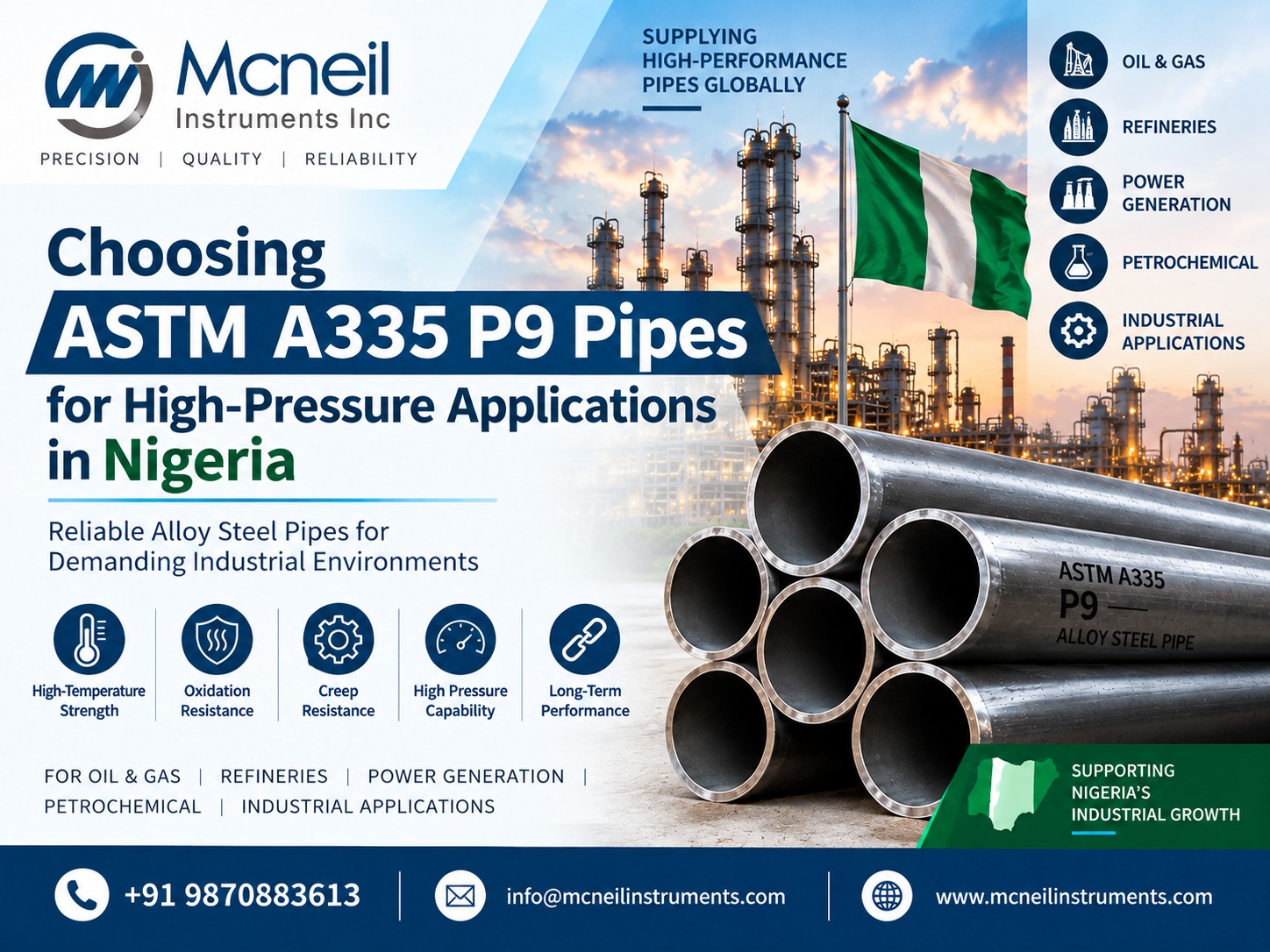
High-pressure industrial piping systems in Nigeria require materials capable of maintaining mechanical strength, thermal stability and dimensional integrity under demanding operating conditions. ASTM A335 P9 Pipes in Nigeria are used for applications where elevated temperature, pressure, oxidation and long-term mechanical performance are important considerations.
Industries such as oil and gas, refining, petrochemicals, power generation, chemical processing and industrial heating operate equipment that can expose piping to substantial thermal and pressure loads. ASTM A335 P9 Pipes in Nigeria provide a chromium-molybdenum alloy steel option for selected high-temperature and high-pressure piping systems.
Mcneil Instrument supplies ASTM A335 / ASME SA335 P9 Pipes for industrial applications, including Nigerian projects. P9 is a seamless ferritic alloy steel pipe grade covered by ASTM A335 for elevated-temperature service. Mcneil Instrument’s published information identifies approximately 8–10% chromium and 0.90–1.10% molybdenum for P9.
What Are ASTM A335 P9 Pipes?
ASTM A335 P9 Pipes are seamless chromium-molybdenum alloy steel pipes intended for high-temperature service. The P9 grade contains a comparatively high chromium content together with molybdenum, providing properties suited to demanding thermal environments.
For Nigerian industrial projects, ASTM A335 P9 Pipes in Nigeria can be evaluated for systems involving:
- High operating temperatures
- High internal pressures
- Thermal cycling
- Oxidizing conditions
- Long-term mechanical loading
- Steam service
- High-temperature process fluids
- Refinery and petrochemical operations
ASTM A335 / ASME SA335 is the relevant specification for seamless ferritic alloy steel pipes intended for elevated-temperature applications. Mcneil Instrument identifies P9 among its ASTM A335 alloy steel pipe grades.
The final grade and pipe dimensions should always be selected according to design temperature, pressure, process medium, applicable engineering codes and project specifications.
Why Choose ASTM A335 P9 Pipes in Nigeria?
Nigeria has major industrial sectors where piping systems may encounter high temperatures, elevated pressure and demanding process conditions. Oil and gas facilities, refineries, petrochemical plants, power stations and industrial processing facilities all have different piping requirements.
ASTM A335 P9 Pipes in Nigeria can be considered when the engineering design requires a chromium-molybdenum alloy steel pipe with enhanced high-temperature and oxidation performance.
Key characteristics include:
- High-temperature mechanical performance
- Improved oxidation resistance
- Thermal stability
- Creep resistance
- Pressure-handling capability
- Resistance to high-temperature scaling
- Long-term service performance
- Seamless construction
Mcneil Instrument’s published Nigerian alloy steel information specifically identifies P9 for applications involving heat exchangers, furnace components, high-pressure boilers, petrochemical process lines and high-temperature steam systems.
Chemical Composition of ASTM A335 P9 Pipes
The chemical composition of P9 contributes significantly to its elevated-temperature characteristics.
| Element | Typical P9 Composition |
| Carbon (C) | 0.15% max |
| Manganese (Mn) | 0.30–0.60% |
| Phosphorus (P) | 0.025% max |
| Sulfur (S) | 0.025% max |
| Silicon (Si) | 0.25–1.00% |
| Chromium (Cr) | 8.00–10.00% |
| Molybdenum (Mo) | 0.90–1.10% |
The published Mcneil Instrument information identifies approximately 8–10% chromium and 0.90–1.10% molybdenum for P9. Exact chemical requirements should be verified against the applicable ASTM material specification and the material test certificate for the supplied pipe.
Importance of Chromium
Chromium contributes to oxidation and scaling resistance, which is particularly useful when piping operates continuously at elevated temperatures.
Importance of Molybdenum
Molybdenum contributes to high-temperature strength and resistance to deformation under sustained thermal and mechanical loads.
The combination makes P9 relevant to demanding high-temperature industrial systems.
Key Properties of ASTM A335 P9 Pipes in Nigeria
1. High-Temperature Strength
ASTM A335 P9 Pipes in Nigeria can be selected for piping systems exposed to sustained elevated temperatures where conventional carbon steel may not provide the required material performance.
2. Oxidation Resistance
The relatively high chromium content helps improve resistance to oxidation and scaling during elevated-temperature operation.
3. Creep Resistance
P9 provides characteristics suitable for applications where long-term exposure to temperature and mechanical stress can lead to creep deformation.
4. Thermal Stability
The chromium-molybdenum alloy composition provides improved thermal stability for demanding process conditions.
5. High-Pressure Capability
When the correct wall thickness, dimensions and design parameters are specified, P9 pipes can be used in high-pressure industrial piping systems.
6. Long-Term Performance
Correct material selection, heat treatment, fabrication, welding and inspection are important for achieving the intended service performance of P9 piping.
ASTM A335 P9 Pipes for High-Pressure Applications in Nigeria
The selection of ASTM A335 P9 Pipes in Nigeria for high-pressure service should be based on more than the nominal pressure rating.
Engineers and procurement teams should evaluate:
- Design pressure
- Design temperature
- Pipe outside diameter
- Wall thickness
- Pipe schedule
- Process medium
- Thermal cycling
- Corrosion environment
- Creep requirements
- Welding requirements
- Applicable design code
- Inspection requirements
The correct P9 pipe must be capable of satisfying the complete operating envelope of the piping system.
ASTM A335 P9 Pipes for Nigerian Oil & Gas Industry
Nigeria’s oil and gas sector includes production facilities, gas-processing plants, refineries, terminals and associated process infrastructure.
ASTM A335 P9 Pipes in Nigeria can be evaluated for selected high-temperature applications such as:
- Refinery process piping
- Furnace systems
- Steam lines
- Heat exchangers
- High-temperature process lines
- Gas-processing systems
- Petrochemical units
- Industrial heating systems
- High-temperature utility piping
Material selection should account for the process fluid, operating temperature, pressure, corrosion mechanisms and applicable project specifications.
ASTM A335 P9 Pipes for Refineries in Nigeria
Refineries contain heaters, furnaces, steam systems, heat exchangers and process units operating under demanding conditions.
P9 pipes can be considered for selected applications including:
Refinery Heater Systems
P9 can be evaluated for high-temperature piping associated with refinery heating equipment.
Furnace Piping
Industrial furnace systems can expose piping to continuous thermal loading. The oxidation and high-temperature characteristics of P9 can make it suitable for specified applications.
Steam Systems
P9 can be used where engineering requirements call for an ASTM A335 alloy steel grade for elevated-temperature steam service.
Heat Exchangers
P9 pipes can be considered for selected heat-transfer systems where the temperature and pressure conditions require alloy steel piping.
Mcneil Instrument’s published Nigerian information identifies P9 for refinery and high-temperature process applications.
ASTM A335 P9 Pipes for Power Plants in Nigeria
Power-generation systems contain boilers, steam lines, superheaters, heat exchangers and other equipment exposed to elevated temperature and pressure.
ASTM A335 P9 Pipes in Nigeria may be considered for:
- High-temperature steam piping
- Boiler systems
- Superheater circuits
- Heat exchangers
- Industrial heating systems
- Steam distribution systems
- High-pressure process piping
The final pipe grade should be determined from the plant’s design conditions and applicable power-piping standards.
ASTM A335 P9 Pipes for Petrochemical Plants
Petrochemical facilities combine temperature, pressure and process-specific chemical conditions.
Applications for ASTM A335 P9 Pipes in Nigeria may include:
- Petrochemical process lines
- High-temperature steam systems
- Furnace circuits
- Heat-transfer systems
- Process utility lines
- Industrial heaters
- High-temperature fluid transportation
P9 selection should consider both mechanical and environmental requirements rather than temperature alone.
ASTM A335 P9 Pipes for Boilers and Steam Systems
Boilers and steam-generation systems require carefully specified materials because piping can experience continuous temperature, pressure and thermal cycling.
P9 pipes may be used in selected:
Boiler Piping
For high-temperature sections where the engineering design specifies an alloy steel pipe.
Steam Lines
For steam transportation systems requiring elevated-temperature alloy steel performance.
Superheaters
Superheater circuits expose pipes to high-temperature steam and require appropriate material selection.
High-Pressure Steam Systems
ASTM A335 P9 vs Other P-Grade Pipes
Understanding the differences between ASTM A335 grades is important when selecting ASTM A335 P9 Pipes in Nigeria.
| Grade | Approx. Chromium | Approx. Molybdenum | Typical Application Areas |
| P5 | 4–6% | 0.45–0.65% | Refineries, boilers, heat exchangers |
| P9 | 8–10% | 0.90–1.10% | High-temperature process, steam and petrochemical systems |
| P11 | 1–1.5% | 0.44–0.65% | Boilers, steam lines, power plants |
| P22 | 1.9–2.6% | 0.87–1.13% | Reheaters, boilers, power plants |
| P91 | 8–9.5% | 0.85–1.05% | Critical high-temperature power systems |
Mcneil Instrument’s published information lists P9 at approximately 8–10% chromium and 0.90–1.10% molybdenum, while P11 and P22 have lower chromium concentrations with different alloy balances.
There is no universal P-grade that is appropriate for every application. Selection should be based on operating conditions, material properties, applicable codes and project requirements.
Seamless ASTM A335 P9 Pipes in Nigeria
Seamless construction is important for applications where piping must meet specified pressure, dimensional and mechanical requirements.
Mcneil Instrument identifies its P5, P9, P11, P22 and P91 ASTM A335 range as seamless alloy steel pipes. Its published Nigerian information lists seamless, hot-finished and cold-drawn options within its alloy steel range.
| Parameter | Typical Details |
| Product | ASTM A335 P9 Pipes |
| Standard | ASTM A335 / ASME SA335 |
| Grade | P9 |
| Material | Chromium-Molybdenum Alloy Steel |
| Construction | Seamless |
| Applications | High-temperature and high-pressure service |
| Industries | Oil & Gas, Refining, Power, Petrochemical |
| Supply Market | Nigeria and international projects |
Exact size, schedule, wall thickness, length, heat treatment and testing requirements should be confirmed against the project purchase specification.
How to Choose ASTM A335 P9 Pipes in Nigeria
Choosing ASTM A335 P9 Pipes in Nigeria requires a systematic review of the piping system.
1. Confirm the Applicable Standard
Specify ASTM A335 / ASME SA335 and any additional project requirements.
2. Confirm P9 Grade
Verify that P9 is suitable for the required temperature, pressure and process conditions.
3. Define Pipe Size
Specify:
- Nominal pipe size
- Outside diameter
- Wall thickness
- Pipe schedule
- Required length
4. Determine Design Pressure
The required wall thickness should be established through the applicable engineering calculations and piping code.
5. Determine Design Temperature
Temperature is a critical factor in determining allowable stresses and long-term material performance.
6. Evaluate Process Conditions
Consider:
- Process medium
- Oxidation
- Corrosion
- Thermal cycling
- Hydrogen exposure where applicable
- Creep conditions
7. Confirm Heat Treatment
Applicable heat-treatment requirements should be confirmed according to the material standard and project specification.
8. Specify Testing
Depending on the project, requirements may include:
- Hydrostatic testing
- Tensile testing
- Hardness testing
- Dimensional inspection
- Ultrasonic examination
- Radiographic examination
- Positive Material Identification
9. Establish Traceability
For critical Nigerian industrial projects, buyers should establish requirements for heat-number identification, material certificates, inspection documentation and traceability.
Testing and Inspection of ASTM A335 P9 Pipes
Quality assurance is especially important when ASTM A335 P9 Pipes in Nigeria are being specified for high-pressure applications.
Potential inspection requirements include:
Chemical Analysis
Confirms that the supplied material meets the required chemical composition.
Tensile Testing
Evaluates mechanical strength according to the applicable specification.
Hardness Testing
Helps verify compliance with specified material requirements.
Hydrostatic Testing
Used to verify pressure integrity where required.
Ultrasonic Testing
Can be specified for detecting internal discontinuities.
Radiographic Testing
May be required for certain project-specific inspection programs.
Dimensional Inspection
Confirms outside diameter, wall thickness, length and other dimensional requirements.
PMI
Positive Material Identification can be used to verify alloy chemistry and material grade.
The exact inspection program should be agreed upon between the purchaser, manufacturer and applicable inspection authority.
Industries Using ASTM A335 P9 Pipes in Nigeria
Oil & Gas
Used for selected high-temperature process and utility applications.
Refineries
Suitable for specified heater, furnace, steam and process piping applications.
Petrochemical Plants
Used in high-temperature process systems, steam circuits and heat-transfer equipment.
Power Generation
Can be considered for selected boiler, steam and high-temperature piping systems.
Chemical Processing
Applicable where process conditions require chromium-molybdenum alloy steel piping.
Industrial Heating
Used for specified furnace and high-temperature heating applications.
Heavy Engineering
Can be incorporated into engineered piping and process equipment requiring elevated-temperature alloy steel performance.
Advantages of ASTM A335 P9 Pipes in Nigeria
The combination of chromium and molybdenum provides several characteristics relevant to demanding industrial piping.
Key advantages include:
- High-temperature strength
- Improved oxidation resistance
- Thermal stability
- Creep resistance
- High-pressure service capability
- Resistance to high-temperature scaling
- Long-term mechanical performance
- Seamless pipe construction
- Suitability for steam and process systems
Mcneil Instrument’s published material identifies P9 as a grade for high-temperature applications including power stations, petrochemical facilities, steam systems, industrial heaters and high-temperature piping.
Why Choose Mcneil Instrument for ASTM A335 P9 Pipes in Nigeria?
Mcneil Instrument manufactures, supplies and exports ASTM A335 / ASME SA335 alloy steel pipes, including P9, for high-temperature industrial applications. Its published Nigerian content identifies P5, P9, P11, P22 and P91 grades for industrial projects in Nigeria.
Key supply considerations include:
- ASTM A335 / ASME SA335 P9 Pipes
- Seamless alloy steel pipe options
- Multiple dimensions and schedules
- Project-specific requirements
- Testing and inspection support
- Material certification
- Heat-number traceability
- International export capability
- Support for oil & gas projects
- Support for refinery and petrochemical applications
- Power-generation applications
For Nigerian projects, customers can provide the required pipe grade, size, schedule, length, end preparation, heat treatment, testing, inspection and certification requirements when requesting a quotation.
Frequently Asked Questions
What are ASTM A335 P9 Pipes?
ASTM A335 P9 Pipes are seamless ferritic chromium-molybdenum alloy steel pipes intended for elevated-temperature service. P9 contains approximately 8–10% chromium and 0.90–1.10% molybdenum according to Mcneil Instrument’s published information.
What are ASTM A335 P9 Pipes used for in Nigeria?
ASTM A335 P9 Pipes in Nigeria can be used for selected high-temperature applications in refineries, power plants, petrochemical facilities, steam systems, heat exchangers, industrial furnaces and process plants.
Why are P9 Pipes used for high-pressure applications?
P9 is a chromium-molybdenum alloy steel grade designed for elevated-temperature service. Its material characteristics provide high-temperature mechanical performance and make it suitable for selected high-pressure systems when the design conditions and applicable codes support its use.
What is the chromium content of ASTM A335 P9?
Mcneil Instrument’s published information identifies approximately 8–10% chromium in P9.
What is the molybdenum content of P9 Pipes?
P9 contains approximately 0.90–1.10% molybdenum according to Mcneil Instrument’s published specifications.
Are ASTM A335 P9 Pipes seamless?
Yes. ASTM A335 covers seamless ferritic alloy steel pipes for elevated-temperature service, and Mcneil Instrument identifies its P9 product range as seamless.
Are P9 Pipes suitable for Nigerian refinery projects?
P9 can be evaluated for selected refinery applications involving high temperatures, pressure and process loads. Mcneil Instrument’s Nigerian content specifically identifies P9 for refinery and high-temperature process applications.
What industries use ASTM A335 P9 Pipes in Nigeria?
Major application sectors include oil and gas, refining, petrochemical processing, power generation, chemical processing, industrial heating and heavy engineering.
How should ASTM A335 P9 Pipes in Nigeria be selected?
Selection should consider design temperature, pressure, pipe dimensions, process medium, corrosion environment, creep conditions, applicable piping code, heat treatment, welding procedures and inspection requirements.
Can Mcneil Instrument supply ASTM A335 P9 Pipes in Nigeria?
Mcneil Instrument publishes information on supplying ASTM A335 alloy steel and P9 pipes for Nigerian industrial projects.
Conclusion
ASTM A335 P9 Pipes in Nigeria provide an engineered chromium-molybdenum alloy steel piping option for selected high-temperature and high-pressure industrial applications. Their combination of chromium and molybdenum contributes to high-temperature mechanical performance, oxidation resistance, thermal stability and long-term service capability.
For Nigerian oil & gas facilities, refineries, petrochemical plants, power stations, boilers, steam systems and industrial heating equipment, P9 pipes can be evaluated where the project design requires the characteristics of ASTM A335 P9 alloy steel.
Choosing the correct ASTM A335 P9 Pipes in Nigeria requires more than specifying the grade. Buyers and engineers should establish the required operating temperature, pressure, pipe dimensions, schedule, process medium, applicable design code, heat-treatment requirements, welding procedures, testing, inspection and documentation before procurement.
Mcneil Instrument supplies ASTM A335 / ASME SA335 P9 Pipes for industrial requirements, supporting project-specific dimensions, inspection and documentation requirements for international markets including Nigeria.


