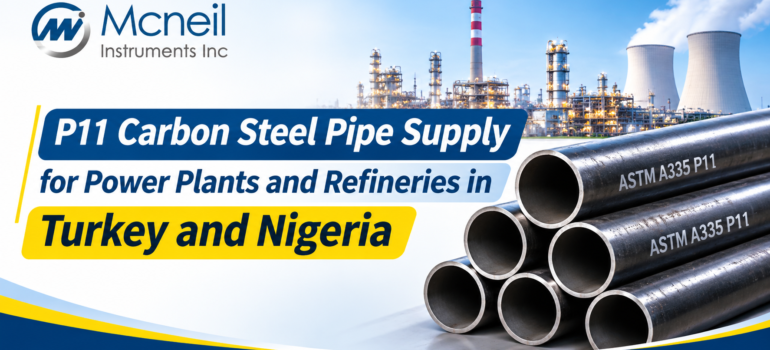
ASTM A335 P11 carbon steel pipes supplied by Mcneil Instruments Inc. for power plants and refineries in Turkey and Nigeria.

P11 Carbon Steel Pipe Supply for Power Plants and Refineries in Turkey and Nigeria

Power plants and refineries operate under demanding conditions where high temperatures, pressure and continuous operations place significant stress on piping systems. Selecting the right piping material is essential for maintaining operational safety, equipment reliability and long-term performance. ASTM A335 Grade P11 pipes are widely used in high-temperature industrial applications because of their strength, heat resistance and ability to perform in demanding service conditions.

At Mcneil Instrument, we understand the importance of supplying quality alloy steel piping solutions for critical industrial projects. We support industrial buyers, engineering contractors, distributors and project procurement teams looking for P11 alloy steel pipes for power generation, petrochemical and refinery applications in Turkey and Nigeria.

Understanding ASTM A335 Grade P11 Pipes

ASTM A335 Grade P11 is a chromium-molybdenum alloy steel pipe designed for high-temperature service. Although it is sometimes commercially searched for as P11 carbon steel pipe, P11 is technically classified as a low-alloy chrome-moly steel grade.

Its typical chemical composition includes approximately 1.00–1.50% chromium and 0.44–0.65% molybdenum. Chromium contributes to oxidation and corrosion resistance, while molybdenum improves high-temperature strength and creep resistance.

These properties make P11 pipes suitable for applications involving elevated temperatures, pressure and demanding operating conditions.

P11 pipes are commonly specified under ASTM A335, which covers seamless ferritic alloy-steel pipe intended for high-temperature service.

Why Choose P11 Pipes for Power Plants?

Power generation facilities require piping materials capable of handling elevated temperatures, steam pressure and continuous operating cycles. P11 alloy steel pipes are used in selected power plant applications where high-temperature mechanical properties are important.

Key benefits include:
High-Temperature Strength: Suitable for piping systems exposed to elevated operating temperatures.
Creep Resistance: Chromium-molybdenum alloy composition supports resistance to deformation under prolonged high-temperature stress.
Oxidation Resistance: Chromium helps improve resistance to oxidation at elevated temperatures.
Pressure Handling: Appropriate pipe dimensions, wall thickness and material properties support demanding pressure applications when correctly engineered.
Industrial Reliability: Suitable for properly designed steam, boiler and process piping systems.

Depending on the engineering design, P11 pipes may be specified for steam lines, boiler-related piping, superheater and reheater systems, and other high-temperature process applications.

Applications of P11 Alloy Steel Pipes in Refineries

Refineries require piping materials that can withstand elevated temperatures, pressure and challenging process environments. ASTM A335 P11 pipes are used in selected refinery and petrochemical applications where their high-temperature properties meet the design requirements.

Common applications include:

  1. Refinery Process Piping
    P11 pipes can be specified for high-temperature process lines in refinery installations, subject to operating conditions and engineering requirements.
  2. Heat Exchangers
    They may be used in associated high-temperature piping systems connected to heat exchangers and other thermal processing equipment.
  3. Petrochemical Plants
    Petrochemical facilities use alloy steel piping for process operations involving elevated temperatures and pressure.
  4. Steam Distribution Systems
    P11 pipes are suitable for selected steam piping applications where the required pressure and temperature ratings are satisfied.
  5. Industrial Heating Systems
    They can be used in high-temperature industrial piping systems where suitable material selection is essential for long-term service.

P11 Pipe Supply for Turkey’s Power and Refinery Industry

Turkey has an established industrial base covering power generation, petroleum refining, petrochemicals and manufacturing. These industries require dependable piping materials for new installations, plant upgrades, maintenance and expansion projects.

For industrial buyers in Istanbul, Ankara, Izmir, Kocaeli and other manufacturing and industrial regions, sourcing the correct alloy steel pipe grade is an important part of project procurement.

Mcneil Instruments Inc. supports international procurement requirements for P11 alloy steel pipes, helping buyers identify suitable material specifications for their applications.

When purchasing P11 pipes for projects in Turkey, buyers should consider:
ASTM A335 P11 material specifications
Required outside diameter and wall thickness
Pipe schedule and length requirements
Chemical composition and mechanical properties
Heat treatment and inspection requirements
Mill Test Certificates (MTC)
Export packaging and shipping documentation
Selecting a supplier that understands international material specifications helps streamline procurement and supports project quality requirements.

P11 Alloy Steel Pipe Supply for Nigeria’s Oil, Gas and Power Sector

Nigeria has significant oil and gas infrastructure, petroleum processing facilities and power generation requirements. These industries depend on reliable piping systems for high-temperature process operations, steam distribution and plant maintenance.

Industrial project buyers and contractors in Lagos, Port Harcourt, Abuja, Warri and other industrial locations may require alloy steel pipes for refinery projects, petrochemical facilities and power generation installations.

P11 alloy steel pipes can be considered for applications where their mechanical properties and temperature capabilities meet the project’s engineering specifications.

For Nigerian buyers, important procurement considerations include:
Compliance with ASTM A335 P11 requirements
Availability of the required pipe sizes and thicknesses
Material traceability and inspection documentation
Chemical and mechanical test reports
Third-party inspection, where specified
Export packing and delivery coordination

Working with an experienced international piping supplier can help procurement teams manage material specifications and sourcing requirements more efficiently.

Technical Specifications of ASTM A335 P11 Pipes

The following table provides a general overview of P11 alloy steel pipe specifications.
Parameter Details
Material Grade ASTM A335 Grade P11
Material Type Chromium-Molybdenum Alloy Steel
Product Type Seamless Alloy Steel Pipe
Chromium Content 1.00–1.50%
Molybdenum Content 0.44–0.65%
Standard ASTM A335 / ASME SA335
Manufacturing Seamless
Heat Treatment As specified by the applicable standard
Applications Power Plants, Refineries, Petrochemical Plants and High-Temperature Piping

Final chemical composition, mechanical properties, dimensions, heat treatment and inspection requirements should always be verified against the applicable standard edition and project specifications.

What to Consider When Purchasing P11 Pipes?

Choosing the right P11 pipe supplier involves more than comparing prices. Buyers should evaluate material quality, documentation, product specifications and export capabilities.

Material Compliance: Confirm that the pipes meet the specified ASTM A335 P11 requirements.
Material Traceability: Request Mill Test Certificates with heat numbers and relevant test results.
Dimensional Accuracy: Verify the outside diameter, wall thickness, schedule and length against project requirements.
Quality Inspection: Ensure that inspection and testing are carried out according to the purchase order and applicable standards.
Export Readiness: Confirm suitable packing, marking and shipping documentation for international deliveries.

These checks help reduce procurement risks and ensure that the supplied materials match the project’s engineering requirements.

Why Choose Mcneil Instrument for P11 Alloy Steel Pipe Supply?

At Mcneil Instrument., we focus on supplying industrial piping products and material solutions for demanding applications. We understand that every power plant, refinery and petrochemical project has specific technical and procurement requirements.

Our approach focuses on:
Material specifications aligned with project requirements
Alloy steel piping solutions for industrial applications
Support with technical documentation and material traceability
Coordination of inspection requirements
International supply and export support
Assistance with product selection based on application needs

Whether you are sourcing P11 alloy steel pipes for a power generation project in Turkey or a refinery application in Nigeria, selecting the correct material grade and specifications is essential.

Conclusion

ASTM A335 Grade P11 alloy steel pipes offer a combination of high-temperature strength, oxidation resistance and creep resistance that makes them suitable for selected power generation, refinery and petrochemical applications.

For buyers in Turkey and Nigeria, choosing the right supplier is an important part of maintaining material quality and meeting project specifications.

Mcneil Instrument supports industrial piping requirements with a focus on material specifications, documentation and dependable international supply solutions.

Contact our team to discuss your P11 alloy steel pipe requirements.

Looking for a Reliable P11 Alloy Steel Pipe Supplier?

Source ASTM A335 Grade P11 alloy steel pipes for power plants, refineries and petrochemical projects in Turkey and Nigeria.
Connect with Mcneil Instrument for product specifications, technical documentation and export supply enquiries.
Contact Us Today for a Competitive Quotation.
Website: https://mcneilinstrument.com

Frequently Asked Questions (FAQs)

  1. What is ASTM A335 Grade P11 pipe?
    ASTM A335 Grade P11 is a seamless chromium-molybdenum alloy steel pipe designed for high-temperature service. It is commonly used in power plants, refineries and petrochemical facilities.
  2. Is P11 a carbon steel or alloy steel pipe?
    P11 is technically a low-alloy chromium-molybdenum steel grade, not conventional carbon steel. It contains chromium and molybdenum to improve its high-temperature properties.
  3. What is the chemical composition of P11 pipe?
    P11 typically contains 1.00–1.50% chromium and 0.44–0.65% molybdenum, along with carbon, manganese, silicon and other elements within the specified limits.
  4. What is the difference between P11 and P22 pipes?
    Both are chromium-molybdenum alloy steel grades used in high-temperature applications. P11 generally contains 1.00–1.50% chromium and 0.44–0.65% molybdenum, while P22 contains approximately 1.90–2.60% chromium and 0.87–1.13% molybdenum. Their selection depends on design temperature, pressure and engineering requirements.
  5. Where are P11 alloy steel pipes commonly used?
    P11 pipes are used in selected steam piping systems, power plants, refineries, petrochemical facilities, heat exchanger connections and other high-temperature industrial applications.
  6. Are P11 pipes suitable for refinery applications in Nigeria?
    Yes, P11 pipes can be suitable for selected refinery and petrochemical applications in Nigeria when the material grade meets the project’s operating temperature, pressure, process conditions and engineering specifications.
  7. Can P11 pipes be supplied for industrial projects in Turkey?
    Yes, international suppliers can support P11 pipe procurement for power plants, refineries and industrial projects in Turkey, subject to required dimensions, specifications and delivery arrangements.
  8. What documents should be provided with P11 pipes?
    Typical documentation includes Mill Test Certificates (MTC), chemical composition reports, mechanical test results, heat treatment records and applicable inspection reports. Additional documentation depends on project and purchaser requirements.
  9. What sizes are available for ASTM A335 P11 pipes?
    P11 pipes are manufactured in different nominal pipe sizes, outside diameters and wall thicknesses. Availability depends on manufacturer capability and order requirements.
  10. How can I request a quotation for P11 alloy steel pipes?
    You can contact Mcneil Instrument with your required grade, pipe size, schedule, quantity, applicable standard, destination country and documentation requirements to request a quotation.
Read More
Stainless steel vs carbon steel pipes comparison by Mcneil Instruments for industrial piping applications.

Stainless Steel vs Carbon Steel Pipes: Which Is Right for Your Project?

Choosing the right pipe material is an important decision for industrial projects. The material you select affects corrosion resistance, mechanical strength, operating performance, maintenance requirements and overall project costs.
Two of the most widely used materials in industrial piping systems are stainless steel and carbon steel. Both offer valuable properties, but their suitability depends on the application, operating environment and engineering specifications.
For industries such as oil and gas, petrochemicals, power generation, chemical processing and manufacturing, understanding the differences between these materials helps engineers and procurement teams make informed decisions.
At Mcneil Instrument, we understand the importance of selecting suitable piping materials for industrial applications. This guide compares stainless steel and carbon steel pipes to help you determine which option best meets your project requirements.

What Are Stainless Steel Pipes?

Stainless steel pipes are manufactured from steel alloys containing chromium, which helps form a protective passive layer on the material’s surface. This layer provides corrosion resistance under suitable environmental conditions.
Common stainless steel grades used in industrial piping include 304 and 316. Grade 304 is widely used for general industrial applications, while grade 316 contains molybdenum, which improves resistance to pitting and crevice corrosion in many chloride-containing environments.
Stainless steel pipes are commonly selected for applications where corrosion resistance, cleanliness, durability and reduced maintenance are important considerations.
Key Benefits of Stainless Steel Pipes

  1. Corrosion Resistance
    Stainless steel offers resistance to many forms of corrosion. Grade selection remains important because exposure to chlorides, acids, chemicals and other aggressive substances can affect performance.
  2. Durability
    Suitable stainless steel grades can provide long service life when correctly selected, fabricated and maintained for the operating environment.
  3. Cleanliness and Hygiene
    Stainless steel is widely used in food processing, pharmaceutical manufacturing and other applications where cleanable surfaces and contamination control are important.
  4. Temperature Performance
    Certain stainless steel grades are suitable for elevated-temperature and low-temperature service. The appropriate grade must be selected according to the actual operating conditions and applicable design requirements.
  5. Lower Maintenance in Suitable Environments
    Where corrosion resistance is critical, stainless steel can reduce the need for corrosion-related maintenance, protective coatings and premature replacement.

What Are Carbon Steel Pipes?

Carbon steel pipes are manufactured primarily from iron and carbon, with other elements present according to the specified grade. Their mechanical properties depend on composition, manufacturing method and heat treatment.
Carbon steel pipes are widely used in industrial infrastructure because they offer a practical combination of strength, availability, fabrication options and cost.
Common applications include water distribution, oil and gas transportation, structural systems, steam lines and industrial process piping. Specific grades, such as those covered by ASTM A106 and ASTM A53, serve different piping requirements.
Key Benefits of Carbon Steel Pipes

  1. High Mechanical Strength
    Carbon steel pipes can provide excellent strength for applications involving substantial pressure, structural loads and demanding operating conditions, provided the selected grade and pipe dimensions meet the design requirements.
  2. Cost-Effective Procurement
    Carbon steel is often less expensive than stainless steel in terms of initial material cost. The total project cost should also account for coatings, corrosion protection, inspection and maintenance.
  3. Wide Availability
    Carbon steel pipes are available in a broad range of sizes, schedules and specifications, making them a common choice for industrial piping projects.
  4. Ease of Fabrication
    Carbon steel is generally suitable for conventional cutting, welding and fabrication processes when appropriate procedures are followed.
  5. Versatile Industrial Applications
    Carbon steel pipes are used in oil and gas facilities, power plants, water systems, construction and manufacturing where their mechanical and corrosion characteristics meet the application requirements.

Stainless Steel vs Carbon Steel Pipes: Key Differences

The main difference between stainless steel and carbon steel pipes is their composition and resulting performance characteristics. Stainless steel generally offers better corrosion resistance, while carbon steel is often selected for its cost-effectiveness and mechanical properties.
Comparison factor Stainless steel pipes Carbon steel pipes
Composition Steel containing chromium and other alloying elements Steel primarily containing iron and carbon
Corrosion resistance Generally higher in suitable environments Generally requires protection in corrosive environments
Mechanical strength Depends on grade and condition Depends on grade and condition
Initial material cost Usually higher Usually lower
Maintenance May require less corrosion-related maintenance May require coatings, inspection and corrosion control
Fabrication Requires grade-appropriate welding and fabrication procedures Generally straightforward with suitable procedures
Common applications Chemical processing, food processing, marine and industrial systems Oil and gas, water distribution, steam and structural applications
Actual performance depends on the material grade, pipe dimensions, manufacturing specification and operating environment.

Stainless Steel vs Carbon Steel: Which Is Better for Corrosion Resistance?

Corrosion resistance is often the deciding factor when choosing between the two materials.
Stainless steel develops a chromium-rich passive layer that helps protect the underlying metal. This makes suitable stainless steel grades a strong choice for many corrosive environments.
Carbon steel, by comparison, is more susceptible to rust when exposed to moisture and oxygen. Protective coatings, linings, corrosion inhibitors and other engineering measures may be required depending on the application.
However, stainless steel is not immune to corrosion. Certain chloride concentrations, temperatures and stagnant conditions can cause pitting, crevice corrosion or stress-corrosion cracking.
For chemical processing, marine environments and chloride-containing fluids, the material should be selected following a detailed assessment of the process conditions.

Stainless Steel vs Carbon Steel: Cost Comparison

Carbon steel generally has a lower initial purchase cost, which makes it attractive for projects with significant piping quantities.
Stainless steel typically requires a higher upfront material investment. However, it may provide economic benefits where corrosion-related repairs, protective coatings or frequent replacements would otherwise increase lifecycle costs.
When comparing the two materials, consider:
Initial material and procurement costs
Fabrication, welding and installation costs
Protective coatings and corrosion-control requirements
Inspection and maintenance expenses
Expected service life and replacement frequency
Downtime and operational risks associated with pipe failure
The most economical choice is the material that meets the engineering requirements while providing an acceptable total cost over the intended service life.

Common Applications of Stainless Steel Pipes

Chemical and Petrochemical Industries
Stainless steel is used in selected process lines, storage systems and equipment where the grade offers suitable resistance to the chemicals being handled.
Food and Pharmaceutical Manufacturing
Appropriate stainless steel grades are widely used where cleanability, surface condition and hygiene requirements are important.
Marine and Coastal Applications
Suitable stainless steel grades may be used in marine environments, but the grade must be selected carefully because seawater and concentrated chlorides can cause localized corrosion.
Water Treatment Systems
Stainless steel pipes can be suitable for water treatment, distribution and process equipment when the water chemistry and operating conditions are compatible with the selected grade.

Common Applications of Carbon Steel Pipes

Oil and Gas Industry
Carbon steel pipes are widely used for transporting oil, gas and other fluids when the material grade satisfies the pressure, temperature and environmental requirements.
Power Generation
Carbon steel and specified alloy steel pipes are used in different power plant systems, including selected steam and utility services. The material must be appropriate for the design temperature and pressure.
Construction and Infrastructure
Carbon steel pipes are commonly used in structural applications, utility systems and industrial infrastructure because of their strength and availability.
Industrial Water and Utility Lines
Carbon steel may be suitable for water and utility services where corrosion protection and water chemistry are properly managed.

How to Choose the Right Pipe Material for Your Project

Before selecting stainless steel or carbon steel pipes, review the following factors.

  1. Operating Environment: Identify the process fluid, moisture exposure, chemicals, chloride levels and other potential corrosion factors.
  2. Temperature and Pressure: Verify the design conditions and confirm that the selected material and pipe dimensions comply with the applicable design code.
  3. Required Mechanical Properties: Evaluate strength, toughness, loading conditions and any cyclic or vibration-related requirements.
  4. Corrosion Protection: Determine whether coatings, linings, corrosion inhibitors or other protection measures are necessary.
  5. Applicable Standards: Confirm the required ASTM, ASME or other project specifications, including grade, manufacturing method and testing requirements.
  6. Total Cost of Ownership: Compare procurement, installation, maintenance, inspection and replacement costs over the expected service life.
  7. Supplier Reliability: Work with a supplier that can provide the specified material grade, product documentation and traceability required for the project.

Why Choose Mcneil Instrument?

At Mcneil Instrument, we understand that every industrial piping project has different technical and operational requirements. Selecting the right pipe material is essential for meeting project specifications and supporting dependable operation.
Our team can help you discuss your industrial piping requirements and identify the relevant material specifications, dimensions and documentation needed for your application.
Whether your project requires stainless steel or carbon steel piping products, confirming the correct grade and applicable standards is an important step toward a suitable procurement decision.

Conclusion

Both stainless steel and carbon steel pipes play important roles in industrial piping systems. Stainless steel is often preferred when corrosion resistance, cleanliness and reduced corrosion-related maintenance are priorities. Carbon steel is frequently selected when strength, availability and initial material cost are important considerations.
Neither material is universally better. The correct choice depends on process conditions, corrosion exposure, mechanical requirements, applicable standards and lifecycle costs.
Mcneil Instrument is committed to helping industrial buyers evaluate piping requirements and identify suitable material specifications. Contact our team to discuss the right piping solution for your next project.

Looking for the Right Industrial Pipes for Your Project?

Choosing between stainless steel and carbon steel pipes starts with understanding your operating conditions, material specifications and long-term performance requirements.
Mcneil Instrument can help you discuss your piping requirements and identify the relevant product specifications for your industrial application.
Contact our team to enquire about piping products and request a quotation for your next project.
Request a Quote Today.

Frequently asked questions (FAQs)

  1. What is the main difference between stainless steel and carbon steel pipes?
    Stainless steel contains chromium, which provides corrosion resistance through a protective passive layer. Carbon steel contains primarily iron and carbon and generally requires additional corrosion protection in environments where rust is a concern.
  2. Which is better: stainless steel or carbon steel pipes?
    The better option depends on the application. Stainless steel is often preferred for corrosion resistance, while carbon steel is frequently selected for cost-effective industrial piping. Operating pressure, temperature, fluid chemistry and project standards must guide the final decision.
  3. Are stainless steel pipes more expensive than carbon steel pipes?
    Stainless steel pipes generally have a higher initial material cost. However, reduced corrosion-related maintenance and longer service life in suitable environments may offset the initial investment.
  4. Which pipe material is better for oil and gas applications?
    Both materials are used in oil and gas projects. Carbon steel is common in many transportation and process systems, while stainless steel may be selected for more corrosive services. The appropriate material depends on fluid composition, operating conditions and applicable industry requirements.
  5. Which is more corrosion-resistant: Stainless Steel 304 or 316?
    Stainless Steel 316 generally offers better resistance to pitting and crevice corrosion in many chloride-containing environments because it contains molybdenum. Neither grade is suitable for every corrosive environment, so the actual service conditions must be assessed.
  6. Can carbon steel pipes be used in corrosive environments?
    Yes, carbon steel pipes can be used in certain corrosive environments when suitable coatings, linings, corrosion inhibitors or other protective measures are provided. The effectiveness of these measures depends on the operating conditions and maintenance practices.
  7. Which pipe material requires less maintenance?
    Stainless steel may require less corrosion-related maintenance when the selected grade is appropriate for the environment. Carbon steel may require additional inspection and protective maintenance, depending on its exposure and corrosion-control system.
  8. How do I choose the right pipe material for my project?
    Evaluate the process fluid, operating pressure and temperature, corrosion exposure, mechanical requirements, applicable standards, budget and expected service life. Consult the project engineer or materials specialist when the service conditions are demanding or uncertain.
Read More

Carbon Steel Pipes in Turkey: Grades P5, P9, P11, P22 and P91 for High-Temperature Applications

Turkey’s industrial sector includes power generation, refineries, petrochemical facilities, chemical processing, and heavy engineering projects where piping systems may operate under high temperatures and pressures. In these environments, selecting the appropriate alloy steel pipe grade is essential for maintaining mechanical strength, thermal stability, and long-term reliability.

ASTM A335 / ASME SA335 P5, P9, P11, P22, and P91 pipes are designed for demanding high-temperature and high-pressure service. Mcneil Instrument supplies these grades for industrial applications and identifies Turkey among its target markets. Its Turkey-specific information highlights power plants, refineries, petrochemical industries, and heavy engineering as key application areas.

What Are P5, P9, P11, P22 and P91 Pipes?

ASTM A335 / ASME SA335 seamless alloy steel pipes use chromium and molybdenum to improve performance at elevated temperatures.

The Mcneil Instrument range includes:

  • ASTM A335 P5 Pipes
  • ASTM A335 P9 Pipes
  • ASTM A335 P11 Pipes
  • ASTM A335 P22 Pipes
  • ASTM A335 P91 Pipes

These grades are used in applications requiring heat resistance, pressure capability, oxidation resistance, and creep resistance.

Why P-Series Alloy Steel Pipes Matter for Turkish Industries

Industrial facilities in Turkey can require piping systems capable of handling demanding operating conditions.

Common applications include:

  • Power plants
  • Refineries
  • Petrochemical plants
  • Chemical processing facilities
  • Steam systems
  • Boilers
  • Heat exchangers
  • Heavy engineering projects
  • High-pressure process piping

Mcneil Instrument’s Turkey-specific page identifies ASTM A335 P5, P9, P11, and P22 as common grades for high-temperature and high-pressure industrial environments, while its broader product range also includes P91.

ASTM A335 P5 Pipes

P5 is a chromium-molybdenum alloy steel grade intended for elevated-temperature and high-pressure applications.

According to Mcneil Instrument’s published specifications, P5 contains approximately 4–6% chromium and 0.45–0.65% molybdenum. The company identifies applications including refineries, chemical plants, power stations, boilers, heaters, and high-pressure piping.

Typical applications

  • Refineries
  • Chemical plants
  • Power stations
  • Boilers
  • Steam lines
  • High-pressure piping

ASTM A335 P9 Pipes

P9 contains higher chromium and molybdenum levels than P5, with the published composition showing approximately 8–10% chromium and 0.90–1.10% molybdenum.

This composition provides strong oxidation resistance and thermal stability for elevated-temperature applications.

Typical applications include:

  • Power plants
  • Refinery heaters
  • Steam systems
  • Heat exchangers
  • Superheaters
  • High-temperature pipelines

ASTM A335 P11 Pipes

P11 provides a balance of strength, ductility, weldability, and high-temperature performance.

Mcneil Instrument identifies P11 for:

  • Steam lines
  • Chemical plants
  • Power-generation units
  • Industrial boilers
  • Heat exchangers
  • Steam header systems

Its published composition includes approximately 1–1.5% chromium and 0.44–0.65% molybdenum.

ASTM A335 P22 Pipes

P22 provides increased chromium and molybdenum compared with P11.

The published Mcneil Instrument specifications list approximately 1.9–2.6% chromium and 0.87–1.13% molybdenum for P22. The grade is used for applications requiring strong creep resistance and high-temperature mechanical performance.

Typical applications

  • Boilers
  • Reheaters
  • Superheaters
  • High-pressure steam pipelines
  • Refineries
  • Petrochemical process lines
  • Heat exchangers

ASTM A335 P91 Pipes

P91 is a high-performance creep-strength-enhanced ferritic alloy steel designed for demanding high-temperature and high-pressure applications.

Mcneil Instrument’s published specifications identify chromium in the 8–9.5% range, molybdenum at approximately 0.85–1.05%, with vanadium and niobium additions.

Typical applications include:

  • Advanced power plants
  • High-pressure steam systems
  • Superheaters
  • Reheaters
  • Critical energy systems
  • Heavy-duty heat-transfer applications

P91 provides higher strength and creep resistance than the other P-series grades in the range.

P5 vs P9 vs P11 vs P22 vs P91

GradeKey CharacteristicTypical Application
P5Oxidation and high-temperature resistanceRefineries
P9Higher chromium and thermal resistancePetrochemical and power plants
P11Balanced strength and weldabilityBoilers and steam systems
P22Strong creep and high-temperature performancePower plants and high-pressure steam
P91Very high strength and creep resistanceCritical energy systems

The correct grade should be selected according to the project’s temperature, pressure, process conditions, applicable standards, and engineering specification rather than simply choosing the highest grade.

Technical Specifications of ASTM A335 Pipes

Mcneil Instrument publishes the following general characteristics for its P-series alloy steel pipes:

ParameterSpecification
StandardASTM A335 / ASME SA335
GradesP5, P9, P11, P22, P91
Pipe TypeSeamless
Size Range1/8″ NB to 24″ NB
ScheduleSCH 20 to SCH XXS
LengthRandom, Double Random, Cut Length
End TypesPlain, Beveled, Threaded
ManufacturingHot Rolled / Cold Drawn

Specific dimensions, schedules, lengths, and finishes should be confirmed against the individual project requirement.

Chemical Composition of P-Series Pipes

The alloying elements are important because they influence the pipe’s performance at elevated temperatures.

GradeChromiumMolybdenum
P54.00–6.00%0.45–0.65%
P98.00–10.00%0.90–1.10%
P111.00–1.50%0.44–0.65%
P221.90–2.60%0.87–1.13%
P918.00–9.50%0.85–1.05%

These ranges are based on Mcneil Instrument’s published product information. P91 additionally contains alloying additions including vanadium and niobium.

Role of Chromium and Molybdenum

Chromium

Chromium contributes to:

  • Oxidation resistance
  • Corrosion resistance
  • High-temperature stability
  • Resistance to scaling

Molybdenum

Molybdenum contributes to:

  • High-temperature strength
  • Creep resistance
  • Structural stability
  • Resistance to softening at elevated temperatures

Together, these alloying elements help P-series pipes perform in applications where conventional materials may not meet the required temperature and pressure conditions.

Applications in Turkey

Power Generation

Power plants require extensive piping for steam, boiler, superheater, reheater, and utility systems.

P11, P22, and P91 can be considered for different high-temperature services depending on the plant’s engineering requirements.

Refineries

Refinery systems may operate at elevated temperatures and pressures.

P5 and P9 are among the grades used in suitable refinery and high-temperature process applications.

Petrochemical Plants

Petrochemical facilities require piping capable of maintaining mechanical integrity during continuous operation.

P9, P11, P22, and P91 can be selected for different process conditions.

Boiler and Steam Systems

Steam systems place significant demands on piping materials because of elevated temperature and pressure.

P11 and P22 are commonly associated with boiler and steam applications, while P91 is suitable for more demanding critical systems.

Heavy Engineering

Turkey’s heavy engineering sector uses specialized piping systems for industrial plants, energy infrastructure, and process equipment.

Selecting the correct alloy grade can help maintain system reliability under demanding operating conditions.

How to Select the Right Grade

Before purchasing an ASTM A335 pipe for a Turkish industrial project, consider:

1. Operating Temperature

Determine the normal and maximum design temperature.

2. Operating Pressure

Check the required design pressure and pipe wall thickness.

3. Process Medium

The chemical characteristics of the transported fluid can affect material selection.

4. Creep Requirements

For long-term high-temperature service, creep resistance becomes an important consideration.

5. Welding Requirements

The selected grade should be compatible with the project’s fabrication and welding procedures.

6. Applicable Standards

Confirm ASTM, ASME, project, EPC, or end-user requirements before procurement.

7. Dimensions

Confirm:

  • Nominal bore
  • Outside diameter
  • Wall thickness
  • Schedule
  • Length
  • End preparation

Quality Testing and Inspection

For high-pressure and high-temperature piping, material verification is an important part of procurement.

Depending on project requirements, inspection can include:

  • Chemical composition testing
  • Mechanical testing
  • Hydrostatic testing
  • Dimensional inspection
  • Ultrasonic testing
  • Radiographic testing
  • Positive Material Identification
  • Heat-treatment verification

Mcneil Instrument’s alloy steel pipe information identifies these types of quality checks as part of the product quality process.

Project-specific inspection requirements should always be confirmed before ordering.

Why Choose an Experienced Supplier in Turkey?

For industrial projects, the supplier’s role extends beyond simply delivering pipe.

A suitable supplier should be able to support:

  • Required P-series grades
  • Correct dimensions
  • Material traceability
  • Inspection documentation
  • International standards
  • Packaging
  • Export documentation
  • Project-specific requirements

For EPC contractors and industrial procurement teams in Turkey, having access to the required grades from an experienced manufacturer and exporter can simplify sourcing for high-temperature piping projects.

Mcneil Instrument Carbon Steel Pipes for Turkey

Mcneil Instrument manufactures, supplies, and exports P5, P9, P11, P22, and P91 pipes manufactured to ASTM A335 / ASME SA335 requirements.

Its Turkey-specific information highlights these grades for power plants, refineries, petrochemical industries, and heavy engineering projects.

The broader product range includes seamless pipes and multiple dimensions, schedules, end configurations, and manufacturing options.

Conclusion

ASTM A335 / ASME SA335 P5, P9, P11, P22, and P91 pipes provide different levels of high-temperature strength, oxidation resistance, and creep performance for demanding industrial piping systems.

For Turkish industries, these pipes can be used across power generation, refineries, petrochemical plants, boiler systems, steam pipelines, heat exchangers, and heavy engineering projects.

The most suitable grade depends on the actual operating temperature, pressure, process medium, creep requirements, dimensions, welding requirements, and applicable engineering standards.

Mcneil Instrument provides P5, P9, P11, P22, and P91 seamless alloy steel pipes for industrial applications and serves international markets including Turkey.

Frequently Asked Questions

What are ASTM A335 P5, P9, P11, P22 and P91 pipes used for?

They are used for high-temperature and high-pressure applications including power plants, refineries, petrochemical facilities, boilers, steam systems, and industrial process piping.

Which P-grade is suitable for boilers?

P11 and P22 are commonly used for boiler and steam applications, while P91 is selected for more demanding critical high-temperature systems based on engineering requirements.

What standard do these pipes follow?

The Mcneil Instrument range is manufactured to ASTM A335 / ASME SA335 requirements.

Are these pipes seamless?

Yes. Mcneil Instrument identifies its P5, P9, P11, P22 and P91 range as seamless alloy steel pipes.

What sizes are available?

Mcneil Instrument’s published range includes sizes from 1/8″ NB to 24″ NB, with schedules from SCH 20 to SCH XXS.

Who supplies P5, P9, P11, P22 and P91 pipes for Turkey?

Mcneil Instrument manufactures, supplies, and exports these ASTM A335 / ASME SA335 grades for high-temperature and high-pressure industrial applications, with Turkey identified as a target market.

Read More

Carbon Steel Pipes (ASTM A335 P5, P9, P11, P22, P91) in Mexico: High-Temperature Piping Solutions for Industrial Applications

Introduction: Why Alloy Carbon Steel Pipes Matter in Industrial Systems

Industrial piping systems operating under high pressure and temperature need materials that don’t weaken, crack, or corrode over time. In sectors like oil refining, power generation, and chemical processing, failure isn’t an option.

This is where ASTM A335 carbon steel pipes (chrome moly alloy steel pipes) come into play. These pipes are specifically designed for high-temperature and high-pressure service, offering excellent strength, durability, and resistance to thermal stress.

In Mexico, industries such as oil & gas, petrochemicals, and power plants rely heavily on ASTM A335 P5, P9, P11, P22, and P91 pipes because they can perform reliably in extreme environments.

These pipes are widely used in steam pipelines, boilers, heat exchangers, and refinery systems, where maintaining structural integrity is critical.

What Are ASTM A335 Carbon Steel Pipes?

ASTM A335 pipes are seamless ferritic alloy steel pipes designed for high-temperature service. They are commonly referred to as chrome moly pipes because they contain chromium and molybdenum as primary alloying elements.

These pipes are manufactured according to ASTM A335 / ASME SA335 standards, ensuring high performance in extreme conditions.

Key Characteristics

• Designed for high-temperature and high-pressure applications
• Suitable for bending, welding, and flanging
• Available in multiple grades like P5, P9, P11, P22, P91
• Used in critical industrial piping systems

These pipes are widely used in industries where durability and thermal resistance are essential.

Chemical Composition of ASTM A335 Pipes

The strength and performance of these pipes come from their alloy composition, especially chromium and molybdenum.

Key Elements

ElementFunction
Chromium (Cr)Improves oxidation and corrosion resistance
Molybdenum (Mo)Enhances high-temperature strength
Carbon (C)Provides hardness and strength
Manganese (Mn)Improves toughness

For example, P5 grade pipes typically contain 4–6% chromium and 0.45–0.65% molybdenum, which improves resistance to oxidation and high-temperature stress.

Mechanical Properties of ASTM A335 Pipes

These pipes are engineered to maintain strength even under extreme thermal and mechanical stress.

PropertyTypical Value
Tensile StrengthHigh (varies by grade)
Yield StrengthModerate to High
Heat ResistanceUp to ~750°C
Creep ResistanceExcellent

ASTM A335 pipes maintain their mechanical properties even at elevated temperatures, making them suitable for long-term industrial use.

Key Advantages of ASTM A335 Carbon Steel Pipes

High Temperature Resistance

Designed to perform in extreme heat environments like boilers and steam pipelines.

Excellent Mechanical Strength

Maintains structural integrity under high pressure.

Creep and Oxidation Resistance

Prevents deformation and failure over time in high-temperature conditions.

Long Service Life

Durable even in aggressive industrial environments.

Versatile Industrial Use

Suitable for power plants, refineries, and chemical industries.

Technical Specifications of ASTM A335 Pipes

SpecificationDetails
StandardASTM A335 / ASME SA335
GradesP5, P9, P11, P22, P91
Pipe TypeSeamless Alloy Steel Pipe
Size Range½″ to 36″ NB
Wall ThicknessSCH 40 to SCH XXS
Manufacturing ProcessHot Rolled / Cold Drawn
End TypePlain End / Beveled / Threaded

These pipes are manufactured to meet global industrial standards for high-performance piping systems.

Industrial Applications of ASTM A335 Pipes in Mexico

Mexico has a strong industrial base with major investments in oil refining, petrochemicals, and power generation. These industries demand piping systems that can handle extreme conditions.

Oil and Gas Industry

Used in refinery pipelines and hydrocarbon processing systems.

Petrochemical Plants

Transport high-temperature and corrosive fluids.

Power Generation Plants

Used in boilers, superheaters, and steam pipelines.

Chemical Processing Industry

Handles aggressive chemicals and high-pressure systems.

Industrial Equipment

Used in heat exchangers, pressure vessels, and process piping.

ASTM A335 pipes are widely used in power plants and petrochemical industries due to their ability to withstand high temperature and pressure.

Major ASTM A335 Pipe Grades

ASTM A335 P5 Pipes

P5 pipes are chromium-molybdenum alloy steels used in high-temperature environments.

Key Characteristics

• Good oxidation resistance
• Suitable for refinery applications
• High durability

Applications

• Oil refineries
• Chemical plants
• High-temperature pipelines

ASTM A335 P9 Pipes

P9 pipes contain higher chromium content, improving heat resistance.

Applications

• Petrochemical plants
• Industrial heating systems
• High-temperature pipelines

ASTM A335 P11 Pipes

P11 is one of the most widely used grades in industrial piping.

Key Characteristics

• High strength
• Good wear resistance
• Reliable performance

Applications

• Power plants
• Boilers
• Heat exchangers

ASTM A335 P22 Pipes

P22 offers excellent creep resistance and is used in high-pressure systems.

Applications

• Boilers
• Pressure vessels
• Steam pipelines

ASTM A335 P91 Pipes

P91 is a high-performance grade designed for extreme environments.

Key Characteristics

• Exceptional creep strength
• High temperature resistance
• Long service life

Applications

• Thermal power plants
• Nuclear plants
• High-pressure steam systems

Comparison of ASTM A335 Grades

GradeAlloy CompositionKey AdvantageTypical Applications
P5Cr-Mo alloyOxidation resistanceRefineries
P9High chromiumHeat resistancePetrochemical plants
P11Cr-Mo steelStrength & durabilityBoilers
P222.25Cr-1MoCreep resistancePower plants
P91Advanced alloyExtreme temperature performanceNuclear & thermal plants

Quality Testing of ASTM A335 Pipes

To ensure performance and safety, these pipes undergo strict quality testing.

Common Testing Methods

• Chemical composition testing
• Mechanical strength testing
• Hydrostatic pressure testing
• Ultrasonic testing
• Radiographic inspection
• Positive Material Identification (PMI)
• Dimensional inspection

These tests ensure compliance with international standards and reliable industrial performance.

Conclusion

ASTM A335 carbon steel pipes (P5, P9, P11, P22, P91) are essential for industries that operate under extreme temperature and pressure conditions. Their chrome-moly composition provides superior strength, durability, and resistance to thermal stress.

In Mexico, industries like oil & gas, petrochemicals, and power generation depend on these pipes for safe and efficient operations.

With their ability to withstand harsh environments and deliver long-term performance, ASTM A335 pipes remain a critical component in modern industrial piping systems.

Read More
Chrome Moly pipes (ASTM A335 P5, P9, P11, P22, and P91) are among the most reliable piping materials used in high-temperature and high-pressure industrial environments. Their chromium-molybdenum alloy composition provides exceptional strength, corrosion resistance, and thermal stability.

Chrome Moly Pipes (ASTM A335 P5, P9, P11, P22, P91) for High-Temperature Industrial Piping in Singapore

Introduction: Why Chrome Moly Pipes Are Critical for Industrial Piping Systems

Industrial pipelines that operate under high temperature and pressure require materials that can maintain strength, resist corrosion, and withstand long-term thermal stress. In sectors such as oil refineries, petrochemical plants, power stations, and marine infrastructure, standard carbon steel pipes often cannot handle these extreme operating conditions.

This is where Chrome Moly pipes become essential. These pipes are manufactured from chromium-molybdenum alloy steel, a material specifically designed for high-temperature and high-pressure applications. The combination of chromium and molybdenum improves oxidation resistance, mechanical strength, and durability in harsh environments.

The most widely used grades include ASTM A335 P5, P9, P11, P22, and P91, each designed to perform under different levels of temperature, pressure, and corrosion exposure. These pipes are commonly used in steam lines, boilers, heat exchangers, and refinery pipelines because they maintain structural integrity even at elevated temperatures.

Industries across Singapore, particularly petrochemical complexes, offshore engineering facilities, and energy plants, depend on Chrome Moly alloy steel pipes for reliable and long-lasting pipeline systems.

This article explains Chrome Moly pipes, their chemical composition, mechanical properties, applications, and the differences between major ASTM A335 grades.

What Are Chrome Moly Pipes?

Chrome Moly pipes are alloy steel pipes manufactured using chromium and molybdenum as the primary alloying elements. These pipes are typically produced according to the ASTM A335 / ASME SA335 specification, which defines seamless ferritic alloy steel pipes designed for high-temperature service.

Because of their high chromium and molybdenum content, these pipes are commonly referred to as Chrome Moly pipes in industrial piping systems.

The ASTM A335 standard covers several P-grade alloys including:

• P5
 • P9
 • P11
 • P22
 • P91

These pipes are suitable for bending, welding, and flanging operations, making them versatile components in complex piping systems.

Chemical Composition of Chrome Moly Pipes

The performance of ASTM A335 Chrome Moly pipes depends on the alloying elements present in the material. Chromium and molybdenum are the primary elements responsible for their superior mechanical and corrosion-resistant properties.

Typical Alloy Elements

ElementFunction in Alloy Steel
Chromium (Cr)Improves oxidation and corrosion resistance
Molybdenum (Mo)Enhances high-temperature strength
Carbon (C)Improves hardness and tensile strength
Manganese (Mn)Increases toughness
Silicon (Si)Improves oxidation resistance

For example, ASTM A335 P5 pipes typically contain around 4–6% chromium and 0.45–0.65% molybdenum, which provides excellent oxidation resistance and long-term stability at high temperatures.

Mechanical Properties of Chrome Moly Pipes

Chrome Moly alloy steels are known for their excellent mechanical strength and resistance to thermal stress.

PropertyTypical Value
Tensile Strength≥ 415 MPa
Yield Strength≥ 205 MPa
Elongation≥ 20%
Temperature ResistanceUp to 540–750°C (depending on grade)

ASTM A335 alloy steel pipes can operate in high-temperature environments where materials must resist creep deformation and oxidation.

Key Advantages of Chrome Moly Pipes

High Temperature Resistance

Chrome Moly pipes are specifically designed for elevated temperature service, making them ideal for boilers, heat exchangers, and steam pipelines.

Excellent Mechanical Strength

The alloy composition enhances tensile strength and durability under high pressure.

Improved Corrosion and Oxidation Resistance

Chromium improves resistance to oxidation and corrosion in industrial environments.

Long-Term Structural Stability

Molybdenum enhances creep strength and prevents structural deformation at high temperatures.

Reliable Performance in Extreme Conditions

These pipes maintain structural integrity even under prolonged heat exposure.

Technical Specifications of ASTM A335 Chrome Moly Pipes

SpecificationDetails
StandardASTM A335 / ASME SA335
GradesP5, P9, P11, P22, P91
Pipe TypeSeamless Alloy Steel Pipe
Size Range½″ to 36″ NB
Wall ThicknessSCH 20 to SCH XXS
Manufacturing ProcessHot Rolled / Cold Drawn
End TypePlain End / Beveled End / Threaded

These pipes are commonly used for high-pressure and high-temperature industrial piping systems.

Industrial Applications of Chrome Moly Pipes in Singapore

Singapore is one of Asia’s major petrochemical and marine engineering hubs. Industries operating in these sectors require piping systems that can withstand high temperatures and corrosive environments.

Oil and Gas Industry

Chrome Moly pipes are widely used in refinery pipelines and offshore platforms.

Petrochemical Plants

These pipes transport high-temperature chemicals and process fluids.

Power Generation Plants

Used in boilers, superheaters, and steam pipelines.

Marine and Offshore Infrastructure

Chrome Moly alloys resist oxidation and corrosion in harsh marine environments.

Chemical Processing Industry

Used in pipelines carrying aggressive chemicals and solvents.

Chrome Moly pipes are commonly used in power generation, refineries, and petrochemical plants because of their ability to operate reliably under high temperature and pressure conditions.

Major Chrome Moly Pipe Grades

ASTM A335 P5 Alloy Steel Pipes

P5 pipes contain chromium and molybdenum alloying elements that improve corrosion resistance and mechanical strength.

Key Characteristics

• Excellent oxidation resistance
 • Good strength at high temperatures
 • Suitable for refinery environments

Applications

• Oil refineries
 • Petrochemical plants
 • High-temperature process pipelines

ASTM A335 P9 Alloy Steel Pipes

P9 pipes contain higher chromium content, which improves oxidation resistance and high-temperature stability.

Key Characteristics

• High strength and corrosion resistance
 • Good performance at elevated temperatures

Applications

• Petrochemical processing units
 • Industrial boilers
 • High-temperature pipelines

ASTM A335 P11 Alloy Steel Pipes

P11 pipes are chromium-molybdenum alloys commonly used in industrial heating and power systems.

Key Characteristics

• High toughness and durability
 • Excellent wear resistance

Applications

• Power plant piping systems
 • Industrial boilers
 • Heat exchangers

ASTM A335 P22 Alloy Steel Pipes

P22 pipes are known for excellent creep strength and oxidation resistance.

Key Characteristics

• High pressure resistance
 • Good high-temperature performance

Applications

• Boilers and pressure vessels
 • Heat exchangers
 • Steam pipelines

ASTM A335 P91 Alloy Steel Pipes

P91 is one of the most advanced chrome-moly steels used for extremely high temperature and pressure environments.

Key Characteristics

• Exceptional creep strength
 • Excellent thermal stability
 • High mechanical strength

Applications

• Thermal power plants
 • Nuclear power plants
 • High-pressure steam pipelines

Comparison of Chrome Moly Pipe Grades

GradeAlloy CompositionKey AdvantageTypical Applications
P5Chromium + MolybdenumOxidation resistanceRefineries
P9High ChromiumHigh temperature strengthPetrochemical plants
P111.25Cr-0.5MoGood mechanical strengthBoilers
P222.25Cr-1MoExcellent creep resistancePower plants
P91Advanced Cr-Mo alloyExtreme temperature performanceNuclear and thermal plants

Quality Testing of Chrome Moly Pipes

To ensure reliability and compliance with international standards, Chrome Moly pipes undergo multiple quality inspections.

Common testing methods include:

• Chemical composition testing
 • Mechanical strength testing
 • Hydrostatic pressure testing
 • Ultrasonic testing
 • Radiographic inspection
 • Positive Material Identification (PMI)
 • Dimensional inspection

These testing procedures ensure the pipes meet strict engineering standards required for industrial applications.

Conclusion

Chrome Moly pipes (ASTM A335 P5, P9, P11, P22, and P91) are among the most reliable piping materials used in high-temperature and high-pressure industrial environments. Their chromium-molybdenum alloy composition provides exceptional strength, corrosion resistance, and thermal stability.

Industries across Singapore, including petrochemical processing, offshore engineering, and power generation, rely on Chrome Moly alloy steel pipes for safe and efficient pipeline operations.

With their ability to perform in extreme conditions, Chrome Moly pipes remain a critical component in modern industrial piping systems.

Read More

Chrome Moly (P-Grade) Carbon Steel Pipes for South Africa’s Energy and Industrial Sector

A Technical Guide to P5, P9, P11, P22 & P91 Pipes

Introduction: Strengthening South Africa’s Industrial Infrastructure

South Africa’s industrial economy relies heavily on sectors such as power generation, mining, petrochemical processing, energy infrastructure, and heavy manufacturing. These industries operate in environments where pipelines must withstand high temperatures, extreme pressure, and corrosive process media.

In such demanding conditions, Chrome Moly (P-grade) carbon steel pipes have become essential components for reliable piping systems. These pipes are engineered under ASTM A335 / ASME SA335 standards and contain alloying elements like chromium and molybdenum that significantly enhance mechanical strength, oxidation resistance, and long-term durability.

As a trusted manufacturer, supplier, and exporter, Mcneil Instrument delivers high-performance carbon steel pipes in grades P5, P9, P11, P22, and P91, supporting industrial projects across South Africa’s energy and infrastructure sectors.

This guide explains the material science, specifications, grades, and applications of these pipes, helping engineers and procurement teams understand why they are widely used in critical systems.

Understanding Chrome Moly Carbon Steel Pipes

Chrome Moly pipes are a category of alloyed carbon steel pipes where chromium and molybdenum are added to improve mechanical and thermal properties.

These alloy elements provide several advantages:

  • Increased tensile and yield strength
  • Superior creep resistance at elevated temperatures
  • Improved resistance to oxidation and scaling
  • Greater durability in pressure and thermal cycling environments

Because of these characteristics, Chrome Moly pipes are commonly used in high-temperature and high-pressure piping systems, including boilers, refineries, and power plants.

Key P-Grade Carbon Steel Pipe Types

ASTM A335 defines several grades of alloy steel pipes, commonly referred to as “P-grades.” Each grade contains a specific combination of chromium and molybdenum designed to meet particular service conditions.

ASTM A335 P5 Pipes

P5 pipes typically contain approximately 5% chromium and 0.5% molybdenum, providing strong resistance to oxidation and scaling at elevated temperatures.

These pipes are widely used in:

  • Oil refineries
  • Heat exchangers
  • Industrial furnaces
  • High-temperature process piping

Their durability and corrosion resistance make them suitable for demanding industrial environments.

ASTM A335 P9 Pipes

P9 pipes contain higher chromium levels (about 9%) along with molybdenum, improving both thermal stability and creep resistance.

Typical applications include:

  • High-temperature steam systems
  • Petrochemical plants
  • Refinery pipelines
  • Power plant components

Their ability to withstand extreme pressure and temperature makes them valuable in energy production facilities.

ASTM A335 P11 Pipes

P11 pipes contain about 1.25% chromium and 0.5% molybdenum, offering a balanced combination of strength, weldability, and resistance to thermal stress.

They are commonly used in:

  • Boiler piping
  • Pressure vessels
  • Heat exchangers
  • Power plant piping systems

This grade is widely used due to its versatility and reliable performance.

ASTM A335 P22 Pipes

P22 pipes are engineered with 2.25% chromium and 1% molybdenum, providing enhanced mechanical properties and high resistance to creep deformation.

Applications include:

  • Superheaters and reheaters
  • High-pressure steam pipelines
  • Power generation systems
  • Petrochemical processing units

These pipes are particularly useful in environments where temperature fluctuations and thermal fatigue are common.

ASTM A335 P91 Pipes

P91 pipes represent the most advanced grade among the P-series, containing chromium, molybdenum, vanadium, and niobium to achieve exceptional strength and oxidation resistance.

They are widely used in:

  • Ultra-supercritical power plants
  • High-pressure steam systems
  • Turbine piping
  • Advanced energy infrastructure

P91 pipes provide superior creep resistance and long service life under extreme conditions.

Technical Specifications of Carbon Steel P-Grade Pipes

SpecificationDetails
StandardASTM A335 / ASME SA335
GradesP5, P9, P11, P22, P91
Pipe TypeSeamless / Welded
Size Range1/8″ NB to 24″ NB
Wall ThicknessSCH 10 to SCH XXS
Temperature CapabilityUp to 700°C (grade dependent)
End FinishPlain End / Beveled End

These specifications ensure compatibility with international piping systems and engineering codes used in industrial facilities worldwide.

Mechanical Properties of P-Grade Pipes

PropertyP5 / P9P11 / P22P91
Tensile Strength≥ 415 MPa≥ 415 MPa≥ 585 MPa
Yield Strength≥ 205 MPa≥ 205 MPa≥ 415 MPa
Hardness≤ 90 HRB≤ 95 HRB≤ 250 HB
Temperature ResistanceHighVery HighExtreme

These mechanical characteristics allow the pipes to perform reliably in environments involving high pressure, thermal cycling, and aggressive chemical exposure.

Typical Pipe Weight Chart

NPSOD (mm)SCH 40 Weight (kg/m)SCH 80 Weight (kg/m)
1/2″21.32.022.63
1″33.43.655.03
2″60.39.2713.09
4″114.327.739.9
6″168.356.389.2
8″219.181.5128.7

These weights help engineers determine structural loads, transportation planning, and project material estimates.

Industrial Applications in South Africa

South Africa’s heavy industrial environment requires piping systems capable of operating safely under extreme conditions.

Chrome Moly pipes supplied by Mcneil Instrument are widely used in:

Power Generation

Steam pipelines, superheaters, reheaters, and boiler systems require high-temperature resistant piping.

Mining and Mineral Processing

Processing plants and smelting operations rely on durable pipes capable of handling thermal stress.

Petrochemical and Oil Processing

Refineries and fuel processing plants use alloy pipes for high-pressure chemical transport.

Energy Infrastructure

Thermal power stations and energy distribution networks depend on strong piping systems.

Heavy Manufacturing

Industrial plants require durable piping for hydraulic systems and process lines.

Quality Control and Testing

To ensure reliability, each pipe undergoes strict quality assurance procedures including:

  • Chemical composition analysis
  • Tensile and hardness testing
  • Ultrasonic and radiographic inspection
  • Hydrostatic pressure testing
  • Positive Material Identification (PMI)
  • Mill Test Certification (EN 10204 3.1 / 3.2)

These tests guarantee that the pipes meet international standards and perform safely in demanding industrial environments.

Why South African Industries Use Chrome Moly Pipes

Chrome Moly pipes are widely preferred because they provide:

  • Superior high-temperature strength
  • Excellent resistance to oxidation and scaling
  • Long service life under pressure
  • Compatibility with global ASTM and ASME standards
  • Reliable performance in energy and process industries

These characteristics make them ideal for South Africa’s energy, mining, and petrochemical sectors.

Mcneil Instrument: Manufacturer, Supplier & Exporter for Global Projects

Mcneil Instrument is recognized as a manufacturer, supplier, and exporter of carbon steel pipes designed for demanding industrial applications. The company produces pipes under strict quality controls and supplies them to global industrial projects.

Key advantages include:

  • International ASTM and ASME compliance
  • Wide range of P-grade pipe options
  • Custom sizes and specifications
  • Complete documentation and certification
  • Reliable export support for international clients

Conclusion: Reliable Pipes for South Africa’s Industrial Future

Chrome Moly carbon steel pipes in grades P5, P9, P11, P22, and P91 are essential for industries operating under high temperature and pressure. Their enhanced mechanical properties and corrosion resistance make them suitable for energy production, petrochemical processing, and heavy industry.

With globally compliant manufacturing and proven reliability, Mcneil Instrument continues to support South Africa’s industrial development by delivering high-performance carbon steel piping solutions.

Read More
From high-pressure weld neck flanges to corrosion-resistant duplex flanges, Mcneil instrument delivers engineered reliability to industries across Spain and Germany. Our flange solutions are designed to perform under: ● Extreme pressure ● High temperatures ● Corrosive environments ● Heavy mechanical stress For industries that demand precision, compliance, and durability — Mcneil instrument stands as a trusted global supplier.

Industrial Flanges in Spain & Germany:Mcneil instrument

Precision Engineering Solutions by Mcneil instrument

Europe’s industrial backbone is powered by precision. From automotive hubs in Spain to advanced engineering and chemical manufacturing sectors in Germany, industrial performance depends heavily on secure, pressure-resistant piping connections.

At the core of every high-performance pipeline system lies one critical component — industrial flanges.

Mcneil instrument is a trusted manufacturer, supplier, and exporter of high-quality industrial flanges in Spain and Germany, delivering precision-forged solutions engineered for durability, safety, and long-term operational reliability.

This comprehensive guide explains flange types, materials, standards, applications, and why Mcneil instrument is a dependable partner for European industries.


1. Industrial Flanges in Spain – Supporting Industrial Growth with Strength & Precision

Spain’s industrial economy includes:

  • Oil & Gas refineries
  • Renewable energy plants
  • Shipbuilding yards
  • Automotive manufacturing
  • Chemical processing facilities
  • Water desalination plants

Each of these sectors depends on robust flange systems to connect pipes, valves, pumps, and equipment securely.

What Are Industrial Flanges?

Industrial flanges are mechanical connectors used to join piping systems, valves, pumps, and other equipment. They provide:

  • Strong mechanical support
  • Leak-proof sealing
  • Easy maintenance access
  • High-pressure reliability

Without properly engineered flanges, pipeline systems cannot operate safely.


Types of Flanges Supplied in Spain

1.1 Weld Neck Flanges

  • Designed for high-pressure systems
  • Long tapered hub for stress distribution
  • Ideal for extreme temperature conditions

1.2 Slip-On Flanges

  • Easy alignment and installation
  • Suitable for moderate pressure
  • Cost-effective option

1.3 Blind Flanges

  • Used to close pipeline ends
  • Allows future system expansion
  • Strong sealing capability

1.4 Socket Weld Flanges

  • Best for small-diameter, high-pressure pipelines
  • Strong internal welding support

1.5 Threaded Flanges

  • No welding required
  • Suitable for low-pressure systems
  • Easy assembly and disassembly

Materials Available

Mcneil instrument supplies flanges in:

  • Stainless Steel (304, 304L, 316, 316L)
  • Carbon Steel
  • Alloy Steel
  • Duplex & Super Duplex Steel

Material selection depends on:

  • Temperature range
  • Pressure level
  • Corrosive exposure
  • Industrial application

Applications Across Spain

Industrial flanges supplied to Spain are widely used in:

  • Oil refineries
  • Offshore platforms
  • Power plants
  • LNG terminals
  • Marine pipelines
  • Wastewater treatment systems

Each product is manufactured to withstand coastal humidity, saline exposure, and high operational stress conditions common in Spanish industries.


2. Industrial Flanges in Germany – Engineered for Precision & High-Performance Systems

Germany is globally recognized for engineering excellence. Industries here demand:

  • Strict dimensional accuracy
  • High mechanical strength
  • Compliance with European standards
  • Long service life

Mcneil instrument delivers flange solutions that meet these expectations.


Engineering Standards Followed

Products comply with:

  • ASTM standards
  • ASME specifications
  • DIN standards (widely used in Germany)
  • EN norms
  • ISO-certified quality systems

Every flange undergoes detailed quality inspection before dispatch.


Why Flange Precision Matters in Germany

German industries operate under high automation and technical precision. Poor-quality flanges can lead to:

  • Pressure leakage
  • Equipment misalignment
  • Operational downtime
  • Safety hazards
  • Financial loss

Mcneil instrument ensures:

  • Accurate bolt hole alignment
  • Smooth surface finishing
  • Perfect sealing faces
  • Pressure-tested performance

Key Industries in Germany Using Mcneil Flanges

  • Chemical processing plants
  • Automotive manufacturing facilities
  • Energy & power generation
  • Pharmaceutical plants
  • Industrial gas distribution systems
  • Heavy machinery production

These sectors demand consistency, reliability, and certification — all delivered by Mcneil instrument.


3. Manufacturing Excellence at Mcneil instrument

To meet European industrial demands, Mcneil instrument operates advanced manufacturing facilities featuring:

  • CNC machining centers
  • Precision forging units
  • Automated heat treatment processes
  • Surface finishing and coating systems
  • Non-destructive testing (NDT) facilities

Each production batch includes:

  • Chemical composition testing
  • Mechanical strength verification
  • Hydrostatic testing
  • Dimensional inspection
  • Third-party certification (if required)

4. Performance Advantages of Mcneil Flanges

Choosing Mcneil instrument means gaining:

✔ High tensile strength
✔ Excellent corrosion resistance
✔ Leak-proof sealing surfaces
✔ Long operational life
✔ Compliance with international standards
✔ Competitive pricing for bulk orders


5. Logistics & Supply Strength Across Spain and Germany

Efficient supply chains are crucial for industrial projects.

Mcneil instrument provides:

  • Fast international shipping
  • Secure export packaging
  • Bulk supply capability
  • Custom size manufacturing
  • Technical documentation support

Whether it’s a small industrial order or a large infrastructure contract, we ensure timely and reliable delivery.


6. Why Choose Mcneil instrument for Flanges in Spain & Germany?

Instead of sourcing from multiple vendors, industries can rely on one comprehensive partner.

Benefits include:

  • Consistent material quality
  • Simplified procurement process
  • Faster project execution
  • Reduced operational risk
  • Dedicated technical consultation

We focus not only on product supply but on building long-term industrial partnerships.


Conclusion – Europe’s Trusted Flange Manufacturing Partner

From high-pressure weld neck flanges to corrosion-resistant duplex flanges, Mcneil instrument delivers engineered reliability to industries across Spain and Germany.

Our flange solutions are designed to perform under:

  • Extreme pressure
  • High temperatures
  • Corrosive environments
  • Heavy mechanical stress

For industries that demand precision, compliance, and durability — Mcneil instrument stands as a trusted global supplier.


Request a Quote for Industrial Flanges in Spain & Germany

Looking for a reliable flange manufacturer and exporter?

✔ Custom dimensions
✔ Bulk supply options
✔ International quality standards
✔ Competitive pricing
✔ Fast dispatch

Contact Mcneil instrument today and receive a tailored quotation within 24 hours.

Read More
The Netherlands is a strategic industrial hub in Europe, home to major ports, chemical processing plants, offshore energy platforms, and advanced manufacturing units. Cities like Rotterdam play a key role in global energy and petrochemical logistics, where pipeline safety and durability are non-negotiable. Why Flanges Matter in Dutch Industries Flanges connect pipes, valves, pumps, and equipment to form a complete piping system. In industries where pressure integrity and corrosion resistance are critical, high-quality flanges ensure:

Industrial Flanges in Netherlands, Turkey & Mexico: Mcneil instrument

Global Engineering Strength by Mcneil instrument

In today’s heavy industrial environment, pipeline integrity is not optional — it is critical. Whether it’s a refinery in Rotterdam, an energy plant in Istanbul, or a petrochemical unit in Mexico, one component quietly ensures structural stability and leak-proof performance across systems:

Industrial Flanges.

Mcneil instrument is a trusted manufacturer, supplier, and exporter of high-quality industrial flanges in the Netherlands, Turkey, and Mexico, delivering precision-engineered solutions built for high pressure, high temperature, and demanding industrial conditions.

This blog provides a complete guide to flange types, materials, standards, industrial applications, and why industries across Europe and Latin America rely on Mcneil instrument.


1. Industrial Flanges in the Netherlands – Engineering Reliability for European Infrastructure

The Netherlands is a strategic industrial hub in Europe, home to major ports, chemical processing plants, offshore energy platforms, and advanced manufacturing units.

Cities like Rotterdam play a key role in global energy and petrochemical logistics, where pipeline safety and durability are non-negotiable.

Why Flanges Matter in Dutch Industries

Flanges connect pipes, valves, pumps, and equipment to form a complete piping system. In industries where pressure integrity and corrosion resistance are critical, high-quality flanges ensure:

  • Secure bolted connections
  • Easy maintenance and dismantling
  • Leak-free sealing under pressure
  • Structural strength in harsh marine environments

Types of Flanges Supplied

  • Weld Neck Flanges
  • Slip-On Flanges
  • Blind Flanges
  • Socket Weld Flanges
  • Threaded Flanges
  • Lap Joint Flanges

Materials Available

  • Stainless Steel (304, 304L, 316, 316L)
  • Carbon Steel
  • Alloy Steel
  • Duplex & Super Duplex Steel

Industries Served in the Netherlands

  • Oil & Gas terminals
  • Offshore platforms
  • Chemical processing plants
  • Shipbuilding yards
  • Water treatment systems
  • Renewable energy infrastructure

Mcneil instrument ensures compliance with ASTM and ASME standards for European industrial compatibility.


2. Industrial Flanges in Turkey – Powering Energy & Manufacturing Growth

Turkey has emerged as a vital bridge between Europe and Asia, with rapidly growing energy, petrochemical, and infrastructure sectors.

Industrial regions around Istanbul and Izmir demand high-performance piping components to support power plants, gas transmission lines, and heavy industries.

Flange Applications in Turkey

Industrial flanges in Turkey are widely used for:

  • Thermal power plants
  • Oil refineries
  • Natural gas pipelines
  • Heavy machinery production
  • Infrastructure projects

Performance Benefits

  • High tensile strength
  • Resistance to thermal expansion
  • Anti-corrosion coating options
  • Precision machining for perfect alignment
  • Strong bolt load distribution

Customization Options

Mcneil instrument provides:

  • Custom drilling patterns
  • Special pressure ratings
  • Surface finishes
  • Third-party inspection certification

Each flange undergoes strict dimensional inspection and hydrostatic pressure verification before export to Turkey.


3. Industrial Flanges in Mexico – Strengthening Latin American Industry

Mexico is one of Latin America’s largest industrial economies, with strong oil, gas, and manufacturing sectors.

Major industrial zones near Monterrey and Veracruz rely on durable flanges to maintain pipeline safety and compliance.

Key Industrial Uses in Mexico

  • Petrochemical plants
  • Oil exploration facilities
  • Automotive manufacturing
  • Power generation units
  • Municipal water projects

Why Mexican Industries Choose Mcneil instrument

  • Corrosion-resistant materials for coastal climates
  • High-pressure class ratings
  • Competitive bulk pricing
  • Export-grade packaging
  • Fast logistics coordination

Our flanges are engineered to withstand extreme temperature variations and chemical exposure common in refinery and energy sectors.


4. Flange Standards & Quality Assurance

Mcneil instrument manufactures flanges in compliance with:

  • ASTM Standards
  • ASME B16.5 & B16.47
  • ANSI Specifications
  • ISO Quality Systems

Each production batch includes:

  • Chemical composition testing
  • Mechanical strength testing
  • Dimensional accuracy checks
  • Surface finish inspection
  • Documentation and traceability reports

Quality is not inspected at the end — it is built into every stage of manufacturing.


5. Manufacturing Excellence at Mcneil instrument

Our production capabilities include:

  • CNC machining centers
  • Automated drilling systems
  • Precision forging facilities
  • Heat treatment units
  • Surface finishing and anti-corrosion treatment

From raw material sourcing to final dispatch, every step follows strict quality control protocols.


6. Logistics & Export Support

For clients in the Netherlands, Turkey, and Mexico, we provide:

  • Secure export packaging
  • Timely international shipping
  • Bulk supply capabilities
  • Custom marking and documentation
  • Technical assistance

We support EPC contractors, OEM manufacturers, and industrial procurement teams with reliable supply chains.


7. Advantages of Choosing Mcneil instrument

✔ Single-source flange supplier
✔ Wide material inventory
✔ Custom manufacturing capability
✔ Competitive global pricing
✔ Certified quality assurance
✔ Dedicated export support

We don’t just manufacture flanges — we deliver complete piping connectivity solutions.


Conclusion – Mcneil instrument: Your Global Flange Partner

From European ports in the Netherlands to energy plants in Turkey and refineries in Mexico, industrial growth depends on safe and reliable pipeline connections.

Mcneil instrument delivers precision-engineered industrial flanges designed for durability, compliance, and long-term performance.

If your project demands strength, accuracy, and certified quality — Mcneil instrument is your trusted partner across the Netherlands, Turkey, and Mexico.


Request a Quote for Industrial Flanges

Looking for a reliable flange supplier?

✔ Bulk Orders
✔ Custom Specifications
✔ Fast International Shipping
✔ Certified Products
✔ Competitive Pricing

Contact Mcneil instrument today and receive a customized quotation within 24 hours.

Read More

Carbon Steel Pipes (Grades P5, P9, P11, P22 & P91): A Comprehensive Guide for South Africa’s Industrial Needs

Introduction: The Backbone of South Africa’s High-Pressure Infrastructure

South Africa’s industrial sectors — including power generation, petrochemical plants, mineral processing, oil & gas, steam systems, and heavy manufacturing — demand piping solutions that can withstand high temperatures, pressures, corrosion, and prolonged service without failure.

In such environments, carbon steel pipes engineered to ASME SA335 / ASTM A335 grades P5, P9, P11, P22, and P91 offer the strength, reliability, and thermal endurance necessary for critical applications. These alloyed carbon steels — enriched with chromium and molybdenum — improve mechanical properties beyond standard carbon steels, making them indispensable in modern industrial infrastructure.

As a trusted manufacturer, supplier, and exporter in India, Mcneil Instrument provides high-quality carbon steel alloy pipes designed and certified to international standards, trusted by industries worldwide — including major projects across South Africa.

This guide explains the alloy grades, their technical specifications, comparative properties, industry applications, and best practices for selection.

What Are ASME SA335 / ASTM A335 Carbon Steel Pipes?

ASME SA335 / ASTM A335 is a specification that covers seamless ferritic alloy steel pipes capable of resisting creep and oxidation at elevated temperatures. Unlike regular carbon pipes, these alloy steels contain additional elements — primarily chromium (Cr) and molybdenum (Mo) — that enhance their performance under heat and pressure.

In South Africa, these pipes are used in:

  • Thermal and coal-fired power plants
  • Petrochemical processing lines
  • Steam pipelines and reformers
  • High-pressure boilers and headers
  • Refinery heater tubes
  • Mineral processing and high-temperature services

The proper selection of grade ensures optimized performance, safety, extended life, and reduced maintenance costs.

Understanding the Grades: P5, P9, P11, P22 & P91

Each carbon alloy grade is engineered for specific strength and temperature requirements:

1. ASME SA335 Grade P5 Alloy Steel Pipes

Composition & Performance: Contains ~5% chromium and ~0.5% molybdenum, providing moderate creep and oxidation resistance.
Best Use: General boiler service, moderate pressure steam lines, refinery and petrochemical feed lines.

2. ASME SA335 Grade P9 Alloy Steel Pipes

Composition & Performance: Increased chromium (~9%) and molybdenum (~1%) enhances high-temperature oxidation resistance and creep strength.
Best Use: Elevated temperature steam systems, high-pressure process lines in petrochemicals.

3. ASME SA335 Grade P11 Alloy Steel Pipes

Composition & Performance: Balanced alloy content (~1.25% Cr and ~0.5% Mo) with broad usage and stronger mechanical properties than P5.
Best Use: Industrial boilers, steam headers, power plant pipe networks, and general high-temperature applications.

4. ASME SA335 Grade P22 Alloy Steel Pipes

Composition & Performance: Higher chromium (~2.25%) and molybdenum (~1.0%) content offers improved creep resistance and mechanical strength.
Best Use: Superheaters, reheaters, high-pressure steam lines, and severe service environments.

5. ASME SA335 Grade P91 Alloy Steel Pipes

Composition & Performance: A creep-strength-enhanced ferritic steel with ~9% Cr, ~1% Mo, plus additions like vanadium (V) and niobium (Nb) for excellent high-temperature strength and long-term stability.
Best Use: Ultra-supercritical power plants, high-pressure boilers, critical petrochemical services, and advanced thermal applications.

Technical Specifications & Property Tables

Material & Specification Table

FeatureDetails
SpecificationASME SA335 / ASTM A335
GradesP5, P9, P11, P22, P91
Pipe TypeSeamless alloy steel
ManufacturingHot rolled, heat treated
Size Range1/8″ NB to 24″ NB
Wall ThicknessSCH 20 to SCH XXS
End TypeBeveled End (BW), Plain End
SurfaceBlack / Pickled / Coated
TestingHydrostatic / PMI / NDT

Mechanical Properties by Grade

PropertyP5P9P11P22P91
Tensile Strength (min)≥ 415 MPa≥ 415 MPa≥ 415 MPa≥ 520 MPa≥ 585 MPa
Yield Strength (min)≥ 205 MPa≥ 205 MPa≥ 205 MPa≥ 310 MPa≥ 415 MPa
Elongation (%)~30%~30%~30%~30%~20%
Hardness≤ 95 HRB≤ 95 HRB≤ 95 HRB≤ 95 HRB≤ 250 HB
Creep ResistanceModerateHighModerateVery HighExceptional

Note: Exact characteristics are verified by Mcneil Instrument’s in-house quality testing and Mill Test Certificates (MTCs) issued with every shipment.

Why These Grades Matter for South African Infrastructure

South Africa operates some of the largest thermal and coal-based power plants in Africa, as well as major petrochemical and processing hubs. Specific sectors gaining significant benefits from these grades include:

Power Generation

  • P22 and P91 are widely used in superheater and reheater sections of boilers where high creep strength and thermal fatigue resistance are essential.

Oil & Gas

  • P9 and P11 are commonly used in refinery heater tubes, steam lines, and hot process streams where corrosion resistance and thermal stability are critical.

Heavy Industrial Manufacturing

  • P11 and P22 are also employed in boiler feed lines and steam distribution networks in large manufacturing facilities.

Chemical & Petrochemical

  • P5 and P9 are often specified for moderate-temperature services in chemical process piping.

Benefits of Carbon Alloy Steel Pipes

  • Enhanced High-Temperature Strength: Alloys maintain integrity under prolonged heat exposure.
  • Better Creep & Oxidation Resistance: Essential for pipeline longevity and safety.
  • Improved Weldability: Easier integration into welded piping systems with minimal distortion.
  • Pressure Stability: Durable under extreme internal pressure conditions.
  • Longer Service Life: Reduces maintenance and replacement costs.

These advantages are crucial in South African conditions, where industrial downtime has high economic consequences.

Manufacturing, Testing & Quality Assurance

Mcneil Instrument’s carbon steel pipes undergo rigorous quality processes:

  • Hydrostatic Pressure Testing
  • Non-Destructive Testing (NDT): Ultrasonic / Radiography
  • Positive Material Identification (PMI)
  • Dimensional & Visual Inspection
  • Mill Test Certificates (3.1 / 3.2)

All documentation is provided to support compliance with local regulations and global project requirements.

Applications Across South African Projects

Power Plants

High-pressure steam lines, superheaters, economizers, and reheaters use P22 and P91 for maximum thermal efficiency and reduced creep deformation.

Oil Refineries

Feedstock piping, distillation heaters, and steam injection lines demand corrosion resistance and high-temperature strength provided by P9 and P11.

Petrochemical Facilities

Process piping and utility steam lines frequently use P11 and P22 due to their balance of strength and ductility.

Chemical Processing

General alloy piping (P5, P9) is suitable for moderate temperature and fluid services.

Why Choose Mcneil Instrument — Manufacturer, Supplier & Exporter

Mcneil Instrument has established a strong reputation for delivering alloy steel pipes that meet both international standards and project-specific performance criteria:

Global Compliance

Supplies pipes conforming to ASTM / ASME / ISO norms trusted by international EPC contractors.

Consistent Quality

Strict inspection, testing, and traceability ensure reliability in high-risk environments.

Comprehensive Product Range

Covering alloy grades from P5 through P91 with flexibility in sizes and schedules.

Export Experience

Smooth documentation and logistics support for delivery to South African ports and industrial sites.

Technical Consultation

Assistance with grade selection, specifications, and project engineering decisions.

Conclusion: Engineered Pipes for South Africa’s Industrial Future

Selecting the right carbon alloy steel pipe grade is a foundational engineering decision. From high-temperature steam loop services to refinery process piping, the difference between grades P5, P9, P11, P22, and P91 is significant in terms of performance and lifecycle.

Mcneil Instrument, as a reliable manufacturer, supplier, and exporter, provides South African industries with pipes that stand up to the most demanding environments while delivering certified performance and peace of mind.

Whether your project is in power generation, petrochemicals, or heavy manufacturing, alloy steel pipes from Mcneil Instrument offer proven strength and durability to keep systems running efficiently and safely.

Read More

ASTM A335 Carbon Steel Pipes (Grades P5, P9, P11, P22 & P91): The Complete Guide for Ghana’s High-Temperature Industrial Applications

Ghana’s industrial sectors — including power generation, oil & gas, mining, thermal energy, chemical processing, and infrastructure development — rely on high-performance piping materials that can endure extreme temperature, pressure, and long operating hours. Among the most trusted materials for these demanding conditions are the ASTM A335 Carbon Steel Alloy Grades P5, P9, P11, P22, and P91.

Mcneil Instrument  supplies these premium alloy steel pipes to Ghana’s industries, ensuring long-lasting performance, reliability, and compliance with international quality standards.

What Are ASTM A335 P-Grade Pipes?

ASTM A335 pipes (also known as ASME SA335) are seamless ferritic alloy-steel pipes engineered for high-temperature service.
The “P-Grade” classification differentiates the alloy composition and performance levels of each material.

These pipes offer:

  • High resistance to oxidation and corrosion
  • Strong creep and stress resistance
  • Long-term durability in power and refinery systems
  • Excellent mechanical strength at elevated temperatures

In Ghana, these properties make A335 pipes essential for use in thermal power plants, refinery expansions, gold processing plants, steam lines, and industrial boilers.

Detailed Breakdown of All Carbon Pipe Grades

Below is a combined overview of all major P-grades used across Ghana’s industrial sectors.

1. ASTM A335 P5 Pipes

Characteristics:

P5 alloy steel pipes contain chromium and molybdenum, offering reliable performance in moderate to high temperatures.

Key Properties

  • Good strength during continuous heat exposure
  • Strong resistance to oxidation
  • Stable performance in refinery and process piping

Common Applications in Ghana

  • Oil refinery lines (Tema, Takoradi)
  • Heat exchangers in food & chemical plants
  • Steam distribution in industrial parks

2. ASTM A335 P9 Pipes

Characteristics:

P9 offers higher strength and creep resistance compared to P5, making it ideal for high-pressure steam systems.

Key Properties

  • Excellent oxidation resistance
  • Strong mechanical stability at high temperature
  • Suitable for continuous, heavy-duty operation

Common Applications in Ghana

  • Boiler systems in energy plants
  • Heat recovery units in manufacturing
  • Heavy-duty steam pipeline networks

3. ASTM A335 P11 Pipes

Characteristics:

P11 is known for its balance of strength, weldability, and cost-effectiveness — a popular choice across developing industrial zones.

Key Properties

  • Superior tensile strength
  • Excellent weldability
  • Stable under thermal cycling

Common Applications in Ghana

  • Steam lines in mining processing plants
  • Chemical handling systems
  • Petroleum distillation units

4. ASTM A335 P22 Pipes

Characteristics:

P22 is widely adopted across Ghana’s power and energy sectors due to its durability and versatility.

Key Properties

  • High creep and corrosion resistance
  • Long-term performance under thermal stress
  • Ideal for steam generation environments

Common Applications in Ghana

  • Power plant steam lines (Bui, Kpone, Aboadze)
  • Industrial furnaces and boilers
  • High-temperature pipelines in heavy industries

5. ASTM A335 P91 Pipes

Characteristics:

P91 is the most technologically advanced grade of the group, offering exceptional strength and thermal endurance.

Key Properties

  • Highest creep-rupture strength
  • Ideal for ultra-high-temperature environments
  • Excellent resistance to thermal fatigue

Common Applications in Ghana

  • High-pressure turbine piping
  • Superheater & reheater tubing
  • Advanced power sector infrastructure projects

Mechanical & Chemical Strength Advantages of ASTM A335 Pipes

1. Outstanding High-Temperature Performance

Each grade is engineered for continuous operation in Ghana’s industrial heat-intensive environments.

2. Superior Creep & Stress Resistance

Ensures long life in steam-based operations common in power plants and heavy industry.

3. Excellent Corrosion Protection

Ideal for environments with moisture, chemicals, and heat — typical in Ghana’s coastal regions and refinery areas.

4. Seamless Construction for High Safety

Seamless design ensures:

  • No weld failure
  • Higher pressure capacity
  • Uniform mechanical performance

5. Long-Term Durability

Reduces downtime, maintenance costs, and operational risks.

Where Are A335 P5, P9, P11, P22 & P91 Pipes Used in Ghana?

These grades serve as critical components in sectors such as:

  • Power Plants (Kpone, Aboadze, Bui)
  • Oil & Gas Refineries (Tema Oil Refinery and private depots)
  • Mining Industry (Obuasi, Tarkwa, Ahafo)
  • Petrochemical and Gas Processing Units
  • Food & Beverage Manufacturing Plants
  • Industrial Boiler Systems
  • Steam & Heat Distribution Networks

Their ability to handle high pressure and temperature makes them ideal for Ghana’s rapidly expanding industrial and energy infrastructure.

Why Ghanaian Industries Prefer Mcneil Instrument 

Mcneil Instrument  is a trusted global supplier offering:

Industry-Leading Advantages

  • 100% seamless ASTM A335 pipes
  • Strict dimensional accuracy
  • Heat-treated & hydro-tested products
  • Custom sizes and wall thickness options
  • Export-ready packaging for Ghana shipments
  • Fast delivery to Tema and Takoradi ports

Quality Standards

All pipes comply with:

  • ASTM A335 / ASME SA335
  • International pressure-temperature ratings
  • Third-party inspections if requested

Selecting the Correct P-Grade for Ghana’s Industrial Needs

GradeStrengthTemperature RangeIdeal for
P5ModerateMedium-HighRefinery & Heat Exchangers
P9StrongHighPower & Steam Systems
P11BalancedMedium-HighChemical Lines & Boilers
P22HighHighPower Plants & Steam Pipelines
P91Very HighUltra-HighAdvanced Energy Infrastructure

Choosing the right grade ensures safety, efficiency, and long-term system performance in Ghana’s industrial landscape.

Conclusion

ASTM A335 Carbon Steel Pipes in Grades P5, P9, P11, P22, and P91 are engineered for the most demanding high-temperature and high-pressure applications across Ghana’s energy, oil & gas, mining, and industrial manufacturing sectors. Their unmatched strength, reliability, and durability make them the top choice for long-term operational excellence.

With Mcneil Instrument  as a trusted supplier, Ghana’s industries gain access to world-class alloy steel pipes that support infrastructure growth, energy expansion, and sustainable industrial development.

Read More

ASTM A335 Carbon Steel Pipes (Grades P5, P9, P11, P22 & P91): The Complete Guide for Ghana’s High-Temperature Industrial Applications

Ghana’s industrial sectors — including power generation, oil & gas, mining, thermal energy, chemical processing, and infrastructure development — rely on high-performance piping materials that can endure extreme temperature, pressure, and long operating hours. Among the most trusted materials for these demanding conditions are the ASTM A335 Carbon Steel Alloy Grades P5, P9, P11, P22, and P91.

Mcneil Instruments supplies these premium alloy steel pipes to Ghana’s industries, ensuring long-lasting performance, reliability, and compliance with international quality standards.

What Are ASTM A335 P-Grade Pipes?

ASTM A335 pipes (also known as ASME SA335) are seamless ferritic alloy-steel pipes engineered for high-temperature service.
The “P-Grade” classification differentiates the alloy composition and performance levels of each material.

These pipes offer:

● High resistance to oxidation and corrosion

● Strong creep and stress resistance

● Long-term durability in power and refinery systems

● Excellent mechanical strength at elevated temperatures

In Ghana, these properties make A335 pipes essential for use in thermal power plants, refinery expansions, gold processing plants, steam lines, and industrial boilers.

Detailed Breakdown of All Carbon Pipe Grades

Below is a combined overview of all major P-grades used across Ghana’s industrial sectors.

1. ASTM A335 P5 Pipes

Characteristics:

P5 alloy steel pipes contain chromium and molybdenum, offering reliable performance in moderate to high temperatures.

Key Properties

● Good strength during continuous heat exposure

● Strong resistance to oxidation

● Stable performance in refinery and process piping

Common Applications in Ghana

● Oil refinery lines (Tema, Takoradi)

● Heat exchangers in food & chemical plants

● Steam distribution in industrial parks

2. ASTM A335 P9 Pipes

Characteristics:

P9 offers higher strength and creep resistance compared to P5, making it ideal for high-pressure steam systems.

Key Properties

● Excellent oxidation resistance

● Strong mechanical stability at high temperature

● Suitable for continuous, heavy-duty operation

Common Applications in Ghana

● Boiler systems in energy plants

● Heat recovery units in manufacturing

● Heavy-duty steam pipeline networks

3. ASTM A335 P11 Pipes

Characteristics:

P11 is known for its balance of strength, weldability, and cost-effectiveness — a popular choice across developing industrial zones.

Key Properties

● Superior tensile strength

● Excellent weldability

● Stable under thermal cycling

Common Applications in Ghana

● Steam lines in mining processing plants

● Chemical handling systems

● Petroleum distillation units

4. ASTM A335 P22 Pipes

Characteristics:

P22 is widely adopted across Ghana’s power and energy sectors due to its durability and versatility.

Key Properties

● High creep and corrosion resistance

● Long-term performance under thermal stress

● Ideal for steam generation environments

Common Applications in Ghana

● Power plant steam lines (Bui, Kpone, Aboadze)

● Industrial furnaces and boilers

● High-temperature pipelines in heavy industries

5. ASTM A335 P91 Pipes

Characteristics:

P91 is the most technologically advanced grade of the group, offering exceptional strength and thermal endurance.

Key Properties

● Highest creep-rupture strength

● Ideal for ultra-high-temperature environments

● Excellent resistance to thermal fatigue

Common Applications in Ghana

● High-pressure turbine piping

● Superheater & reheater tubing

● Advanced power sector infrastructure projects

Mechanical & Chemical Strength Advantages of ASTM A335 Pipes

1. Outstanding High-Temperature Performance

Each grade is engineered for continuous operation in Ghana’s industrial heat-intensive environments.

2. Superior Creep & Stress Resistance

Ensures long life in steam-based operations common in power plants and heavy industry.

3. Excellent Corrosion Protection

Ideal for environments with moisture, chemicals, and heat — typical in Ghana’s coastal regions and refinery areas.

4. Seamless Construction for High Safety

Seamless design ensures:

● No weld failure

● Higher pressure capacity

● Uniform mechanical performance

5. Long-Term Durability

Reduces downtime, maintenance costs, and operational risks.

Where Are A335 P5, P9, P11, P22 & P91 Pipes Used in Ghana?

These grades serve as critical components in sectors such as:

● Power Plants (Kpone, Aboadze, Bui)

● Oil & Gas Refineries (Tema Oil Refinery and private depots)

● Mining Industry (Obuasi, Tarkwa, Ahafo)

● Petrochemical and Gas Processing Units

● Food & Beverage Manufacturing Plants

● Industrial Boiler Systems

● Steam & Heat Distribution Networks

Their ability to handle high pressure and temperature makes them ideal for Ghana’s rapidly expanding industrial and energy infrastructure.

Why Ghanaian Industries Prefer Mcneil Instruments

Mcneil Instruments is a trusted global supplier offering:

Industry-Leading Advantages

● 100% seamless ASTM A335 pipes

● Strict dimensional accuracy

● Heat-treated & hydro-tested products

● Custom sizes and wall thickness options

● Export-ready packaging for Ghana shipments

● Fast delivery to Tema and Takoradi ports

Quality Standards

All pipes comply with:

● ASTM A335 / ASME SA335

● International pressure-temperature ratings

● Third-party inspections if requested

Selecting the Correct P-Grade for Ghana’s Industrial Needs

GradeStrengthTemperature RangeIdeal for
P5ModerateMedium-HighRefinery & Heat Exchangers
P9StrongHighPower & Steam Systems
P11BalancedMedium-HighChemical Lines & Boilers
P22HighHighPower Plants & Steam Pipelines
P91Very HighUltra-HighAdvanced Energy Infrastructure

Choosing the right grade ensures safety, efficiency, and long-term system performance in Ghana’s industrial landscape.

Conclusion

ASTM A335 Carbon Steel Pipes in Grades P5, P9, P11, P22, and P91 are engineered for the most demanding high-temperature and high-pressure applications across Ghana’s energy, oil & gas, mining, and industrial manufacturing sectors. Their unmatched strength, reliability, and durability make them the top choice for long-term operational excellence.

With Mcneil Instruments as a trusted supplier, Ghana’s industries gain access to world-class alloy steel pipes that support infrastructure growth, energy expansion, and sustainable industrial development.

Read More