

Introduction: Why Alloy Steel Flanges Are Essential in High-Pressure Piping Systems
Industrial pipelines used in energy plants, refineries, marine facilities, and chemical plants require strong and reliable components to handle high pressure and extreme temperatures. Among these components, alloy steel flanges play a crucial role in connecting pipes, valves, pumps, and other equipment within a piping network.
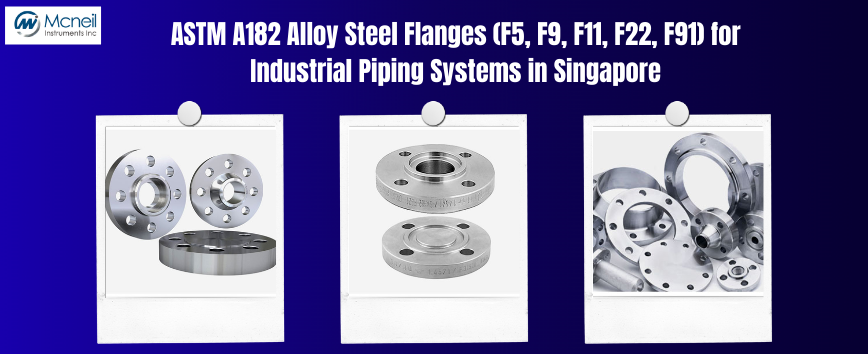
ASTM A182 alloy steel flanges are widely used because they are specifically designed for high-temperature and high-pressure service environments. This specification covers forged or rolled alloy steel flanges, fittings, and valve components used in demanding industrial applications.
Industries in Singapore, particularly oil & gas terminals, petrochemical plants, marine infrastructure, and power generation facilities, rely on ASTM A182 F5, F9, F11, F22, and F91 alloy steel flanges because of their excellent mechanical strength, corrosion resistance, and heat resistance.
These chrome-moly alloy steel flanges are engineered to perform reliably in extreme environments where conventional carbon steel components may fail.
This article explains ASTM A182 alloy steel flanges, their properties, grades, industrial uses, and importance in modern piping systems.
What Are ASTM A182 Alloy Steel Flanges?
ASTM A182 alloy steel flanges are forged piping components used to connect pipes, valves, pumps, and other equipment in industrial piping systems. Flanged joints are typically bolted together with a gasket placed between them to create a leak-proof seal.
The ASTM A182 specification covers forged alloy steel materials used in pressure systems, especially where pipelines operate at high temperature or high pressure.
These flanges are manufactured using forging and machining processes that ensure durability, strength, and dimensional precision.
Common Types of Alloy Steel Flanges
• Weld Neck Flanges – used for high pressure pipelines
• Slip-On Flanges – easy to install and commonly used
• Socket Weld Flanges – ideal for small diameter pipes
• Blind Flanges – used to close pipeline ends
• Threaded Flanges – used where welding is not preferred
Each flange type is designed to support different piping configurations and pressure conditions.
Chemical Composition of ASTM A182 Alloy Steel Flanges
Alloy steel flanges are manufactured using chromium-molybdenum alloy steels that offer superior mechanical strength and temperature resistance.
Typical elements present in these materials include:
| Element | Role in Alloy |
| Chromium (Cr) | Improves corrosion resistance |
| Molybdenum (Mo) | Enhances high-temperature strength |
| Carbon (C) | Provides hardness and strength |
| Manganese (Mn) | Improves toughness |
| Silicon (Si) | Enhances oxidation resistance |
For example, ASTM A182 F22 contains chromium and molybdenum, which enhance both corrosion resistance and high-temperature strength.
Mechanical Properties of ASTM A182 Alloy Steel Flanges
Alloy steel flanges offer high strength and durability, making them suitable for demanding industrial systems.
| Property | Typical Value |
| Tensile Strength | ≥ 415 MPa |
| Yield Strength | ≥ 205 MPa |
| Elongation | ≥ 20% |
| Hardness | Varies by grade |
Grades such as ASTM A182 F91 provide excellent mechanical strength and resistance to high temperatures and pressure.
Key Advantages of ASTM A182 Alloy Steel Flanges
Excellent High-Temperature Performance
Chrome-moly alloy steels are designed to operate under elevated temperatures, making them suitable for power plants and refineries.
Superior Mechanical Strength
These flanges maintain structural integrity even under heavy pressure and mechanical stress.
Strong Corrosion Resistance
Chromium content enhances resistance against oxidation and corrosion in industrial environments.
High Pressure Handling Capability
Alloy steel flanges are designed for pressure systems in boilers, reactors, and petrochemical pipelines.
Long Operational Life
The durability of these materials ensures long-term reliability and reduced maintenance costs.
Technical Specifications of ASTM A182 Alloy Steel Flanges
| Specification | Details |
| Standard | ASTM A182 / ASME SA182 |
| Grades | F5, F9, F11, F22, F91 |
| Size Range | ½″ to 36″ NB |
| Pressure Class | 150# to 2500# |
| Flange Faces | Raised Face (RF), Flat Face (FF), RTJ |
| Manufacturing Type | Forged |
| Flange Types | Weld Neck, Slip-On, Blind, Socket Weld, Threaded |
These flanges comply with international piping standards such as ASME B16.5 and B16.47.
Industrial Applications of Alloy Steel Flanges in Singapore
Singapore is a global hub for petrochemical refining, offshore energy, and marine engineering. ASTM A182 alloy steel flanges are widely used in these sectors.
Oil and Gas Industry
Used in refineries and offshore platforms for transporting hydrocarbons.
Petrochemical Plants
Suitable for handling high-temperature chemical processes.
Power Generation Plants
Used in steam pipelines, boilers, and turbine systems.
Marine and Offshore Infrastructure
Corrosion-resistant flanges are essential for offshore energy facilities.
Chemical Processing Industry
Reliable for transporting aggressive chemicals and high-pressure fluids.
Major ASTM A182 Alloy Steel Flange Grades
ASTM A182 F5 Alloy Steel Flanges
F5 flanges contain approximately 5% chromium, providing excellent oxidation resistance and durability.
Applications
• Oil refineries
• Chemical plants
• High-temperature piping systems
ASTM A182 F9 Alloy Steel Flanges
F9 flanges provide enhanced strength and corrosion resistance in high-temperature environments.
Applications
• Petrochemical plants
• Power generation facilities
• Industrial heat processing systems
ASTM A182 F11 Alloy Steel Flanges
F11 flanges are widely used in high-temperature and high-pressure systems.
Key Characteristics
• High tensile strength
• Excellent heat resistance
• Good weldability
Applications
• Power plants
• Oil & gas pipelines
• Nuclear and petrochemical industries
ASTM A182 F22 Alloy Steel Flanges
F22 is a chromium-molybdenum alloy steel with excellent resistance to high pressure and heat.
Applications
• Boilers and condensers
• Heat exchangers
• Pressure vessels
ASTM A182 F91 Alloy Steel Flanges
F91 is a high-strength alloy steel designed for extreme temperature applications.
Key Characteristics
• Excellent creep resistance
• High mechanical strength
• Strong oxidation resistance
Applications
• Nuclear power plants
• Petrochemical refineries
• High-temperature steam pipelines
Comparison of Alloy Steel Flange Grades
| Grade | Alloy Composition | Key Advantage | Typical Applications |
| F5 | Chromium alloy steel | Oxidation resistance | Refineries |
| F9 | Chrome-moly steel | High temperature durability | Petrochemical plants |
| F11 | Chrome-moly steel | High pressure performance | Power plants |
| F22 | Chromium + molybdenum | Excellent strength | Boilers & heat exchangers |
| F91 | 9% Cr + 1% Mo | Extreme temperature resistance | Nuclear & energy plants |
Quality Testing of Alloy Steel Flanges
To ensure reliability and safety, ASTM A182 alloy steel flanges undergo strict quality inspections.
Common testing procedures include:
• Chemical composition analysis
• Mechanical strength testing
• Hydrostatic pressure testing
• Ultrasonic testing
• Radiographic testing
• Positive Material Identification (PMI)
• Dimensional inspection
These tests ensure the flanges comply with international engineering standards.
Conclusion
ASTM A182 alloy steel flanges are critical components in modern industrial piping systems. Their chrome-moly alloy composition provides excellent strength, corrosion resistance, and stability at high temperatures.
Industries in Singapore, particularly petrochemical refining, marine engineering, and power generation, rely on ASTM A182 F5, F9, F11, F22, and F91 alloy steel flanges for reliable and long-lasting pipeline connections.
With their ability to withstand extreme operating conditions, these flanges remain a preferred choice for high-pressure and high-temperature industrial applications.


