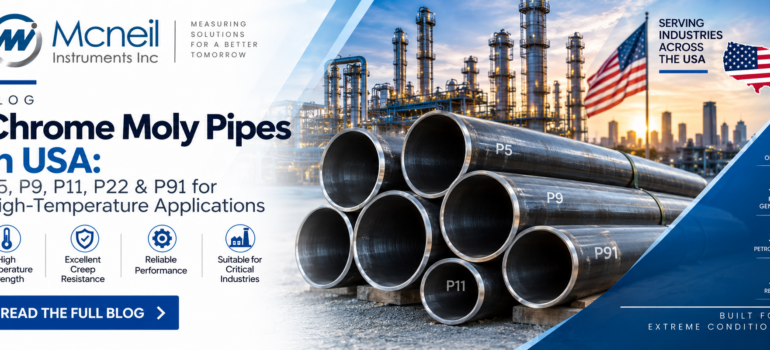
Chrome Moly Pipes in USA: P5, P9, P11, P22 & P91 for High-Temperature Applications
High-temperature industrial piping systems in the United States require materials capable of maintaining strength, dimensional stability and long-term performance under elevated temperature and pressure. Chrome Moly Pipes, manufactured from chromium-molybdenum alloy steel, are widely considered for demanding applications in power generation, refineries, petrochemical plants, boilers, steam systems, heat exchangers and high-temperature process equipment.
Mcneil Instrument supplies ASTM A335 / ASME SA335 Chrome Moly Pipes in P5, P9, P11, P22 and P91 grades for industrial requirements in the USA. These seamless alloy steel pipes are designed for applications where high temperature, pressure, thermal cycling, oxidation resistance and long-term mechanical performance are important.
What Are Chrome Moly Pipes?
Chrome Moly Pipes are chromium-molybdenum alloy steel pipes in which chromium and molybdenum are important alloying elements. Compared with conventional carbon steel, these alloy additions can provide improved high-temperature strength, oxidation resistance, creep resistance and thermal stability.
For industrial projects, ASTM A335 / ASME SA335 is the key specification associated with the seamless ferritic alloy steel pipes covered by the P5, P9, P11, P22 and P91 grades discussed here.
These pipes are particularly relevant when piping systems must operate for extended periods under combinations of:
- High operating temperature
- High internal pressure
- Thermal cycling
- Mechanical loading
- Oxidizing environments
- Long-term creep conditions
- Demanding process conditions
The correct grade should always be selected according to the actual design temperature, pressure, process medium, applicable code, fabrication requirements and project specifications.
Why Are Chrome Moly Pipes Important for US Industries?
Industrial facilities throughout the USA operate sophisticated systems where piping can experience severe temperature and pressure conditions. Power generation, refining, petrochemical processing and industrial heating operations are examples where material selection directly influences reliability and service life.
Chromium-molybdenum alloy steel pipes are considered for these applications because their alloy composition contributes to:
- High-temperature strength
- Oxidation resistance
- Creep resistance
- Thermal stability
- Pressure-handling capability
- Long-term mechanical performance
ASTM A335 alloy steel pipes are used in applications such as power plants, boilers, refineries, petrochemical facilities, steam systems and other high-temperature process equipment.
ASTM A335 Chrome Moly Pipe Grades Available for USA Projects
Mcneil Instrument’s published Chrome Moly range includes:
- ASTM A335 P5 Pipes
- ASTM A335 P9 Pipes
- ASTM A335 P11 Pipes
- ASTM A335 P22 Pipes
- ASTM A335 P91 Pipes
Each grade has a different alloy composition and therefore offers different characteristics for high-temperature service.
ASTM A335 P5 Chrome Moly Pipes
ASTM A335 P5 is a chromium-molybdenum alloy steel pipe grade intended for elevated-temperature service.
Mcneil Instrument’s published information gives P5 approximately 4–6% chromium and 0.45–0.65% molybdenum.
Typical P5 applications include:
- Refineries
- Heat exchangers
- Boilers
- Petrochemical plants
- High-temperature process piping
P5 is particularly considered where high-temperature performance and oxidation resistance are important.
ASTM A335 P9 Chrome Moly Pipes
ASTM A335 P9 contains a higher chromium and molybdenum content than P5. Mcneil Instrument lists approximately 8–10% chromium and 0.90–1.10% molybdenum for P9.
This composition makes P9 suitable for demanding elevated-temperature environments.
Typical P9 applications include:
- Power plants
- Refineries
- Petrochemical facilities
- Steam systems
- Industrial heaters
- High-temperature piping
P9 can be considered when a project requires strong thermal and oxidation resistance.
ASTM A335 P11 Chrome Moly Pipes
ASTM A335 P11 is widely associated with boilers, steam systems and power-generation applications.
Mcneil Instrument’s published specifications identify approximately 1–1.5% chromium and 0.44–0.65% molybdenum for P11.
Common P11 applications include:
- Industrial boilers
- Power plants
- Steam lines
- Heat exchangers
- Process piping
- High-temperature utility systems
P11 is often evaluated where a combination of mechanical strength, thermal performance and fabrication requirements is needed.
ASTM A335 P22 Chrome Moly Pipes
ASTM A335 P22 is a chromium-molybdenum alloy steel grade used in systems requiring elevated-temperature strength and creep resistance.
Mcneil Instrument lists approximately 1.9–2.6% chromium and 0.87–1.13% molybdenum for P22.
P22 pipes are commonly considered for:
- Power plants
- Main steam systems
- Reheaters
- Boilers
- Heat recovery units
- Petrochemical facilities
- High-temperature process piping
P22 is particularly relevant where long-term performance and creep resistance are important.
ASTM A335 P91 Chrome Moly Pipes
ASTM A335 P91 is a higher-performance chromium-molybdenum alloy steel grade intended for demanding high-temperature and high-pressure service.
Mcneil Instrument’s published composition identifies approximately 8–9.5% chromium and 0.85–1.05% molybdenum, together with additional alloying elements used in the grade.
Typical P91 applications include:
- Supercritical power plants
- Ultra-supercritical power plants
- High-pressure steam systems
- Advanced boiler systems
- Superheated steam lines
- Critical power-generation applications
- Advanced energy systems
P91 offers high creep resistance and high-temperature performance, making appropriate manufacturing, heat treatment, welding and inspection especially important for critical applications.
P5 vs P9 vs P11 vs P22 vs P91 Chrome Moly Pipes
| Grade | Key Characteristic | Typical Applications |
| P5 | Heat and oxidation resistance | Refineries, heat exchangers, boilers |
| P9 | Higher chromium and thermal resistance | Power and petrochemical systems |
| P11 | Balanced strength and thermal performance | Boilers, steam systems, power plants |
| P22 | High-temperature and creep resistance | Power plants, steam systems, reheaters |
| P91 | High strength and advanced creep performance | Critical power and high-pressure steam systems |
The highest alloy grade is not automatically the correct choice. Selection should be based on operating temperature, pressure, process conditions, design code, welding requirements and project specifications.
Seamless Chrome Moly Pipes for USA Industrial Projects
Mcneil Instrument’s published range covers seamless Chrome Moly and alloy steel pipes for high-temperature applications.
| Specification | Details |
| Product | Chrome Moly / Alloy Steel Pipes |
| Standard | ASTM A335 / ASME SA335 |
| Grades | P5, P9, P11, P22, P91 |
| Construction | Seamless |
| Size Range | 1/8″ NB to 24″ NB |
| Schedule | SCH 20 to SCH XXS |
| Applications | Boilers, power plants, refineries, petrochemical systems |
Actual availability, dimensions, schedules and manufacturing requirements should be confirmed against the individual project or purchase order.
Chrome Moly Pipes for Power Plants in the USA
Power generation is one of the major application areas for Chrome Moly piping.
Power plants can contain piping systems exposed continuously to elevated temperatures and pressures. Depending on the operating conditions, Chrome Moly pipes may be used for:
- Boilers
- Main steam lines
- Superheaters
- Reheaters
- Steam headers
- High-pressure steam piping
- Heat-recovery systems
P11, P22 and P91 are particularly associated with increasingly demanding steam and power-generation applications, with the final grade selected according to actual plant operating conditions.
Chrome Moly Pipes for Oil & Gas and Refining in the USA
The US oil and gas sector includes upstream, midstream and downstream facilities with different material requirements. In high-temperature sections of refineries, gas-processing plants and petrochemical facilities, Chrome Moly pipes can be considered where elevated-temperature mechanical performance is required.
Potential applications include:
- Refinery process units
- Gas processing plants
- Petrochemical facilities
- Steam systems
- Heat exchangers
- High-temperature utility systems
- Industrial heating systems
- Process piping
Material selection should be based on the actual process medium, operating temperature, pressure, corrosion environment and applicable engineering requirements.
Chrome Moly Boiler and Steam Pipes
Boiler and steam-generation systems require piping capable of maintaining mechanical performance under sustained heat and pressure.
Chrome Moly pipes are used in applications such as:
Boiler Piping
Used for selected high-temperature sections where alloy steel performance is required.
Superheater Systems
Superheaters expose piping to high-temperature steam, making appropriate material selection important.
Reheater Systems
Reheater circuits operate under demanding thermal conditions and can require alloy steel piping.
Steam Headers
Headers collect and distribute steam and can be exposed to significant temperature and pressure.
High-Pressure Steam Lines
High-pressure steam piping requires carefully specified materials, dimensions, welding procedures and inspection.
How to Select Chrome Moly Pipes for a USA Project
Choosing the right Chrome Moly pipe requires more than simply specifying P5, P9, P11, P22 or P91.
Before procurement, buyers should define:
1. ASTM/ASME Standard
Specify the applicable ASTM A335 / ASME SA335 requirements.
2. Grade
Select P5, P9, P11, P22 or P91 according to the engineering design.
3. Pipe Size
Define nominal pipe size, outside diameter and required wall thickness.
4. Schedule
Specify the required pipe schedule according to pressure and design calculations.
5. Operating Conditions
Review design temperature, operating pressure, thermal cycling and process medium.
6. Heat Treatment
Confirm applicable heat-treatment requirements for the selected grade.
7. Testing and Inspection
Define testing, inspection and certification requirements before placing the order.
8. Traceability and Documentation
For critical projects, establish requirements for marking, material certificates, traceability and project documentation.
Mcneil Instrument’s USA-specific information recommends identifying the standard, grade, dimensions, schedule, length, end preparation, heat treatment, testing, inspection, certification and traceability requirements during procurement.
Industries Using Chrome Moly Pipes in the USA
Chrome Moly Pipes can support a wide range of high-temperature industrial applications.
Power Generation
Used in boilers, steam lines, superheaters, reheaters and other high-temperature systems.
Oil & Gas
Applicable to selected high-temperature process and utility systems across refining and gas processing.
Petrochemical
Used in process systems, heaters, steam circuits and heat-transfer applications where alloy steel performance is required.
Refineries
P5 and P9, among other suitable grades, can be considered for elevated-temperature refinery applications.
Chemical Processing
Chrome Moly pipes can be evaluated for high-temperature process piping based on the process environment.
Boilers and Heat Exchangers
Alloy steel piping can be selected for systems involving elevated temperatures and pressure.
Why Choose Mcneil Instrument for Chrome Moly Pipes in USA?
Mcneil Instrument supplies ASTM A335 / ASME SA335 Chrome Moly Pipes in P5, P9, P11, P22 and P91 grades for high-temperature industrial requirements in the USA and international markets.
Key supply advantages include:
- P5 to P91 grade availability
- Seamless Chrome Moly pipe options
- ASTM A335 / ASME SA335 compliance
- Multiple sizes and schedules
- Support for project-specific requirements
- Testing and inspection support
- Documentation and certification support
- Applications across power, oil & gas, refining and petrochemical industries
For USA projects, customers can specify the required grade, size, schedule, testing, inspection, certification and other project-specific requirements.
Frequently Asked Questions
What are Chrome Moly Pipes?
Chrome Moly Pipes are chromium-molybdenum alloy steel pipes designed primarily for demanding elevated-temperature and high-pressure industrial applications.
Which Chrome Moly grades does Mcneil Instrument supply?
Mcneil Instrument’s published range includes ASTM A335 P5, P9, P11, P22 and P91 Chrome Moly pipe grades.
What standard covers P5, P9, P11, P22 and P91 pipes?
The grades discussed in this range are covered by ASTM A335 / ASME SA335, which specifies seamless ferritic alloy steel pipe for high-temperature service.
What are P11 pipes used for?
P11 pipes are commonly used in boilers, steam lines, power plants, heat exchangers and high-temperature process piping.
What are P22 pipes used for?
P22 pipes are used in applications such as power plants, reheaters, boilers, steam systems, heat-recovery units and high-temperature process piping where elevated-temperature strength and creep resistance are important.
What are P91 pipes used for?
P91 pipes are associated with demanding applications including supercritical and ultra-supercritical power plants, high-pressure steam systems, advanced boilers and critical high-temperature piping.
Are Chrome Moly Pipes available in seamless construction?
Yes. Mcneil Instrument’s published range includes seamless Chrome Moly and alloy steel pipes in P5, P9, P11, P22 and P91 grades.
What size range is available?
The published product information lists a size range of 1/8″ NB to 24″ NB, with schedules from SCH 20 to SCH XXS, subject to project requirements and availability.
Can Mcneil Instrument supply Chrome Moly Pipes for USA projects?
Yes. Mcneil Instrument provides USA-focused information for its Chrome Moly pipe range and supplies these products for international industrial requirements, including projects requiring delivery to the USA.
Conclusion
Chrome Moly Pipes in P5, P9, P11, P22 and P91 grades provide engineered material options for high-temperature industrial piping systems where conventional materials may not provide the required performance.
From boilers and steam systems to power plants, refineries and petrochemical facilities, ASTM A335 / ASME SA335 alloy steel pipes can provide the combination of high-temperature strength, oxidation resistance, creep resistance and long-term mechanical performance required for demanding service.
For USA industrial projects, selecting the correct grade should be based on actual operating temperature, pressure, process conditions, applicable design codes, fabrication requirements, inspection needs and expected service life.
Mcneil Instrument supplies ASTM A335 / ASME SA335 P5, P9, P11, P22 and P91 seamless Chrome Moly Pipes for industrial applications, with dimensions, schedules, testing, inspection and documentation requirements configurable according to project specifications.