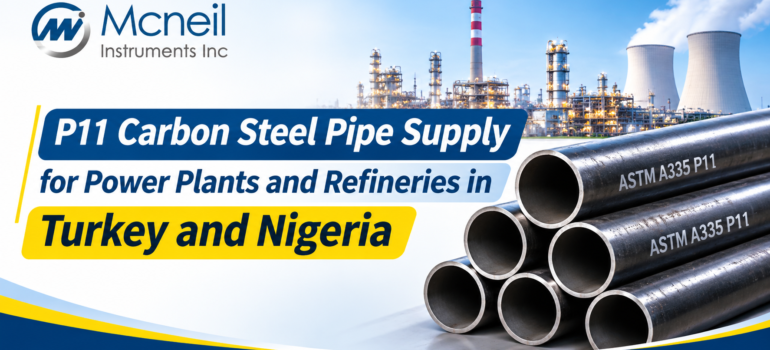
ASTM A335 P11 carbon steel pipes supplied by Mcneil Instruments Inc. for power plants and refineries in Turkey and Nigeria.

P11 Carbon Steel Pipe Supply for Power Plants and Refineries in Turkey and Nigeria

Power plants and refineries operate under demanding conditions where high temperatures, pressure and continuous operations place significant stress on piping systems. Selecting the right piping material is essential for maintaining operational safety, equipment reliability and long-term performance. ASTM A335 Grade P11 pipes are widely used in high-temperature industrial applications because of their strength, heat resistance and ability to perform in demanding service conditions.

At Mcneil Instrument, we understand the importance of supplying quality alloy steel piping solutions for critical industrial projects. We support industrial buyers, engineering contractors, distributors and project procurement teams looking for P11 alloy steel pipes for power generation, petrochemical and refinery applications in Turkey and Nigeria.

Understanding ASTM A335 Grade P11 Pipes

ASTM A335 Grade P11 is a chromium-molybdenum alloy steel pipe designed for high-temperature service. Although it is sometimes commercially searched for as P11 carbon steel pipe, P11 is technically classified as a low-alloy chrome-moly steel grade.

Its typical chemical composition includes approximately 1.00–1.50% chromium and 0.44–0.65% molybdenum. Chromium contributes to oxidation and corrosion resistance, while molybdenum improves high-temperature strength and creep resistance.

These properties make P11 pipes suitable for applications involving elevated temperatures, pressure and demanding operating conditions.

P11 pipes are commonly specified under ASTM A335, which covers seamless ferritic alloy-steel pipe intended for high-temperature service.

Why Choose P11 Pipes for Power Plants?

Power generation facilities require piping materials capable of handling elevated temperatures, steam pressure and continuous operating cycles. P11 alloy steel pipes are used in selected power plant applications where high-temperature mechanical properties are important.

Key benefits include:
High-Temperature Strength: Suitable for piping systems exposed to elevated operating temperatures.
Creep Resistance: Chromium-molybdenum alloy composition supports resistance to deformation under prolonged high-temperature stress.
Oxidation Resistance: Chromium helps improve resistance to oxidation at elevated temperatures.
Pressure Handling: Appropriate pipe dimensions, wall thickness and material properties support demanding pressure applications when correctly engineered.
Industrial Reliability: Suitable for properly designed steam, boiler and process piping systems.

Depending on the engineering design, P11 pipes may be specified for steam lines, boiler-related piping, superheater and reheater systems, and other high-temperature process applications.

Applications of P11 Alloy Steel Pipes in Refineries

Refineries require piping materials that can withstand elevated temperatures, pressure and challenging process environments. ASTM A335 P11 pipes are used in selected refinery and petrochemical applications where their high-temperature properties meet the design requirements.

Common applications include:

  1. Refinery Process Piping
    P11 pipes can be specified for high-temperature process lines in refinery installations, subject to operating conditions and engineering requirements.
  2. Heat Exchangers
    They may be used in associated high-temperature piping systems connected to heat exchangers and other thermal processing equipment.
  3. Petrochemical Plants
    Petrochemical facilities use alloy steel piping for process operations involving elevated temperatures and pressure.
  4. Steam Distribution Systems
    P11 pipes are suitable for selected steam piping applications where the required pressure and temperature ratings are satisfied.
  5. Industrial Heating Systems
    They can be used in high-temperature industrial piping systems where suitable material selection is essential for long-term service.

P11 Pipe Supply for Turkey’s Power and Refinery Industry

Turkey has an established industrial base covering power generation, petroleum refining, petrochemicals and manufacturing. These industries require dependable piping materials for new installations, plant upgrades, maintenance and expansion projects.

For industrial buyers in Istanbul, Ankara, Izmir, Kocaeli and other manufacturing and industrial regions, sourcing the correct alloy steel pipe grade is an important part of project procurement.

Mcneil Instruments Inc. supports international procurement requirements for P11 alloy steel pipes, helping buyers identify suitable material specifications for their applications.

When purchasing P11 pipes for projects in Turkey, buyers should consider:
ASTM A335 P11 material specifications
Required outside diameter and wall thickness
Pipe schedule and length requirements
Chemical composition and mechanical properties
Heat treatment and inspection requirements
Mill Test Certificates (MTC)
Export packaging and shipping documentation
Selecting a supplier that understands international material specifications helps streamline procurement and supports project quality requirements.

P11 Alloy Steel Pipe Supply for Nigeria’s Oil, Gas and Power Sector

Nigeria has significant oil and gas infrastructure, petroleum processing facilities and power generation requirements. These industries depend on reliable piping systems for high-temperature process operations, steam distribution and plant maintenance.

Industrial project buyers and contractors in Lagos, Port Harcourt, Abuja, Warri and other industrial locations may require alloy steel pipes for refinery projects, petrochemical facilities and power generation installations.

P11 alloy steel pipes can be considered for applications where their mechanical properties and temperature capabilities meet the project’s engineering specifications.

For Nigerian buyers, important procurement considerations include:
Compliance with ASTM A335 P11 requirements
Availability of the required pipe sizes and thicknesses
Material traceability and inspection documentation
Chemical and mechanical test reports
Third-party inspection, where specified
Export packing and delivery coordination

Working with an experienced international piping supplier can help procurement teams manage material specifications and sourcing requirements more efficiently.

Technical Specifications of ASTM A335 P11 Pipes

The following table provides a general overview of P11 alloy steel pipe specifications.
Parameter Details
Material Grade ASTM A335 Grade P11
Material Type Chromium-Molybdenum Alloy Steel
Product Type Seamless Alloy Steel Pipe
Chromium Content 1.00–1.50%
Molybdenum Content 0.44–0.65%
Standard ASTM A335 / ASME SA335
Manufacturing Seamless
Heat Treatment As specified by the applicable standard
Applications Power Plants, Refineries, Petrochemical Plants and High-Temperature Piping

Final chemical composition, mechanical properties, dimensions, heat treatment and inspection requirements should always be verified against the applicable standard edition and project specifications.

What to Consider When Purchasing P11 Pipes?

Choosing the right P11 pipe supplier involves more than comparing prices. Buyers should evaluate material quality, documentation, product specifications and export capabilities.

Material Compliance: Confirm that the pipes meet the specified ASTM A335 P11 requirements.
Material Traceability: Request Mill Test Certificates with heat numbers and relevant test results.
Dimensional Accuracy: Verify the outside diameter, wall thickness, schedule and length against project requirements.
Quality Inspection: Ensure that inspection and testing are carried out according to the purchase order and applicable standards.
Export Readiness: Confirm suitable packing, marking and shipping documentation for international deliveries.

These checks help reduce procurement risks and ensure that the supplied materials match the project’s engineering requirements.

Why Choose Mcneil Instrument for P11 Alloy Steel Pipe Supply?

At Mcneil Instrument., we focus on supplying industrial piping products and material solutions for demanding applications. We understand that every power plant, refinery and petrochemical project has specific technical and procurement requirements.

Our approach focuses on:
Material specifications aligned with project requirements
Alloy steel piping solutions for industrial applications
Support with technical documentation and material traceability
Coordination of inspection requirements
International supply and export support
Assistance with product selection based on application needs

Whether you are sourcing P11 alloy steel pipes for a power generation project in Turkey or a refinery application in Nigeria, selecting the correct material grade and specifications is essential.

Conclusion

ASTM A335 Grade P11 alloy steel pipes offer a combination of high-temperature strength, oxidation resistance and creep resistance that makes them suitable for selected power generation, refinery and petrochemical applications.

For buyers in Turkey and Nigeria, choosing the right supplier is an important part of maintaining material quality and meeting project specifications.

Mcneil Instrument supports industrial piping requirements with a focus on material specifications, documentation and dependable international supply solutions.

Contact our team to discuss your P11 alloy steel pipe requirements.

Looking for a Reliable P11 Alloy Steel Pipe Supplier?

Source ASTM A335 Grade P11 alloy steel pipes for power plants, refineries and petrochemical projects in Turkey and Nigeria.
Connect with Mcneil Instrument for product specifications, technical documentation and export supply enquiries.
Contact Us Today for a Competitive Quotation.
Website: https://mcneilinstrument.com

Frequently Asked Questions (FAQs)

  1. What is ASTM A335 Grade P11 pipe?
    ASTM A335 Grade P11 is a seamless chromium-molybdenum alloy steel pipe designed for high-temperature service. It is commonly used in power plants, refineries and petrochemical facilities.
  2. Is P11 a carbon steel or alloy steel pipe?
    P11 is technically a low-alloy chromium-molybdenum steel grade, not conventional carbon steel. It contains chromium and molybdenum to improve its high-temperature properties.
  3. What is the chemical composition of P11 pipe?
    P11 typically contains 1.00–1.50% chromium and 0.44–0.65% molybdenum, along with carbon, manganese, silicon and other elements within the specified limits.
  4. What is the difference between P11 and P22 pipes?
    Both are chromium-molybdenum alloy steel grades used in high-temperature applications. P11 generally contains 1.00–1.50% chromium and 0.44–0.65% molybdenum, while P22 contains approximately 1.90–2.60% chromium and 0.87–1.13% molybdenum. Their selection depends on design temperature, pressure and engineering requirements.
  5. Where are P11 alloy steel pipes commonly used?
    P11 pipes are used in selected steam piping systems, power plants, refineries, petrochemical facilities, heat exchanger connections and other high-temperature industrial applications.
  6. Are P11 pipes suitable for refinery applications in Nigeria?
    Yes, P11 pipes can be suitable for selected refinery and petrochemical applications in Nigeria when the material grade meets the project’s operating temperature, pressure, process conditions and engineering specifications.
  7. Can P11 pipes be supplied for industrial projects in Turkey?
    Yes, international suppliers can support P11 pipe procurement for power plants, refineries and industrial projects in Turkey, subject to required dimensions, specifications and delivery arrangements.
  8. What documents should be provided with P11 pipes?
    Typical documentation includes Mill Test Certificates (MTC), chemical composition reports, mechanical test results, heat treatment records and applicable inspection reports. Additional documentation depends on project and purchaser requirements.
  9. What sizes are available for ASTM A335 P11 pipes?
    P11 pipes are manufactured in different nominal pipe sizes, outside diameters and wall thicknesses. Availability depends on manufacturer capability and order requirements.
  10. How can I request a quotation for P11 alloy steel pipes?
    You can contact Mcneil Instrument with your required grade, pipe size, schedule, quantity, applicable standard, destination country and documentation requirements to request a quotation.
Read More
ASTM A335 alloy steel pipes in grades P5, P9, P11, P22 and P91 by Mcneil Instruments Inc., manufacturer, supplier and exporter in Turkey.

ASTM A335 Alloy Steel Pipes P5, P9, P11, P22 & P91 Manufacturer, Supplier & Exporter in Turkey

Alloy Steel Pipes are widely used in industrial systems that operate under high temperatures, elevated pressure, and demanding service conditions. Their alloying elements help maintain mechanical strength and performance in applications where conventional carbon steel may not meet the required engineering specifications.
Mcneil Instrument manufactures, supplies, and exports ASTM A335 Alloy Steel Pipes in grades P5, P9, P11, P22 and P91 for industrial applications, including projects in Turkey. These seamless chromium-molybdenum alloy steel pipes are used in power plants, refineries, petrochemical facilities, boiler systems, heat exchangers, and high-temperature process piping.
For Turkish industrial buyers, EPC contractors, engineering companies, and procurement teams, selecting the right alloy steel pipe grade is essential for meeting operating requirements and maintaining system reliability. The correct grade depends on design temperature, pressure, process conditions, applicable standards, and project specifications.

What Are ASTM A335 Alloy Steel Pipes?

ASTM A335 is a specification covering seamless ferritic alloy steel pipes intended for elevated-temperature service. These pipes contain alloying elements such as chromium and molybdenum, which contribute to high-temperature strength, oxidation resistance, and resistance to creep under suitable operating conditions.
The corresponding ASME designation is SA335. Grades P5, P9, P11, P22 and P91 have different chemical compositions and mechanical properties, making them suitable for different industrial applications.

Key Characteristics of ASTM A335 Pipes

High-temperature performance: Designed for suitable elevated-temperature applications.
Pressure-bearing capability: Used in piping systems designed for demanding pressure conditions.
Chromium-molybdenum composition: Provides specific mechanical and thermal properties.
Creep resistance: Selected grades are used in systems exposed to sustained stress and elevated temperatures.
Seamless construction: Suitable for applications where seamless alloy steel pipes are specified.
Multiple grade options: Allows engineers to match the material to the intended operating conditions.
The final material selection should always be based on engineering calculations and the applicable piping code rather than the grade designation alone.

ASTM A335 Alloy Steel Pipe Grades Available

Mcneil Instrument’s alloy steel pipe range includes P5, P9, P11, P22 and P91. Each grade offers a different combination of alloy composition and performance characteristics.

  1. ASTM A335 P5 Alloy Steel Pipes
    P5 is a chromium-molybdenum alloy steel pipe grade intended for elevated-temperature service. It is commonly considered for selected refinery, heating, and high-temperature process applications.
    Key characteristics:
    Chromium-molybdenum alloy composition
    Suitability for specified elevated-temperature service
    Resistance to oxidation under appropriate operating conditions
    Use in selected industrial process systems
    Typical applications:
    Refineries
    Industrial heaters
    Heat exchangers
    High-temperature process piping
    Selected boiler and petrochemical systems
    P5 should be selected when its specified material properties meet the design and service requirements of the installation.
  2. ASTM A335 P9 Alloy Steel Pipes
    P9 is a higher-chromium alloy steel grade used in selected high-temperature applications. Its composition supports oxidation resistance and thermal performance in appropriate industrial environments.
    Key characteristics:
    Higher chromium content than P5
    Suitability for selected elevated-temperature applications
    Resistance to oxidation and scaling under suitable conditions
    Use in specified industrial process systems
    Typical applications:
    Refinery piping
    Furnace and heating systems
    Petrochemical facilities
    High-temperature process lines
    Selected steam and heat-transfer systems
    The suitability of P9 depends on the actual operating environment, including temperature, pressure, process medium, and project requirements.
  3. ASTM A335 P11 Alloy Steel Pipes
    P11 is a chromium-molybdenum alloy steel pipe grade widely associated with boiler, steam, and power-generation applications. It provides a combination of strength and high-temperature performance for suitable industrial services.
    Key characteristics:
    Chromium-molybdenum alloy composition
    Suitable mechanical properties for specified thermal service
    Applicability to selected steam and boiler systems
    Compatibility with approved fabrication and welding procedures
    Typical applications:
    Boiler piping
    Steam pipelines
    Power plants
    Heat-transfer equipment
    Refinery process systems
    Industrial utility piping
    P11 is frequently considered for high-temperature systems where the grade meets the specified design requirements.
  4. ASTM A335 P22 Alloy Steel Pipes
    P22 is a chromium-molybdenum alloy steel grade used in demanding elevated-temperature applications. Its alloy composition makes it relevant to power-generation equipment and selected high-temperature process systems.
    Key characteristics:
    Chromium-molybdenum composition
    High-temperature strength for specified service conditions
    Creep resistance under suitable operating conditions
    Application in demanding thermal systems
    Typical applications:
    Boilers
    Heat exchangers
    Main steam systems
    Superheater and reheater-related piping
    Power-generation facilities
    High-temperature refinery piping
    P22 may be considered when the project requires its specific material properties and operating performance.
  5. ASTM A335 P91 Alloy Steel Pipes
    P91 is a high-strength alloy steel pipe grade developed for demanding elevated-temperature service. Its alloy system includes chromium, molybdenum, vanadium, and niobium, contributing to its high-temperature strength and creep resistance.
    Key characteristics:
    High strength for specified service conditions
    Creep resistance for demanding elevated-temperature applications
    Use in critical steam and power-generation systems
    Specific heat-treatment and fabrication requirements
    Typical applications:
    Advanced power plants
    High-pressure steam pipelines
    Boiler systems
    Superheaters
    Reheaters
    Critical high-temperature piping
    P91 requires careful control of welding, heat treatment, inspection, and material verification. These requirements should be addressed through approved project procedures.

P5 vs P9 vs P11 vs P22 vs P91: Grade Comparison

The following table provides a general overview to support preliminary material selection.
Grade General characteristics Typical applications
P5 Chromium-molybdenum alloy steel for elevated-temperature service Refineries, heaters, heat exchangers
P9 Higher-chromium alloy steel Selected refinery and high-temperature process systems
P11 Chromium-molybdenum alloy steel Boilers, steam lines, power plants
P22 Alloy steel for demanding elevated-temperature service Steam systems, boilers, heat exchangers
P91 High-strength alloy steel for critical thermal service Advanced power generation and high-pressure steam systems
These grades are not interchangeable. The correct choice depends on design temperature, pressure, mechanical properties, process conditions, welding requirements, and the applicable engineering code.

Technical Specifications of ASTM A335 Alloy Steel Pipes

Mcneil Instrument’s published product information identifies its alloy steel pipe range as seamless and lists sizes from 1/8 inch NB to 24 inches NB, with schedules ranging from SCH 20 to SCH XXS. Actual availability should be confirmed for each grade and size.

Parameter General specification
Product Alloy Steel Pipes
Standards ASTM A335 / ASME SA335
Grades P5, P9, P11, P22 and P91
Construction Seamless
Published size range 1/8 inch NB to 24 inches NB
Published schedules SCH 20 to SCH XXS
Length options Random, double random, or cut length, subject to availability
End finishes Plain, beveled, or threaded, where specified
Applications Power plants, refineries, petrochemical plants, boilers, and heat exchangers
Final dimensions, schedules, lengths, heat treatment, end preparation, testing, and documentation must be confirmed against the purchase order and applicable material standard.

Chemical Composition of ASTM A335 Pipe Grades

Chromium and molybdenum content are important factors in determining the properties of alloy steel pipes. The following ranges are indicative of commonly specified compositions; the applicable edition of ASTM A335 and the material test certificate must govern acceptance.

Grade Chromium (Cr) Molybdenum (Mo)
P5 4.00–6.00% 0.45–0.65%
P9 8.00–10.00% 0.90–1.10%
P11 1.00–1.50% 0.44–0.65%
P22 1.90–2.60% 0.87–1.13%
P91 8.00–9.50% 0.85–1.05%
P91 also contains specified additions of elements such as vanadium and niobium. Complete chemical composition requirements include additional elements and limits, so the table should not be used as a substitute for the governing standard.
Role of Chromium
Chromium contributes to oxidation resistance and high-temperature performance. Its concentration varies by grade, influencing the material’s characteristics and intended applications.
Role of Molybdenum
Molybdenum contributes to high-temperature strength and resistance to creep under suitable service conditions. Its concentration is one of the factors distinguishing the performance profiles of different P-series grades.

Applications of Alloy Steel Pipes in Turkey

Turkey’s industrial sectors include power generation, petroleum refining, petrochemical processing, chemical manufacturing, and heavy engineering. These industries require piping materials selected to suit their operating temperatures, pressures, process media, and applicable standards.
Power Generation Plants
Power plants use alloy steel pipes in selected boiler, steam, superheater, reheater, and high-temperature utility systems.
Depending on the design requirements, P11, P22 and P91 may be specified for different services. Grade selection must consider operating conditions, creep requirements, and applicable construction codes.
Oil Refineries
Refinery processes may expose piping to elevated temperatures and demanding operating conditions. P5 and P9 are used in selected refinery services where their specified properties meet the requirements.
Petrochemical Facilities
Petrochemical plants require piping suitable for process fluids, thermal loads, and operating pressures. ASTM A335 alloy steel pipes may be specified for appropriate high-temperature process applications.
Boiler and Steam Systems
Boiler and steam installations require materials that maintain the required properties under sustained thermal and mechanical loads. P11 and P22 are commonly associated with suitable boiler and steam applications, while P91 may be selected for more demanding services.
Heat Exchangers
Alloy steel pipes can be used in specified heat-transfer systems where operating temperature, pressure, fluid compatibility, and design requirements call for the selected grade.
Heavy Engineering Projects
Industrial engineering and EPC projects may require alloy steel piping for high-temperature process systems and specialized equipment. Procurement must follow the approved material list, piping specification, and inspection plan.

Benefits of ASTM A335 Alloy Steel Pipes

High-Temperature Strength
Suitable grades maintain required mechanical properties at elevated temperatures when selected and used within their design limits.
Resistance to Creep
Creep resistance is particularly important for components exposed to sustained stress and high temperature. Different grades provide different levels of performance.
Oxidation Resistance
Chromium-containing alloy steels can provide improved oxidation resistance in suitable high-temperature environments.
Seamless Construction
Seamless pipes are specified for many demanding industrial applications where this construction method is required by the design.
Grade Selection Flexibility
The availability of multiple grades helps engineers select materials according to the service conditions and applicable technical requirements.
Industrial Versatility
ASTM A335 pipes are used across suitable power, refinery, petrochemical, boiler, and heat-transfer applications.

How to Select the Right Alloy Steel Pipe in Turkey

Selecting the correct grade involves reviewing technical requirements and confirming that the material meets the project’s design specification.

  1. Identify the required standard and grade. Confirm whether ASTM A335 / ASME SA335 applies and identify the required grade, such as P5, P9, P11, P22, or P91.
  2. Review operating temperature. Determine normal, maximum, and transient temperatures and check material suitability against the design code.
  3. Confirm design pressure. Pipe diameter, wall thickness, grade, and design conditions all influence pressure capability.
  4. Specify dimensions and schedule. Provide nominal size, outside diameter where required, wall thickness, schedule, length, and end preparation.
  5. Evaluate the process medium. Consider the fluid or gas, corrosion mechanisms, and other service-specific conditions.
  6. Check welding and heat-treatment requirements. Confirm approved fabrication procedures, particularly for grades with specific heat-treatment requirements such as P91.
  7. Define inspection and documentation. Specify material certificates, testing, traceability, non-destructive examination, and any third-party inspection requirements.
  8. Confirm delivery and availability. Check grade, size, quantity, production or stock availability, and delivery arrangements for the Turkish project location.

Quality Testing and Inspection

Quality assurance helps verify that alloy steel pipes meet the specified material and dimensional requirements. Testing should follow the governing standard, purchase order, and project quality plan.
Depending on the grade and order, inspection may include:
Chemical analysis: Confirms material composition against the required grade.
Tensile testing: Evaluates specified mechanical properties.
Hardness testing: Checks compliance with applicable acceptance criteria.
Dimensional inspection: Verifies diameter, wall thickness, length, and tolerances.
Hydrostatic testing: Performed where required by the applicable specification.
Non-destructive examination: Conducted when required by the standard or project.
Heat-treatment verification: Confirms compliance with the specified heat-treatment requirements.
Material Test Certificates: Provide material chemistry and relevant test results.
Traceability checks: Link material identification to the relevant inspection and certification records.
Testing requirements vary by grade, specification, and project. The required scope should be agreed upon before procurement.

Why Choose Mcneil Instrument for Alloy Steel Pipes in Turkey?

Mcneil Instrument offers alloy steel pipe grades P5, P9, P11, P22 and P91 for industrial applications. Its published Turkey-specific information identifies power plants, refineries, petrochemical industries, and heavy engineering projects as relevant application areas.
For Turkish industrial buyers, a clear technical enquiry can help match the supplied material to the project’s requirements.
When requesting a quotation, provide:
Required ASTM or ASME specification
Alloy grade
Nominal pipe size and schedule
Required wall thickness and length
Quantity
End preparation
Heat-treatment requirements
Inspection and testing scope
Material certification requirements
Delivery location in Turkey
Mcneil Instrument serves international industrial markets, including Turkey. Grade availability, order quantities, delivery timelines, and certification requirements should be confirmed for each enquiry.

Frequently Asked Questions

What are ASTM A335 alloy steel pipes used for?
ASTM A335 pipes are seamless ferritic alloy steel pipes intended for elevated-temperature service. They are used in suitable power-generation, refinery, petrochemical, boiler, steam, and heat-transfer applications.
Which grades are available from Mcneil Instrument?
The published range includes ASTM A335 / ASME SA335 P5, P9, P11, P22 and P91 alloy steel pipes. Confirm the specific grade, size, and availability for your project.
What is the difference between P11 and P22 pipes?
Both are chromium-molybdenum alloy steel grades. P22 has higher chromium and molybdenum content than P11 and is associated with different high-temperature performance characteristics. The correct grade depends on the design conditions and engineering specification.
What is P91 alloy steel pipe used for?
P91 is used in selected demanding high-temperature applications, including critical steam systems and power-generation equipment. Its suitability depends on design conditions, fabrication procedures, heat treatment, and the applicable code.
Are ASTM A335 alloy steel pipes seamless?
Yes. ASTM A335 covers seamless ferritic alloy steel pipe intended for elevated-temperature service.
What sizes are available?
Mcneil Instrument’s published range includes nominal sizes from 1/8 inch NB to 24 inches NB and schedules from SCH 20 to SCH XXS. Actual availability should be confirmed for the required grade and dimensions.
Which industries in Turkey use alloy steel pipes?
Relevant industries include power generation, oil refining, petrochemical processing, boiler manufacturing, heat-transfer equipment, and heavy engineering.
What documents should be requested with an alloy steel pipe order?
Documentation may include Material Test Certificates, chemical and mechanical test results, heat-treatment records, inspection reports, and traceability documents, according to the purchase order and applicable standard.
How can I request a quotation for alloy steel pipes in Turkey?
Provide the required grade, ASTM/ASME specification, nominal size, schedule, quantity, length, end preparation, testing requirements, documentation, and delivery location.

Conclusion

ASTM A335 Alloy Steel Pipes in grades P5, P9, P11, P22 and P91 are used in industrial systems that require material properties suitable for elevated temperatures and demanding operating conditions. Each grade offers a distinct composition and performance profile, making engineering-based selection essential for power plants, refineries, petrochemical facilities, boilers, and heat exchangers.
Mcneil Instrument supplies alloy steel pipe solutions for industrial buyers, including projects in Turkey. Confirming the applicable standard, grade, dimensions, testing requirements, and material documentation helps ensure that the selected pipes align with the project’s technical specification.
For companies searching for an ASTM A335 Alloy Steel Pipes Manufacturer, Supplier & Exporter in Turkey, Mcneil Instrument offers a range of P5, P9, P11, P22 and P91 grades for suitable industrial applications.

Read More