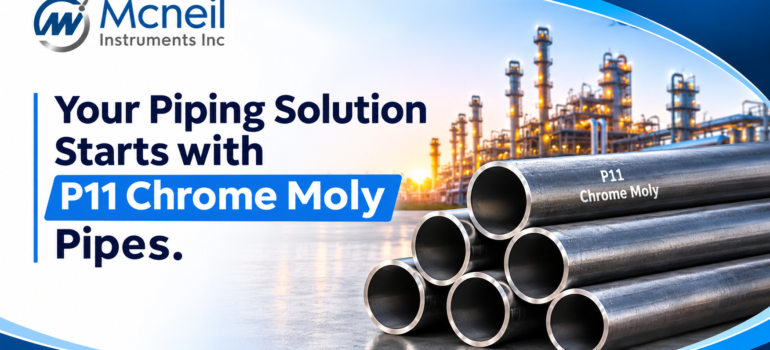
Mcneil Instruments Inc. P11 Chrome Moly alloy steel pipes for high-temperature and high-pressure industrial piping applications.

Your Piping Solution Starts with P11 Chrome Moly Pipes

Introduction

In industries where high temperatures, pressure, and demanding operating conditions are part of everyday operations, selecting the right piping material is essential. P11 chrome moly pipes are widely used in industrial applications that require high-temperature strength, oxidation resistance, and reliable performance.

Manufactured from chromium-molybdenum alloy steel, ASTM A335 P11 pipes are designed for elevated-temperature service. Their chemical composition provides a combination of strength, durability, and resistance to oxidation, making them suitable for critical piping systems.

From power generation plants to oil refineries and petrochemical facilities, P11 chrome moly pipes play an important role in maintaining efficient and dependable industrial operations.
At Mcneil Instrument, we understand the importance of selecting the right piping material for demanding applications. Our range of industrial alloy products supports businesses looking for reliable piping solutions.

What Are P11 Chrome Moly Pipes?

ASTM A335 P11 is a ferritic alloy steel pipe grade designed for high-temperature service.

These pipes contain chromium and molybdenum as their primary alloying elements. Chromium improves oxidation resistance, while molybdenum enhances strength and resistance to creep deformation at elevated temperatures.

P11 pipes are commonly used in applications involving steam, hot gases, and high-temperature fluids.

Their mechanical properties and chemical composition make them suitable for industrial environments where conventional carbon steel may not provide the required performance.

Key Features of ASTM A335 P11 Pipes

  1. Excellent High-Temperature Strength
    P11 chrome moly pipes are designed to maintain their mechanical properties under elevated-temperature conditions.
    Their chromium-molybdenum composition helps improve strength and resistance to deformation during prolonged exposure to heat.
    This makes them suitable for industrial piping systems that operate continuously at high temperatures.
  2. Improved Oxidation Resistance
    The chromium content in P11 pipes helps protect the material against oxidation in high-temperature environments.
    This property is particularly important in steam piping, power generation, and industrial heating applications.
  3. Good Creep Resistance
    Creep is the gradual deformation of a material under constant stress at elevated temperatures.
    P11 pipes offer improved resistance to creep compared with conventional carbon steel, making them suitable for selected high-temperature applications.
  4. Reliable Mechanical Properties
    P11 chrome moly pipes offer a combination of tensile strength, yield strength, and durability.
    These properties help support piping system integrity under demanding operating conditions.
  5. Compatibility with Alloy Steel Fittings
    ASTM A335 P11 pipes are commonly used with compatible alloy steel fittings, including ASTM A234 WP11.
    This compatibility helps maintain material consistency throughout high-temperature piping systems.

Applications of P11 Chrome Moly Pipes

Power Generation Industry
Power generation facilities require piping materials capable of handling elevated temperatures and pressure.
P11 chrome moly pipes are used in applications such as:
Steam distribution systems
Boiler piping
High-temperature feedwater systems
Thermal power plant piping
Industrial heating systems
Their high-temperature properties make them suitable for selected power generation applications.

Oil and Gas Industry
Oil and gas facilities require reliable piping materials for processing and transporting fluids under demanding operating conditions.
P11 pipes are commonly used in:
Refinery piping systems
Hydrocarbon processing units
High-temperature process lines
Steam piping systems
Industrial heating equipment
Their mechanical properties support dependable performance in appropriate high-temperature service conditions.

Petrochemical Industry
Petrochemical plants operate with complex processes involving high temperatures, pressure variations, and demanding fluid conditions.
P11 pipes are used in:
Petrochemical processing units
Heat exchanger piping
Industrial process lines
High-temperature transfer systems
Steam distribution networks
Selecting the right alloy steel grade helps improve piping system reliability and operational efficiency.

ASTM A335 P11 vs. Carbon Steel Pipes

P11 chrome moly pipes and carbon steel pipes are used in industrial piping systems, but their material properties differ.

Feature ASTM A335 P11 Carbon Steel Pipes
Material composition Chromium-molybdenum alloy steel Primarily iron and carbon
High-temperature strength Suitable for elevated-temperature service Depends on grade and operating conditions
Oxidation resistance Improved due to chromium content Generally lower at elevated temperatures
Creep resistance Improved for high-temperature applications Generally lower in comparable conditions
Common applications Power plants, refineries, petrochemical facilities General industrial piping

The choice between these materials depends on operating temperature, pressure, mechanical requirements, and applicable design codes.

How to Select the Right P11 Chrome Moly Pipe

Selecting the appropriate P11 pipe requires careful consideration of several factors.
Operating Temperature: Confirm that the material is suitable for the maximum operating temperature and expected temperature fluctuations.
Pressure Requirements: Select the appropriate pipe dimensions and wall thickness based on the system’s design pressure and applicable piping code.
Chemical Compatibility: Consider the type of fluid or gas being transported and its potential effect on the piping material.
Manufacturing Standards: Verify compliance with ASTM A335 and applicable project specifications.
Inspection and Documentation: Confirm material traceability, chemical composition, mechanical properties, and required inspection records.
These factors help ensure that the selected piping material meets the technical and operational requirements of the project.

Why Choose Mcneil Instrument for P11 Chrome Moly Pipes?

Mcneil Instrument supplies industrial alloy products for demanding applications across the oil and gas, petrochemical, and power generation industries.

When sourcing P11 chrome moly pipes, material quality, dimensional accuracy, and compliance with applicable specifications are important considerations.

Mcneil Instrument supports industrial buyers in identifying suitable alloy steel products based on their project requirements.

Whether you need P11 pipes for a refinery, power plant, or industrial processing facility, selecting the right material is essential for long-term performance.

Conclusion

ASTM A335 P11 chrome moly pipes are an important solution for industrial piping systems operating under elevated temperatures and demanding pressure conditions.

Their chromium-molybdenum composition provides improved high-temperature strength, oxidation resistance, and creep resistance, making them suitable for selected applications in power generation, oil and gas, and petrochemical processing.

Looking for reliable P11 chrome moly pipes for your industrial piping requirements?

Contact Mcneil Instrument today to discuss your specifications, dimensions, and project requirements.

Choose quality alloy steel piping solutions designed to support dependable performance in demanding industrial environments.

Frequently Asked Questions (FAQs)

  1. What are P11 chrome moly pipes?
    P11 chrome moly pipes are chromium-molybdenum alloy steel pipes manufactured according to ASTM A335. They are designed for high-temperature service in industrial piping systems.
  2. What are ASTM A335 P11 pipes used for?
    They are commonly used in power generation plants, oil refineries, petrochemical facilities, boiler piping, and high-temperature steam systems.
  3. What is the chemical composition of P11 pipes?
    ASTM A335 P11 pipes typically contain approximately 1.0–1.5% chromium and 0.44–0.65% molybdenum. Exact composition requirements depend on the applicable specification.
  4. What is the difference between P11 and P22 chrome moly pipes?
    P11 and P22 are both chromium-molybdenum alloy steel grades. P22 generally contains higher chromium and molybdenum levels, providing different high-temperature properties and suitability for specific operating conditions.
  5. Are P11 pipes suitable for high-pressure applications?
    Yes. P11 pipes can be used in high-pressure piping systems when the pipe dimensions, wall thickness, operating temperature, and pressure requirements meet the applicable design code.
  6. Which fittings are compatible with P11 chrome moly pipes?
    ASTM A234 WP11 alloy steel fittings are commonly used with ASTM A335 P11 pipes in compatible high-temperature piping systems.
  7. What industries use P11 chrome moly pipes?
    P11 pipes are commonly used in power generation, oil and gas, petrochemical processing, refineries, and industrial heating applications.
  8. What inspection documents should be checked when purchasing P11 pipes?
    Buyers should verify material test certificates, chemical composition reports, mechanical test results, dimensional inspection records, and heat treatment documentation as required by the project.
Read More
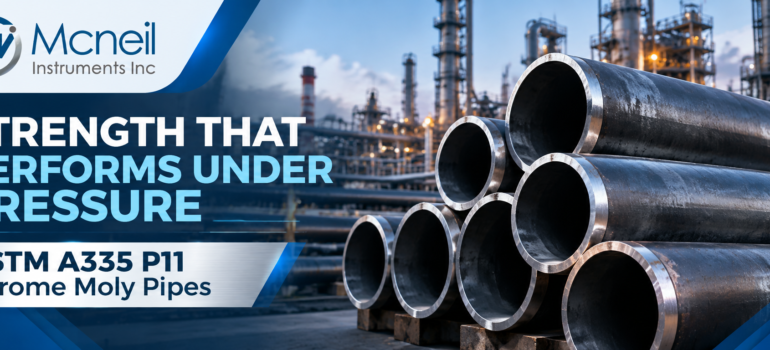
ASTM A335 P11 chrome moly steel pipes by Mcneil Instruments Inc., displayed in front of an industrial refinery.

Strength That Performs Under Pressure: ASTM A335 P11 Chrome Moly Pipes

Introduction

In industries where high temperatures, pressure, and demanding operating conditions are part of everyday operations, choosing the right piping material is essential. Power generation plants, refineries, petrochemical facilities, and industrial processing units require pipes that can maintain strength and reliability even under challenging conditions. This is where ASTM A335 P11 Chrome Moly Pipes play an important role.

Manufactured from chromium-molybdenum alloy steel, ASTM A335 P11 pipes are designed for high-temperature service. Their material composition offers a balance of strength, heat resistance, and durability, making them suitable for demanding piping systems. At Mcneil Instrument, we understand the importance of dependable piping solutions and help industrial buyers source products that meet their project specifications and operational requirements.

What Are ASTM A335 P11 Chrome Moly Pipes?

ASTM A335 P11 is a specification for seamless ferritic alloy-steel pipe intended for high-temperature service. P11 is a chromium-molybdenum grade containing approximately 1.0–1.5% chromium and 0.44–0.65% molybdenum, with the exact composition governed by the applicable ASTM specification.

Chromium contributes to oxidation resistance and high-temperature performance, while molybdenum helps improve strength at elevated temperatures. Together, these alloying elements make P11 pipes suitable for applications where ordinary carbon steel may not provide the required performance.

The final suitability of a P11 pipe depends on operating temperature, pressure, design conditions, heat treatment, and applicable engineering standards. Selecting the correct grade and specification is therefore an important part of any industrial piping project.

Why Choose ASTM A335 P11 Chrome Moly Pipes?

  1. Reliable Performance at Elevated Temperatures
    P11 pipes are used in piping systems that operate at elevated temperatures. Their alloy composition and specified manufacturing requirements help them maintain suitable mechanical properties under demanding service conditions.
  2. Strength for Demanding Applications
    Industrial piping systems must withstand operating pressure, temperature variations, and continuous service demands. ASTM A335 P11 pipes are selected for applications where the specified mechanical properties and design requirements call for chromium-molybdenum alloy steel.
  3. Oxidation Resistance at High Temperatures
    The chromium content of P11 alloy steel helps improve oxidation resistance compared with many conventional carbon steel grades. However, resistance to oxidation and corrosion depends on the operating environment, temperature, and service medium.
  4. Suitable for Power and Process Industries
    P11 pipes are commonly considered for high-temperature piping applications in power plants, refineries, petrochemical facilities, and other industrial installations. The grade must be selected according to the relevant design code and process conditions.
  5. Long-Term Operational Reliability
    Correct material selection, installation, inspection, and maintenance all contribute to piping system reliability. Using an appropriate alloy-steel grade such as ASTM A335 P11 can help support safe and dependable operation when the pipe is designed and installed for its intended service.

Applications of ASTM A335 P11 Pipes

ASTM A335 P11 Chrome Moly Pipes are used across several industries where elevated-temperature performance is an important consideration.

Power Generation Plants: Used in suitable steam and high-temperature piping systems, depending on plant design and operating conditions.
Oil and Gas Refineries: Applied in refinery process lines and other high-temperature services where the specified material grade is appropriate.
Petrochemical Plants: Used in selected process piping systems that require alloy-steel materials for elevated-temperature operation.
Boilers and Heat Exchangers: Considered for associated piping and equipment connections where the engineering design permits ASTM A335 P11.
Industrial Processing Facilities: Used in process installations that require a seamless alloy-steel pipe meeting the relevant material specification.
The exact application should always be confirmed against design pressure, operating temperature, fluid characteristics, and applicable codes.

ASTM A335 P11 Pipe: Key Material Considerations

When purchasing P11 pipes, buyers should evaluate more than the grade designation alone. Pipe dimensions, wall thickness, manufacturing route, heat treatment, inspection requirements, and material traceability are all important.

ASTM A335 covers seamless alloy-steel pipe for high-temperature service. Buyers should confirm the applicable specification edition, pipe size, schedule, dimensional tolerances, and required testing with their engineering or procurement team. Material Test Certificates and other inspection documents should be checked against the purchase order and project requirements.

Welding and fabrication also require attention. The correct welding procedure, filler material, preheating, and post-weld heat treatment requirements, where applicable, should be determined by qualified personnel based on the governing code and service conditions.

Why Source ASTM A335 P11 Pipes from Mcneil Instrument?

At Mcneil Instrument, we recognize that industrial procurement involves more than finding a pipe of the correct size. Buyers need products that match technical specifications, project documentation, and delivery requirements.

We support customers looking for piping solutions for power generation, oil and gas, petrochemical, and other industrial projects. Our team can assist with enquiries for ASTM A335 P11 Chrome Moly Pipes based on required dimensions, quantities, applicable standards, and documentation needs.

Whether you are planning a new installation, managing a maintenance shutdown, or sourcing materials for an ongoing project, clearly defined specifications help ensure the right product is selected. Availability, inspection documentation, and supply conditions should be confirmed at the time of enquiry.

Conclusion

ASTM A335 P11 Chrome Moly Pipes are an important material choice for suitable high-temperature industrial piping systems. Their chromium-molybdenum alloy composition, mechanical properties, and established specification make them relevant to power generation, refinery, and petrochemical applications.

Choosing the right pipe requires careful consideration of operating conditions, dimensions, quality documentation, and applicable engineering standards. Mcneil Instrument is ready to assist with your ASTM A335 P11 pipe enquiries and help you identify a supply solution aligned with your project requirements.

Looking for ASTM A335 P11 Chrome Moly Pipes for your next industrial project?

Connect with Mcneil Instrument for your piping requirements. Share your specifications, required quantities, and project documentation needs with our team to discuss suitable supply options for your high-temperature piping applications.
Contact Mcneil Instrument today to enquire about ASTM A335 P11 Chrome Moly Pipes.

Frequently Asked Questions

  1. What is ASTM A335 P11 pipe?
    ASTM A335 P11 is a seamless ferritic alloy-steel pipe grade intended for high-temperature service. It contains chromium and molybdenum to support the required material properties.
  2. What is the chemical composition of ASTM A335 P11?
    P11 typically contains approximately 1.0–1.5% chromium and 0.44–0.65% molybdenum. All chemical composition limits should be verified against the applicable ASTM A335 specification and material certificate.
  3. Are ASTM A335 P11 pipes seamless?
    Yes. ASTM A335 specifies seamless ferritic alloy-steel pipes for high-temperature service.
  4. Where are P11 Chrome Moly Pipes used?
    They are used in suitable high-temperature piping applications across power generation, refineries, petrochemical plants, and industrial processing facilities.
  5. What is the difference between P11 and P22 pipes?
    Both are chromium-molybdenum alloy-steel grades, but their chemical compositions and specified properties differ. P22 generally contains higher chromium and molybdenum levels than P11. The appropriate grade depends on design conditions, applicable codes, and project specifications.
  6. What information is needed to order ASTM A335 P11 pipes?
    Buyers should provide the required outside diameter, wall thickness or schedule, length, quantity, specification edition, inspection requirements, and material certification needs.
  7. What documents should accompany P11 pipes?
    Depending on the purchase order and project requirements, documentation may include Material Test Certificates, heat-number traceability, dimensional inspection reports, and applicable non-destructive or other test records.
  8. Can ASTM A335 P11 pipes be welded?
    Yes, but welding must follow an approved procedure appropriate to the material, thickness, and service conditions. Preheating and post-weld heat treatment may be required by the applicable code or project specification.
  9. How do I select the correct P11 pipe thickness?
    Wall thickness should be determined by the project engineer based on design pressure, temperature, allowable stress, corrosion allowance where applicable, mechanical loads, and the governing design code.
  10. How can I enquire about ASTM A335 P11 Chrome Moly Pipes from Mcneil Instrument?
    Contact Mcneil Instrument with your required dimensions, quantity, technical specification, delivery location, and documentation requirements so the team can review your enquiry and confirm available supply options.
Read More