Industrial metal pipes and piping components illustrating pressure ratings for flanges and piping systems

Understanding Pressure Ratings in Industrial Flanges and Piping Components

Pressure rating is one of the most important parameters when selecting industrial flanges, pipe fittings, valves, and other pressure-containing piping components. A component may appear mechanically suitable based on its size and material, but that does not automatically mean it is suitable for a particular pressure and temperature combination.
In industrial piping systems, pressure capability is influenced by several factors, including material grade, operating temperature, flange class, component design, wall thickness, connection type, gasket selection, bolting, and applicable standards.
Understanding these factors helps engineers, procurement teams, plant operators, and maintenance professionals select components that are appropriate for the intended service.
For flanges and flanged fittings, ASME B16.5 establishes pressure-temperature ratings, materials, dimensions, tolerances, marking, testing, and related requirements for NPS 1/2 through NPS 24. The standard includes Class 150, 300, 400, 600, 900, 1500 and 2500 designations, with Class 2500 covered through NPS 12.

What Is a Pressure Rating?

A pressure rating indicates the pressure capability assigned to a piping component under specified conditions.
However, pressure rating should not be interpreted as a single universal pressure value.
The allowable pressure of a component can depend on:
Material group
Operating temperature
Pressure class
Component design
Size
Wall thickness
Applicable standard
Connection configuration
Gasket and bolting arrangement
Service conditions
This is why a flange marked Class 300 should not simply be interpreted as having a maximum allowable pressure of 300 psi.
The number represents a pressure class designation, not a universal pressure limit.
Actual allowable pressure must be determined from the applicable pressure-temperature rating tables and the specific material and service conditions.

Understanding Flange Pressure Classes

Industrial flanges are commonly identified using pressure classes such as:
Class 150
Class 300
Class 400
Class 600
Class 900
Class 1500
Class 2500
ASME B16.5 specifies these classes for covered flange sizes and materials.
Generally, higher pressure classes provide greater pressure capability under comparable conditions, but the actual allowable pressure depends on temperature and material.
Basic Pressure Class Comparison
Flange Class General Application Positioning
Class 150 Lower-pressure industrial services
Class 300 Moderate-pressure process systems
Class 400 Higher-pressure applications
Class 600 High-pressure process and energy systems
Class 900 High-pressure services
Class 1500 Very high-pressure applications
Class 2500 Extremely demanding pressure service
This table is a general classification guide, not a pressure-rating table. The allowable pressure must always be verified against the applicable standard and material at the actual operating temperature.

Why Temperature Changes Pressure Rating

One of the most important concepts in flange selection is that pressure capability is temperature-dependent.
As operating temperature increases, material strength can decrease. Consequently, a flange or fitting that can withstand a particular pressure at ambient temperature may have a lower allowable pressure at elevated temperature.
For this reason, pressure-temperature rating tables are essential when selecting components for:
Steam systems
Power plants
Refineries
Petrochemical plants
High-temperature process lines
Heat-transfer systems
Chemical processing
Boiler systems
ASME B16.5 specifically incorporates pressure-temperature ratings into its requirements.
Example
Consider a piping system operating at elevated temperature.
Selecting a flange solely because its nominal pressure class appears to exceed the system pressure could be misleading. The engineer must check the applicable rating at the actual operating temperature and for the specific flange material.
This distinction becomes particularly important in high-temperature alloy steel and stainless-steel applications.

Material Has a Major Effect on Pressure Rating

Two flanges with the same nominal pressure class can have different allowable pressures depending on their material.
Common industrial flange materials include:
Carbon steel
Stainless steel
Alloy steel
Duplex stainless steel
Super duplex stainless steel
Nickel alloys
Monel
Inconel
Hastelloy
Copper alloys
Material selection depends not only on pressure but also on:
Temperature
Corrosion resistance
Mechanical strength
Fluid compatibility
Chloride exposure
Sulfur-containing environments
Seawater exposure
Chemical compatibility
Welding requirements
Therefore, selecting a flange based only on its pressure class is incomplete.

Pressure Rating vs Design Pressure

Another important distinction is between component pressure rating and system design pressure.
Design Pressure
Design pressure is the pressure used by the engineering design process to establish the required strength and pressure containment capability of the piping system.
Component Pressure Rating
The component rating describes the allowable pressure capability of the specific component under defined conditions.
For a reliable system:
Component rating should be appropriate for the system’s design pressure and operating temperature.
The engineering design must also account for applicable piping codes, loads, thermal expansion, hydrostatic testing, external forces, and other service conditions.

Pressure Rating of Piping Components

Pressure ratings are not limited to flanges.
Other pressure-containing components include:
Pipe
Elbows
Tees
Reducers
Crosses
Couplings
Caps
Valves
Strainers
Filters
Flanged fittings
Branch connections
Line blanks
Instrumentation components
Each component may have its own applicable standard and rating methodology.
The complete piping system must therefore be evaluated rather than selecting every component independently.

How Pipe Wall Thickness Affects Pressure Capability

For piping components, wall thickness is an important factor in pressure containment.
Pipe dimensions may be specified using schedules such as:
SCH 10
SCH 20
SCH 40
SCH 80
SCH 120
SCH 160
XXS
In general, increasing wall thickness can increase the pressure capability of a pipe, subject to the applicable design code and material properties.
However, pipe schedule should not be treated as a universal pressure rating.
The allowable pressure depends on factors including:
Outside diameter
Wall thickness
Material allowable stress
Design temperature
Corrosion allowance
Manufacturing tolerance
Applicable piping code
Joint efficiency where relevant

Flange Rating and Pipe Schedule Are Not the Same

This distinction is particularly important during procurement.
A flange might be specified as:
ASME B16.5 Class 600
while the connecting pipe might be:
ASTM A106 Grade B, SCH 80
These two designations describe different characteristics.
The flange class identifies the flange pressure class, while the pipe schedule describes its wall thickness designation.
The pipe, flange, fitting, valve, gasket, and bolting must all be suitable for the system’s design conditions.

The Role of Gaskets in Flanged Connections

A flange does not create a leak-tight connection by itself.
A typical flanged joint consists of:
Flanges
Gasket
Bolting
Pipe or equipment connection
The gasket provides the sealing interface between the flange faces.
Gasket selection must consider:
Pressure
Temperature
Fluid
Flange facing
Chemical compatibility
Installation requirements
Applicable standards
Common gasket types include:
Spiral wound gaskets
Ring-type joint gaskets
Metal-jacketed gaskets
Graphite gaskets
PTFE gaskets
Non-metallic sheet gaskets
The gasket must be compatible with the flange facing and service conditions.

The Importance of Flange Facing

Flange facing influences how the gasket seals.
Common configurations include:
Raised Face (RF)
Flat Face (FF)
Ring Type Joint (RTJ)
Male and Female
Tongue and Groove
The selected gasket must correspond to the flange facing and service requirements.
For high-pressure applications, RTJ connections may be used where the applicable design and service requirements call for a metallic ring-type seal.

Bolting Also Affects Flanged Joint Integrity

A flange connection depends on appropriate bolt preload to maintain gasket compression and joint integrity.
Important factors include:
Bolt material
Bolt diameter
Bolt quantity
Bolt grade
Tightening sequence
Torque
Lubrication
Operating temperature
Thermal expansion
Incorrect bolt selection or tightening can result in:
Gasket leakage
Flange distortion
Uneven gasket compression
Bolt overstress
Joint loosening
ASME’s guidance on bolted flange joints highlights the interaction between flange design, bolts and gaskets in achieving a leak-tight connection.

Why Flange Size Matters

Pressure capability is also influenced by component size.
ASME B16.5 covers flanges and flanged fittings from NPS 1/2 through NPS 24. For larger steel flanges, ASME B16.47 covers NPS 26 through NPS 60 and includes Classes 75, 150, 300, 400, 600 and 900.
This means engineers working with large-diameter piping should verify which flange standard applies before selecting the component.

ASME B16.5 and ASME B16.47

Two important standards for industrial steel flanges are ASME B16.5 and ASME B16.47.
ASME B16.5
ASME B16.5 covers:
Pipe flanges
Flanged fittings
Pressure-temperature ratings
Materials
Dimensions
Tolerances
Marking
Testing
It applies to the specified NPS range through NPS 24.
ASME B16.47
ASME B16.47 covers:
Large-diameter steel flanges
NPS 26 through NPS 60
Pressure-temperature ratings
Materials
Dimensions
Tolerances
Marking
Testing
Its listed pressure classes include 75, 150, 300, 400, 600 and 900.
Choosing the correct standard is therefore an important first step in flange specification.

Pressure Rating of Valves

Valves are another major pressure-containing component in an industrial piping system.
Common valve pressure classes include:
Class 150
Class 300
Class 600
Class 900
Class 1500
Class 2500
Valve selection should consider:
Pressure
Temperature
Fluid
Valve material
Valve type
End connection
Flow requirements
Shutoff requirements
For example, a ball valve, gate valve, globe valve and check valve may have different design characteristics even when supplied with the same nominal pressure class.

Pressure Rating of Butt-Weld Fittings

Butt-weld fittings such as elbows, tees and reducers do not always use the same Class designation system as flanges.
Their pressure capability depends on factors including:
Material
Wall thickness
Fitting geometry
Pipe dimensions
Manufacturing standard
Design temperature
Piping code
Common standards used for industrial fittings include:
ASME B16.9
ASME B16.11
MSS standards
ASTM material specifications
The fitting must be selected to match the pipe dimensions and the pressure design of the system.

Forged Fittings and Pressure Ratings

Forged fittings such as socket-weld and threaded fittings are commonly used in high-pressure and high-temperature services.
Their specifications can include:
Pressure class
Material grade
Size
End connection
Temperature range
Applicable ASTM/ASME standard
Common applications include:
Instrumentation
Process piping
Hydraulic systems
Oil & gas
Chemical processing
Power generation
Material and class selection should always be verified against the applicable component standard and project specification.

How to Select the Correct Pressure Class

A practical selection process can follow these steps.
Step 1: Determine Design Pressure
Identify:
Normal operating pressure
Maximum operating pressure
Design pressure
Potential pressure surges
Step 2: Determine Design Temperature
Identify:
Normal temperature
Maximum temperature
Minimum temperature
Thermal cycling
Step 3: Select the Material
Consider:
Mechanical strength
Corrosion resistance
Fluid compatibility
Temperature capability
Environmental conditions
Step 4: Identify the Applicable Standard
Depending on the component, this may include:
ASME B16.5
ASME B16.47
ASME B16.9
ASME B16.11
ASME B16.36
Applicable ASTM material specification
Applicable ASME piping code
ASME’s B16 committee covers standards relating to valves, flanges, fittings, gaskets and related components used in pressure services.
Step 5: Check the Pressure-Temperature Rating
Do not select the component based only on its Class designation.
Check the allowable pressure at the actual design temperature and for the applicable material.
Step 6: Check Connections
Confirm:
Flange facing
Nominal size
Bolt pattern
Bore
Pipe schedule
End connection
Gasket type
Step 7: Verify Documentation
For critical applications, documentation may include:
Material Test Certificate
Dimensional inspection report
Chemical analysis
Mechanical test results
PMI report
Hydrostatic test report
NDT documentation
Third-party inspection documentation

Common Mistakes When Selecting Pressure-Rated Components

Mistake 1: Treating Class 300 as 300 psi
The Class designation is not a universal pressure value.
Mistake 2: Ignoring Temperature
Allowable pressure can change with operating temperature.
Mistake 3: Selecting Material Based Only on Pressure
Corrosion and fluid compatibility can be equally important.
Mistake 4: Mixing Incompatible Components
The flange, pipe, gasket, bolts and fittings must be compatible as a complete assembly.
Mistake 5: Ignoring Pipe Schedule
A high-class flange does not automatically make a thin-wall pipe suitable for the same pressure.
Mistake 6: Using the Wrong Flange Standard
Large-diameter applications may fall under ASME B16.47 rather than B16.5.
Mistake 7: Ignoring Flange Facing
RF, FF and RTJ connections require appropriate gasket and mating arrangements.
Mistake 8: Using Generic Pressure Tables
Pressure-temperature ratings are material- and standard-specific. Always use the applicable engineering standard.

Pressure Rating Selection Checklist

Before ordering an industrial flange or piping component, verify the following:
Parameter Check
Component Flange, fitting, valve, pipe, etc.
Nominal size NPS/DN
Pressure class 150/300/600/etc.
Design pressure Confirm maximum requirement
Design temperature Confirm maximum/minimum
Material Confirm exact grade
Standard ASME/ASTM/MSS/API as applicable
Flange facing RF/FF/RTJ/etc.
Pipe schedule Match connected pipe
Gasket Compatible with service and facing
Bolting Correct material and dimensions
Fluid Verify chemical compatibility
Testing Confirm project requirements
Documentation MTC and inspection records

Why Correct Pressure Rating Matters

Incorrect pressure selection can have serious consequences for industrial piping systems.
Potential problems include:
Leakage
Flange deformation
Gasket failure
Bolt failure
Pipe rupture
Unplanned shutdown
Equipment damage
Process contamination
Safety incidents
Pressure-rated components should therefore be selected as part of the overall piping design rather than as isolated products.

Mcneil Instruments for Industrial Flanges and Piping Components

Mcneil Instruments supplies industrial piping products for applications across sectors such as:
Oil & gas
Petrochemical
Chemical processing
Power generation
Refineries
Marine
Offshore
Water treatment
Industrial manufacturing
Its product portfolio includes industrial flanges, pipe fittings, instrumentation fittings, valves and related piping components in materials such as carbon steel, stainless steel, alloy steel and nickel alloys.
For demanding piping applications, component selection can be supported by specifying the required material grade, pressure class, dimensions, applicable standard, connection type, temperature range and testing requirements.
This approach helps ensure that the selected component is aligned with the actual operating conditions rather than relying on nominal pressure class alone.

Frequently Asked Questions

What does Class 150, Class 300 or Class 600 mean on a flange?
These are pressure class designations used by applicable flange standards. They should not be interpreted as direct pressure values in psi. The actual allowable pressure depends on factors such as material and temperature.
Does a higher flange class always mean a higher allowable pressure?
Not necessarily under every operating condition. Allowable pressure depends on the applicable pressure-temperature rating, material and standard.
Why does temperature affect flange pressure rating?
Increasing temperature can reduce material strength and therefore affect the allowable pressure of the component.
What is the difference between ASME B16.5 and B16.47?
ASME B16.5 covers pipe flanges and flanged fittings through NPS 24, while ASME B16.47 covers large-diameter steel flanges from NPS 26 through NPS 60.
Can a Class 600 flange be connected to a Class 300 flange?
Such a connection should not be treated as automatically acceptable simply because the bolt holes or dimensions appear compatible. The complete joint must be evaluated according to the applicable engineering design, standards, flange dimensions, gasket and bolting requirements.
Does pipe schedule determine the flange pressure class?
No. Pipe schedule identifies the pipe wall thickness designation, while flange class identifies the flange pressure class. Both components must be evaluated for the system’s design conditions.
What information should be provided when ordering a pressure-rated flange?
At minimum, provide the required nominal size, pressure class, material grade, flange standard, facing, bore or pipe schedule, service conditions and any applicable testing or certification requirements.

Conclusion

Understanding pressure ratings is essential for selecting industrial flanges and piping components for safe and reliable service. Pressure class is only one part of the selection process. The actual allowable pressure must be evaluated together with material, operating temperature, component size, applicable standards, pipe schedule, gasket, bolting and service conditions.
ASME B16.5 establishes pressure-temperature ratings and related requirements for covered pipe flanges and flanged fittings, while ASME B16.47 addresses large-diameter steel flanges.
For engineers and procurement teams, the safest approach is to begin with the system’s design pressure and temperature, identify the applicable standard, select the appropriate material and then verify the pressure-temperature rating of the complete piping component.
When correctly specified and installed, properly rated flanges, fittings, valves and piping components can provide the mechanical integrity required for demanding industrial pressure systems.

Read More

How to Select the Right Flange Material for High-Temperature and Corrosive Environments

Introduction

Industrial piping systems are only as reliable as the components that connect them. Among these components, flanges play a critical role by providing secure, leak-proof joints between pipes, valves, pumps, pressure vessels, and other equipment. However, selecting the wrong flange material for harsh operating conditions can lead to corrosion, mechanical failure, costly downtime, and safety risks.

Industries such as oil & gas, petrochemicals, power generation, offshore engineering, LNG processing, marine applications, and chemical manufacturing operate in environments where extreme temperatures, aggressive chemicals, and high-pressure conditions are common. In these applications, choosing the correct flange material is just as important as selecting the right pipe or valve.

At Mcneil Instrument, we manufacture and supply a comprehensive range of industrial flanges in stainless steel, alloy steel, duplex steel, super duplex steel, carbon steel, and nickel alloys, helping industries worldwide achieve reliable and long-lasting piping systems. Mcneil Instrument supplies industrial flanges in a wide variety of materials and configurations that comply with international standards for demanding industrial applications.

Why Flange Material Selection Matters

A flange must perform reliably throughout the life of the piping system.

Selecting an unsuitable material can result in:

• Corrosion damage

• Leakage

• Bolt failure

• Thermal fatigue

• Pressure loss

• Frequent shutdowns

• Increased maintenance costs

Choosing the correct material ensures:

• Long service life

• Leak-free performance

• Improved plant safety

• Reduced maintenance

• Better operational efficiency

• Lower lifecycle costs

Key Factors to Consider Before Selecting a Flange Material

1. Operating Temperature

Temperature is one of the most important factors.

Industrial applications may involve:

• Steam systems

• Boilers

• Furnaces

• Heat exchangers

• Thermal power plants

• Petrochemical reactors

For elevated temperatures, alloy steels and nickel alloys generally provide significantly better strength retention than standard carbon steels.

2. Corrosive Environment

Determine what media the flange will encounter.

Examples include:

• Seawater

• Chlorides

• Sulfuric acid

• Nitric acid

• Hydrogen

• LNG

• Saltwater

• Process chemicals

Corrosion resistance should always match the process fluid.

3. Operating Pressure

Pressure ratings influence both flange design and material selection.

Higher operating pressures require materials capable of maintaining strength without deformation.

4. Mechanical Loading

Consider:

• Vibration

• Thermal cycling

• Pipeline expansion

• External loading

Materials with higher fatigue strength perform better under cyclic loading.

5. Industry Standards

Always select flanges manufactured according to internationally recognized standards such as:

• ASTM

• ASME

• ANSI

• API

• DIN

• EN

These standards help ensure compatibility, dimensional accuracy, and reliable performance.

Choosing the Right Flange Material

Stainless Steel Flanges

Best For

• Food Processing

• Pharmaceutical Plants

• Water Treatment

• General Chemical Processing

• Process Industries

Popular Grades

• Stainless Steel 304 Flanges

• Stainless Steel 304L Flanges

• Stainless Steel 316 Flanges

• Stainless Steel 316L Flanges

• Stainless Steel 321 Flanges

• Stainless Steel 347 Flanges

Advantages

• Excellent corrosion resistance

• Good weldability

• Long service life

• Attractive finish

Stainless steel is an excellent choice for applications where corrosion resistance is required without exposure to extremely aggressive chemicals.

Carbon Steel Flanges

Best For

• Utility Pipelines

• Water Distribution

• Structural Applications

• Low to Medium Temperature Systems

Benefits

• High strength

• Cost-effective

• Easy fabrication

Carbon steel flanges are widely used where corrosion exposure is limited and economic considerations are important.

Alloy Steel Flanges

Recommended For

• Power Plants

• Refineries

• Steam Systems

• Boilers

• Petrochemical Facilities

Common Grades

• ASTM A182 F5 Flanges

• ASTM A182 F9 Flanges

• ASTM A182 F11 Flanges

• ASTM A182 F22 Flanges

• ASTM A182 F91 Flanges

Advantages

• Excellent high-temperature strength

• Outstanding creep resistance

• Superior oxidation resistance

• Long-term thermal stability

Chrome Moly Alloy Steel Flanges are specifically developed for elevated temperature and high-pressure applications.

Duplex Stainless Steel Flanges

Ideal For

• Offshore Platforms

• Marine Engineering

• Desalination Plants

• Oil & Gas Pipelines

Popular Grades

• Duplex 2205 Flanges

• ASTM A182 F51 Flanges

Benefits

• High mechanical strength

• Excellent chloride resistance

• Superior stress corrosion resistance

Super Duplex Stainless Steel Flanges

Recommended For

• Offshore Oil Production

• Seawater Systems

• Chemical Processing

• Marine Installations

Available Grades

• Super Duplex S32750 Flanges

• Super Duplex S32760 Flanges

• Super Duplex 2507 Flanges

Advantages

• Outstanding seawater resistance

• Exceptional pitting resistance

• Excellent fatigue strength

Inconel Flanges

Best Applications

• Gas Turbines

• LNG Facilities

• Aerospace

• Petrochemical Plants

Available Grades

• Inconel 600 Flanges

• Inconel 625 Flanges

• Inconel 718 Flanges

• Inconel 800 Flanges

• Inconel 800H Flanges

Benefits

• Excellent oxidation resistance

• High-temperature stability

• Superior corrosion protection

Monel Flanges

Recommended For

• Marine Industry

• Offshore Platforms

• Desalination Plants

Popular Grades

• Monel 400 Flanges

• Monel K500 Flanges

Advantages

• Outstanding seawater resistance

• Excellent corrosion resistance

• Long operational life

Hastelloy Flanges

Best For

• Acid Processing

• Chemical Manufacturing

• Fertilizer Plants

Available Grades

• Hastelloy C276 Flanges

• Hastelloy C22 Flanges

• Hastelloy B2 Flanges

• Hastelloy B3 Flanges

• Hastelloy X Flanges

Benefits

• Exceptional chemical resistance

• Superior corrosion protection

• Outstanding durability

Titanium Flanges

Recommended For

• Aerospace

• Offshore Engineering

• Desalination

• Marine Systems

Popular Grades

• Titanium Grade 1 Flanges

• Titanium Grade 2 Flanges

• Titanium Grade 5 Flanges

Advantages

• Lightweight

• Outstanding corrosion resistance

• Excellent strength-to-weight ratio

Match the Material to the Environment

Operating EnvironmentRecommended Flange Material
High Temperature SteamASTM A182 F11, F22, F91 Alloy Steel
Offshore & SeawaterDuplex, Super Duplex, Monel
Chemical ProcessingHastelloy, Titanium
LNG PlantsInconel, Stainless Steel 316L
PharmaceuticalStainless Steel 316L
Food ProcessingStainless Steel 304/316
Marine ApplicationsMonel, Duplex, Titanium
Power GenerationAlloy Steel F11, F22, F91

Choosing the Right Flange Type

Material selection should also complement the flange design.

Mcneil Instrument manufactures:

• Weld Neck Flanges

• Slip-On Flanges

• Blind Flanges

• Socket Weld Flanges

• Threaded Flanges

• Lap Joint Flanges

• Ring Type Joint (RTJ) Flanges

Different flange types are selected based on pressure, maintenance requirements, and piping configuration. Mcneil Instrument supplies a complete range of industrial flange types for oil & gas, petrochemical, power, and process industries.

Industries That Require Specialized Flange Materials

Mcneil Instrument supplies industrial flanges to:

Oil & Gas

• Refineries

• Pipelines

• Offshore Platforms

Petrochemical

• Process Plants

• Chemical Reactors

Power Generation

• Boilers

• Turbines

• Steam Pipelines

Marine Industry

• Shipbuilding

• Offshore Installations

LNG Industry

• Cryogenic Systems

• Gas Processing

Chemical Industry

• Acid Processing

• Corrosive Fluid Handling

Why Choose Mcneil Instrument?

Mcneil Instrument is a trusted manufacturer, supplier, exporter, distributor, and wholesaler of industrial flanges serving global industries.

Our strengths include:

• Extensive material options

• International manufacturing standards

• Precision machining

• Strict quality inspections

• Ready stock for project requirements

• Worldwide exports

• Technical support for material selection

The company supplies flanges in stainless steel, carbon steel, alloy steel, duplex, super duplex, and nickel alloys for customers across global industrial markets.

Quality Assurance

Every flange undergoes comprehensive testing including:

• PMI Testing

• Hydrostatic Testing

• Mechanical Testing

• Dimensional Inspection

• Material Traceability

• Visual Inspection

• Third-Party Inspection

These inspections help ensure compliance with international standards and reliable field performance.

Conclusion

Selecting the correct flange material is essential for ensuring safety, durability, and operational efficiency in industrial piping systems. Factors such as operating temperature, pressure, corrosion exposure, and mechanical loading should always be evaluated before making a material selection.

Whether your project requires Stainless Steel Flanges, Carbon Steel Flanges, ASTM A182 F5 Flanges, ASTM A182 F11 Flanges, ASTM A182 F22 Flanges, ASTM A182 F91 Flanges, Duplex Steel Flanges, Super Duplex Flanges, Inconel Flanges, Monel Flanges, Hastelloy Flanges, or Titanium Flanges, Mcneil Instrument delivers precision-engineered flange solutions designed for the world’s most demanding industrial applications.

Read More

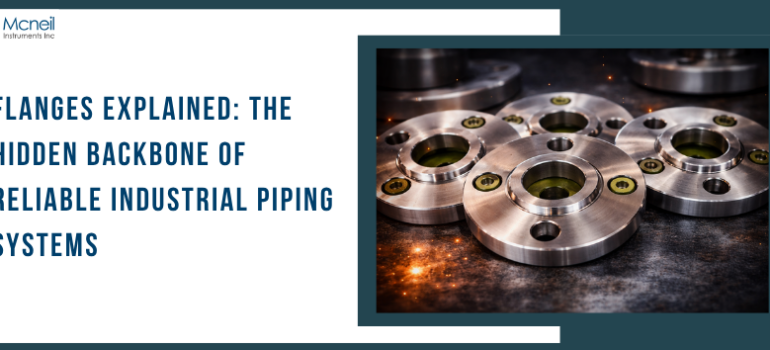
Flanges Explained: The Hidden Backbone of Reliable Industrial Piping Systems

Introduction: The Connection That Holds Everything Together

Here’s what most people overlook—pipes don’t fail as often as connections do. A poorly designed joint can cause leaks, pressure drops, and system failure.

That’s why flanges are so critical. They create strong, detachable, and leak-proof connections between pipes and equipment, making maintenance easier and systems more reliable.

Across industries, flanges are the silent components that keep everything running smoothly.

What Are Flanges?

Flanges are mechanical components used to connect pipes, valves, pumps, and other equipment in a piping system.

They are typically bolted together with a gasket in between to create a tight seal.

What They Do

• Connect pipeline components securely
• Allow easy disassembly for maintenance
• Ensure leak-proof sealing
• Maintain alignment of piping systems

Types of Flanges

Different applications require different flange designs.

Weld Neck Flanges

• Strongest type
• Used in high-pressure systems

Slip-On Flanges

• Easy to install
• Cost-effective for low-pressure use

Blind Flanges

• Seal pipeline ends
• Used for inspection and testing

Socket Weld Flanges

• Ideal for small pipes with high pressure

Threaded Flanges

• No welding required
• Used in low-pressure systems

Each type is designed to handle specific operational conditions.

Materials Used in Flanges

Flanges are available in different materials depending on usage.

Common Materials

MaterialApplication
Stainless SteelCorrosion-resistant environments
Carbon SteelGeneral industrial use
Alloy SteelHigh temperature and pressure
Duplex SteelMarine and offshore use
Nickel AlloysExtreme corrosion conditions

Choosing the right material ensures long-term performance.

Technical Specifications

SpecificationDetails
StandardsASME B16.5 / B16.47
Size Range½″ to 48″
Pressure Class150# to 2500#
Face TypesRF, FF, RTJ
ManufacturingForged / Machined

These standards ensure compatibility across global piping systems.

Key Advantages of Flanges

Strong Leak-Proof Joints

Ensures safety in high-pressure systems.

Easy Maintenance

Can be dismantled quickly for inspection.

Versatility

Available in various sizes and materials.

High Strength

Handles pressure and temperature variations.

Long Service Life

Reliable for long-term industrial use.

Industrial Applications

Flanges are used in almost every major industry:

Oil & Gas

Pipeline and refinery systems

Petrochemical Plants

Handling chemicals and fluids

Power Generation

Boilers and turbines

Water Treatment

Distribution and filtration systems

Construction & Infrastructure

HVAC and plumbing systems

How Flanges Work

A typical flanged joint includes:

• Two flanges
• A gasket
• Bolts and nuts

When tightened, they form a secure, leak-proof seal that can be opened when needed.

Quality Testing

Flanges go through strict quality checks:

• Mechanical strength testing
• Pressure testing
• Ultrasonic inspection
• Dimensional verification
• Material testing

These tests ensure safety and reliability.

Conclusion

Flanges may look simple, but they are one of the most critical components in any piping system. They provide strength, flexibility, and ease of maintenance.

Without them, modern industrial systems simply wouldn’t function efficiently.

Read More

How Mcneil’s Industrial Flanges Support the Energy, Petrochemical & Construction Sectors

Introduction: The Hidden Strength Behind Every Connection

In every industrial piping network — whether in an oil refinery, power plant, or chemical processing unit — the smallest components often play the biggest roles. One such indispensable element is the industrial flange, a mechanical connector that ensures tight, secure, and leak-proof joints between pipes, valves, and equipment.

At Mcneil Instruments, we understand that reliability begins with precision. As one of the leading flange manufacturers, suppliers, and exporters in India, we specialize in designing and producing flanges that meet global standards like ASTM, ASME, ANSI, DIN, and JIS. Our products are engineered to perform under extreme conditions of temperature, pressure, and corrosion — ensuring long-term performance and safety across diverse industries.

This blog explores the types, materials, specifications, and applications of industrial flanges, while highlighting how Mcneil Instruments continues to set the benchmark for quality and trust worldwide.

What Are Industrial Flanges?

A flange is a mechanical part used to connect two sections of a piping system. It provides a secure method for assembling and disassembling pipes, valves, pumps, and other equipment without welding. Flanges are joined by bolts and sealed with gaskets to prevent fluid or gas leakage — making them essential in high-pressure and high-temperature systems.

The versatility of flanges lies in their wide material availability, pressure ratings, and dimensional standards, making them suitable for everything from small utility pipelines to large petrochemical installations.

Types of Flanges Manufactured by Mcneil Instruments

Each type of flange serves a unique purpose, ensuring flexibility in design and functionality. Mcneil Instruments offers a complete range of industrial flanges in various materials and configurations:

Flange TypeDescription & Applications
Weld Neck FlangeIdeal for high-pressure, high-temperature systems. Its long tapered hub provides stress distribution between pipe and flange.
Slip-On FlangeEasy to install and align, commonly used in low-pressure applications. Cost-effective and widely used in general industries.
Blind FlangeUsed to close the ends of piping systems or pressure vessel openings. Perfect for testing or maintenance operations.
Socket Weld FlangeDesigned for small-bore, high-pressure lines. Offers excellent fatigue resistance and leak-proof sealing.
Threaded FlangeConnected without welding, making it ideal for systems where welding is impractical, such as explosive environments.
Lap Joint FlangeUsed with stub ends in systems that require frequent dismantling for inspection or cleaning.
Orifice FlangeUsed for flow measurement and pressure drop calculations in pipelines.
Reducing FlangeEnables the connection of pipes with different diameters. Useful in flow distribution systems.

Materials Used in Manufacturing Flanges

At Mcneil Instruments, our flanges are available in a wide range of materials to meet the diverse needs of industries:

  • Carbon Steel Flanges – Known for durability and cost-effectiveness; suitable for moderate temperature and pressure applications.
  • Stainless Steel Flanges – Offer excellent resistance to corrosion and oxidation; ideal for food, chemical, and pharmaceutical sectors.
  • Alloy Steel Flanges – Designed for high-temperature, high-pressure, and corrosive conditions such as refineries and power plants.
  • Duplex & Super Duplex Flanges – Combine high strength with exceptional corrosion resistance, commonly used in marine and offshore systems.
  • Nickel Alloy, Inconel, and Monel Flanges – Preferred for extreme environments like chemical processing and seawater systems.
  • Copper-Nickel Flanges – Deliver superior resistance to seawater corrosion, used in desalination and marine pipelines.

Technical Specifications of Industrial Flanges

SpecificationDetails
Standards ComplianceASTM, ASME, ANSI, DIN, JIS, BS, EN
Pressure RatingClass 150 to 2500, PN 6 to PN 400
Size Range½” to 48” NB
Connection TypeWelded, Threaded, Bolted
Manufacturing ProcessForged, Machined, Heat Treated
Material GradesASTM A105, A182 F304/F316, F5/F9/F11/F22/F91, ASTM A350 LF2
Surface FinishRust Preventive Oil Coating / Galvanized / Polished

Mechanical Properties of Mcneil Flanges

PropertyValue (Typical for ASTM A105)
Tensile Strength≥ 485 MPa
Yield Strength≥ 250 MPa
Elongation≥ 20%
Hardness≤ 187 HB
Temperature Range-20°C to +600°C
Corrosion ResistanceHigh (varies by material)

Key Advantages of Industrial Flanges

  • Leak-proof Connections: Designed for precision sealing under high pressure.
  • Easy Assembly and Maintenance: Allows dismantling without disturbing other components.
  • Versatility in Materials and Design: Compatible with different pipe materials and applications.
  • High Pressure and Temperature Endurance: Suitable for critical service conditions.
  • Customizable Options: Available in bespoke sizes, coatings, and materials per client specifications.

Applications Across Major Industries

Industrial flanges are the cornerstone of fluid transport systems across several sectors:

  • Oil & Gas: For pipelines, refineries, and offshore rigs.
  • Power Generation: In boilers, turbines, and high-temperature steam lines.
  • Petrochemical & Chemical Plants: For handling corrosive fluids.
  • Marine & Shipbuilding: In seawater systems and desalination plants.
  • Pharmaceuticals & Food Industry: Where hygiene and corrosion resistance are vital.
  • Water Treatment Plants: For pressure control and fluid distribution.

Quality Control and Testing at Mcneil Instruments

Every flange manufactured undergoes stringent quality checks to ensure dimensional accuracy and structural integrity.

Testing Methods Include:

  • Hydrostatic and Pneumatic Pressure Testing
  • Ultrasonic and Radiographic Testing
  • PMI (Positive Material Identification)
  • Dimensional Accuracy Verification
  • Visual & Surface Inspections

Certifications:

  • ISO 9001:2015 Certified Facilities
  • Material Test Certificates (EN 10204 3.1/3.2)
  • ASTM / ASME / ANSI Compliance
  • Third-Party Inspection (TPI) Approval on Request

Global Reach of Mcneil Instruments

Mcneil Instruments is one of India’s most recognized industrial flange exporters, serving clients in over 40 countries worldwide.

Export Destinations Include:

  • Middle East: Saudi Arabia, UAE, Qatar, Kuwait
  • Africa: Nigeria, Egypt, Ghana, Kenya
  • Asia-Pacific: Malaysia, Singapore, Indonesia, Thailand
  • Europe & North America: USA, UK, Germany, Canada

Our global reputation is built on precision engineering, timely delivery, and adherence to international standards, making us a trusted partner for EPC contractors and industrial clients globally.

Future Trends in Flange Manufacturing

With industries moving toward sustainable engineering and automation, flanges are being developed with improved coatings, advanced metallurgy, and digital quality monitoring systems. The integration of smart materials and predictive maintenance tools will further enhance reliability and reduce lifecycle costs in the years ahead.

Conclusion: Strength You Can Trust

Flanges may be small components, but they hold the backbone of industrial safety and efficiency. From power generation to offshore exploration, Mcneil Instrument flanges are trusted for their precision, durability, and compliance with global standards.

As a leading manufacturer, supplier, and exporter in India, Mcneil Instrument delivers flanges that meet the most demanding requirements — providing reliable connections that drive global industries forward.

Read More