ASME SA335 P5 vs P9 vs P11 vs P22 vs P91: Which Grade Should You Choose?

Alloy Steel ASME SA335 Pipes in Turkey are used in industrial piping systems that operate under elevated temperatures, high pressures, thermal cycling, and demanding service conditions. These pipes are particularly relevant to power generation, refineries, petrochemical plants, chemical processing facilities, boilers, steam systems, heat exchangers, and heavy engineering projects.

Mcneil Instrument manufactures, supplies, and exports ASTM A335 / ASME SA335 Alloy Steel Pipes in grades P5, P9, P11, P22, and P91. The company’s Turkey-focused information identifies these chromium-molybdenum alloy steel grades for high-temperature and high-pressure industrial applications.

What Are Alloy Steel ASME SA335 Pipes?

ASME SA335 is the ASME designation associated with the ASTM A335 requirements for ferritic alloy steel pipe intended for high-temperature service.

The P-series grades offered by Mcneil Instrument include:

  • ASME SA335 P5
  • ASME SA335 P9
  • ASME SA335 P11
  • ASME SA335 P22
  • ASME SA335 P91

These chromium-molybdenum alloy steels are engineered to provide different combinations of:

  • High-temperature strength
  • Oxidation resistance
  • Thermal stability
  • Creep resistance
  • Pressure resistance
  • Mechanical strength
  • Long-term service performance

Mcneil Instrument identifies its P5, P9, P11, P22, and P91 range as seamless alloy steel pipes.

Why Are ASME SA335 Alloy Steel Pipes Important in Turkey?

Turkey has a diverse industrial sector that includes power generation, refining, petrochemical processing, chemical manufacturing, boiler systems, and heavy engineering.

These industries can require piping materials capable of maintaining performance under high temperature and pressure.

Typical Turkish applications include:

  • Power plants
  • Refineries
  • Petrochemical plants
  • Chemical processing facilities
  • Boilers
  • Steam systems
  • Heat exchangers
  • Heavy engineering projects
  • High-pressure process piping

The appropriate grade should be selected according to the actual operating temperature, pressure, process medium, creep requirements, welding procedure, applicable code, and project specification.

ASME SA335 P5 Alloy Steel Pipes

P5 is a chromium-molybdenum alloy steel grade designed for elevated-temperature and high-pressure service.

According to Mcneil Instrument’s published specifications, P5 contains approximately 4–6% chromium and 0.45–0.65% molybdenum.

Typical Applications

P5 pipes can be used in suitable applications involving:

  • Refineries
  • Chemical plants
  • Power stations
  • Boilers
  • Heaters
  • High-pressure piping
  • High-temperature process systems

P5 can be considered for Turkish refinery and process industries where its specific temperature and mechanical characteristics meet the engineering requirements.

ASME SA335 P9 Alloy Steel Pipes

P9 contains higher chromium and molybdenum levels than P5, providing a different balance of oxidation resistance and high-temperature performance.

Mcneil Instrument’s published composition range includes approximately 8–10% chromium and 0.90–1.10% molybdenum.

Typical Applications

  • Refinery process systems
  • Furnace systems
  • Heat exchangers
  • Petrochemical facilities
  • High-temperature steam systems
  • Power-generation equipment

P9 is suitable for applications where the design requires its specific alloy composition and high-temperature properties.

ASME SA335 P11 Alloy Steel Pipes

P11 is a widely used chromium-molybdenum alloy steel grade for high-temperature piping.

Its combination of mechanical strength, thermal stability, weldability, and resistance to oxidation and scaling makes it relevant to various industrial applications.

Mcneil Instrument’s published P11 composition includes approximately 1.00–1.50% chromium and 0.44–0.65% molybdenum.

Applications

P11 pipes can be used in:

  • Boilers
  • Steam pipelines
  • Power plants
  • Superheater systems
  • Heat exchangers
  • Petrochemical facilities
  • High-temperature process piping

ASME SA335 P22 Alloy Steel Pipes

P22 provides enhanced high-temperature performance and creep resistance compared with lower-alloy grades.

Mcneil Instrument lists approximately 1.90–2.60% chromium and 0.87–1.13% molybdenum for P22.

Applications

P22 pipes are commonly associated with:

  • Boilers
  • Superheaters
  • Reheaters
  • High-pressure steam systems
  • Power-generation plants
  • Heat exchangers
  • Petrochemical plants
  • High-temperature process piping

P22 can be considered where long-term exposure to elevated temperature and pressure creates demanding creep and strength requirements.

ASME SA335 P91 Alloy Steel Pipes

P91 is a creep-strength-enhanced chromium-molybdenum alloy steel designed for demanding high-temperature and high-pressure applications.

Its alloy system includes chromium and molybdenum along with additional strengthening elements.

Mcneil Instrument’s published composition range includes approximately 8.00–9.50% chromium and 0.85–1.05% molybdenum.

Typical Applications

  • Advanced power-generation systems
  • High-pressure steam pipelines
  • Superheaters
  • Reheaters
  • Boilers
  • Steam headers
  • Critical high-temperature piping

P91 should be specified only after evaluating the complete design conditions and applicable material and fabrication requirements.

P5 vs P9 vs P11 vs P22 vs P91

GradeApprox. CrApprox. MoTypical Applications
P54–6%0.45–0.65%Refineries, heaters, boilers
P98–10%0.90–1.10%Furnaces, heat exchangers, petrochemical
P111.00–1.50%0.44–0.65%Boilers, steam, power generation
P221.90–2.60%0.87–1.13%Reheaters, superheaters, steam systems
P918.00–9.50%0.85–1.05%Critical power and high-temperature steam

The chemical composition ranges above are based on Mcneil Instrument’s published P-series information.

The highest-alloy grade is not automatically the correct choice. Selection should be based on the complete operating conditions and applicable engineering specification.

Technical Specifications of ASME SA335 Pipes

Mcneil Instrument publishes the following general specifications for its P-series alloy steel pipes:

ParameterSpecification
StandardASTM A335 / ASME SA335
GradesP5, P9, P11, P22, P91
ConstructionSeamless
Size Range1/8″ NB to 24″ NB
ScheduleSCH 20 to SCH XXS
LengthRandom, Double Random, Cut Length
EndsPlain, Beveled, Threaded
ManufacturingHot Rolled / Cold Drawn

Exact dimensions, schedules, lengths, end finishes, and project-specific requirements should be confirmed against the applicable purchase specification.

Seamless Alloy Steel Pipes for Turkey

Seamless construction is important for many high-temperature and high-pressure piping applications.

Because seamless pipe does not contain a longitudinal welded seam, it can provide a consistent pipe structure for pressure-containing service.

Mcneil Instrument identifies its P5, P9, P11, P22, and P91 products as seamless alloy steel pipes.

These pipes can be supplied in different:

  • Nominal bore sizes
  • Wall thicknesses
  • Schedules
  • Lengths
  • End configurations
  • Manufacturing conditions

Applications of Alloy Steel ASME SA335 Pipes in Turkey

Power Generation

Power generation is one of the major application areas for chromium-molybdenum alloy steel pipes.

Potential applications include:

  • Boilers
  • Superheaters
  • Reheaters
  • Steam pipelines
  • High-pressure steam systems
  • Heat-transfer systems

P11, P22, and P91 can be considered for progressively demanding thermal and mechanical conditions according to the engineering design.

Refineries

Turkish refineries use complex process systems involving high temperatures, steam, heaters, furnaces, and heat-transfer equipment.

P5 and P9 can be considered for selected high-temperature refinery applications, while other P-series grades may be used in steam and utility systems according to project requirements.

Petrochemical Plants

Petrochemical facilities require piping that can handle high temperatures, pressure, thermal cycling, and process fluids.

Potential applications include:

  • Process piping
  • Heat exchangers
  • Steam systems
  • Furnace systems
  • High-temperature equipment
  • Pressure-containing lines

Chemical Processing

Chemical plants can involve elevated temperatures and aggressive process environments.

Alloy steel pipes can be considered where the combination of high-temperature mechanical properties and process requirements makes them suitable.

Boiler and Steam Systems

Boilers and steam systems are among the key applications for P-series alloy steel pipes.

P11 and P22 are commonly associated with boiler and steam applications, while P91 can be specified for more demanding critical high-temperature systems based on the engineering design.

Heat Exchangers

Heat exchangers operate with continuous temperature differences and may experience thermal cycling.

P5, P9, P11, and P22 can be used in suitable heat-transfer applications depending on design temperature, pressure, and process conditions.

How to Select the Right ASME SA335 Grade

Selecting an Alloy Steel ASME SA335 Pipe in Turkey requires evaluation of the complete service environment.

1. Operating Temperature

Determine normal, maximum, and design temperatures.

Higher temperatures can require higher-performance alloy grades depending on the applicable design code.

2. Operating Pressure

Confirm the working and design pressure and calculate the required wall thickness according to the applicable code.

3. Process Medium

Identify whether the pipe will transport:

  • Steam
  • Hydrocarbons
  • Process gases
  • Chemicals
  • Water
  • Other process fluids

4. Creep Requirements

For continuous high-temperature service, long-term creep strength is an important consideration.

5. Welding Requirements

P-series alloy steels require appropriate welding procedures based on the specific grade, material condition, applicable code, and project requirements.

Higher-alloy grades such as P91 require particular attention to qualified welding and heat-treatment procedures.

6. Pipe Dimensions

Confirm:

  • Nominal bore
  • Outside diameter
  • Wall thickness
  • Schedule
  • Length
  • End type
  • Dimensional tolerances

7. Documentation

Critical industrial projects may require:

  • Material Test Certificates
  • Chemical composition verification
  • Mechanical testing
  • Dimensional inspection
  • Visual inspection
  • Heat-number traceability
  • Third-party inspection
  • Code compliance documentation

Mcneil Instrument highlights testing, documentation, and project-specific customization for its international P-series supply.

Quality Testing for ASME SA335 Alloy Steel Pipes

Quality control is particularly important for high-temperature and high-pressure piping.

Depending on project requirements, inspection may include:

  • Chemical analysis
  • Mechanical testing
  • Hydrostatic testing
  • Hardness testing
  • Dimensional inspection
  • Visual inspection
  • PMI where specified
  • Heat-treatment verification
  • Non-destructive testing
  • Material traceability

Mcneil Instrument’s published information specifically references hydrostatic testing, hardness testing, dimensional inspection, and Material Test Certificates for its P-series products.

Why Choose Mcneil Instrument for Alloy Steel ASME SA335 Pipes in Turkey?

Mcneil Instrument manufactures, supplies, and exports ASTM A335 / ASME SA335 P5, P9, P11, P22, and P91 Alloy Steel Pipes for high-temperature and high-pressure industrial applications.

Its published Turkey-focused information highlights supply for:

  • Power plants
  • Refineries
  • Petrochemical facilities
  • Chemical industries
  • Heavy engineering
  • Boiler systems
  • Steam applications
  • Heat exchangers

The company also offers:

  • P5, P9, P11, P22 and P91 grades
  • Seamless pipe options
  • Multiple sizes and schedules
  • Plain, beveled and threaded ends
  • Random, double-random and cut lengths
  • Project-specific customization
  • Testing and inspection
  • Material documentation
  • International export capability

Benefits of Alloy Steel ASME SA335 Pipes

The P-series alloy steel pipes provide several benefits for suitable high-temperature applications:

  • High-temperature mechanical strength
  • Improved oxidation resistance
  • Good thermal stability
  • Creep resistance
  • Pressure-bearing capability
  • Long-term service performance
  • Suitable strength for demanding process systems
  • Availability in multiple grades
  • Seamless construction options
  • Compatibility with industrial boiler and steam applications

The exact performance depends on the selected grade and actual service conditions.

Frequently Asked Questions

What are Alloy Steel ASME SA335 Pipes?

Alloy Steel ASME SA335 Pipes are ferritic alloy steel pipes intended for high-temperature service. The Mcneil Instrument range includes P5, P9, P11, P22, and P91 grades.

What is the difference between ASTM A335 and ASME SA335?

ASTM A335 is the ASTM specification for ferritic alloy steel pipe for high-temperature service, while SA335 is the corresponding ASME material specification designation used within ASME construction requirements.

Which grades are available from Mcneil Instrument?

Mcneil Instrument publishes P5, P9, P11, P22, and P91 within its ASME SA335 alloy steel pipe range.

Are P5, P9, P11, P22 and P91 carbon steel pipes?

No. They are generally classified as ferritic alloy/chromium-molybdenum steel grades, rather than ordinary carbon steel.

Which ASME SA335 grade is used for boiler applications?

P11 and P22 are commonly associated with boiler and steam applications, while P91 may be selected for more demanding critical high-temperature systems depending on the engineering requirements.

What sizes are available?

Mcneil Instrument’s published P-series range covers 1/8″ NB to 24″ NB, with schedules from SCH 20 to SCH XXS.

Are ASME SA335 pipes available in seamless construction?

Yes. Mcneil Instrument identifies its P5, P9, P11, P22, and P91 range as seamless alloy steel pipes.

Does Mcneil Instrument supply ASME SA335 pipes in Turkey?

Yes. Mcneil Instrument identifies Turkey as an international market and specifically publishes P5, P9, P11, P22, and P91 alloy steel pipe information for Turkish industrial applications.

Conclusion

Alloy Steel ASME SA335 Pipes in Turkey provide engineered piping solutions for industrial systems exposed to high temperatures, high pressures, thermal cycling, and demanding operating conditions.

The P5, P9, P11, P22, and P91 grades offer different combinations of chromium, molybdenum, mechanical strength, oxidation resistance, thermal stability, and creep performance.

P5 and P9 are relevant to selected refinery, furnace, and high-temperature process applications. P11 and P22 are widely associated with boiler, steam, heat-exchanger, and power-generation systems, while P91 provides a higher-strength option for critical high-temperature service.

For Turkish industrial projects, grade selection should be based on operating temperature, pressure, process medium, creep requirements, welding procedure, pipe dimensions, applicable standards, and inspection requirements.

Mcneil Instrument supplies ASTM A335 / ASME SA335 P5, P9, P11, P22, and P91 seamless alloy steel pipes for Turkish industries including power generation, refineries, petrochemical plants, chemical processing, boiler systems, and heavy engineering.
Read More

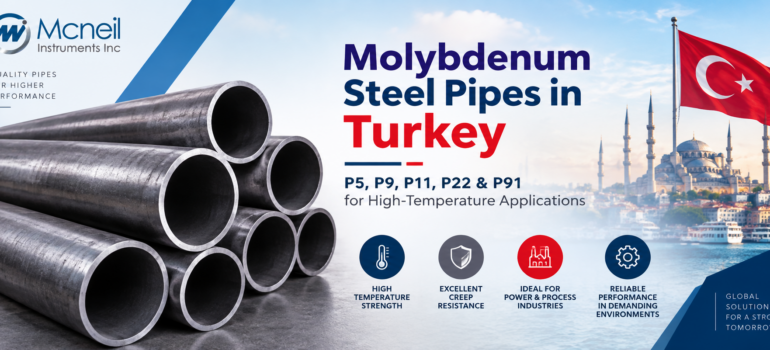
Molybdenum Steel Pipes in Turkey: P5, P9, P11, P22 & P91 for High-Temperature Applications

Industrial piping systems operating under elevated temperatures and pressures require materials that can maintain strength, dimensional stability, and resistance to oxidation and thermal degradation. This is where molybdenum steel pipes and chromium-molybdenum alloy steel pipes become important for demanding applications.

Turkey’s power generation, refining, petrochemical, chemical processing, boiler, and heavy engineering sectors use piping systems designed for challenging operating conditions. For these applications, ASTM A335 / ASME SA335 P5, P9, P11, P22 and P91 pipes provide different combinations of high-temperature strength, oxidation resistance, weldability, and creep resistance.

Mcneil Instrument manufactures, supplies, and exports these grades for industrial applications and identifies Turkey among its international markets. Its product range includes seamless P5, P9, P11, P22 and P91 molybdenum steel pipes for applications involving high temperature and pressure.

What Are Molybdenum Steel Pipes?

Molybdenum steel pipes are alloy steel pipes containing molybdenum along with other alloying elements such as chromium, depending on the grade.

For high-temperature piping, chromium contributes to oxidation and scaling resistance, while molybdenum helps improve high-temperature strength and resistance to degradation. This combination makes chromium-molybdenum alloy steels suitable for applications where ordinary carbon steel may not provide the required performance.

Mcneil Instrument’s P5, P9, P11, P22 and P91 range is manufactured according to ASTM A335 / ASME SA335 requirements and is intended for demanding temperature and pressure service.

Technical note: P5, P9, P11, P22 and P91 are generally classified as ferritic alloy/chromium-molybdenum steels, rather than ordinary carbon steel. This distinction is important when specifying materials for high-temperature piping.

Why Molybdenum Steel Pipes Are Important for Turkish Industries

Turkey has a broad industrial base where high-temperature piping is required across energy and process industries. Mcneil Instrument’s Turkey-specific information highlights applications including power plants, refineries, petrochemical facilities, chemical processing, steam systems, boilers, heat exchangers, and heavy engineering.

Molybdenum alloy steel pipes can be considered when a piping system requires:

  • High-temperature mechanical strength
  • Resistance to oxidation and scaling
  • Improved creep resistance
  • Long-term thermal stability
  • Pressure-bearing capability
  • Reliable performance in steam systems
  • Compatibility with demanding industrial service

The correct grade should always be selected according to the actual design temperature, pressure, process medium, code requirements, welding procedure, and service conditions.

ASTM A335 P5, P9, P11, P22 & P91 Grades Explained

Each P-grade has a different alloy composition and performance profile. Understanding these differences is essential when selecting molybdenum steel pipes in Turkey.

ASTM A335 P5 Pipes

P5 is a chromium-molybdenum alloy steel grade designed for elevated-temperature service.

According to Mcneil Instrument’s published information, P5 contains approximately 4–6% chromium and 0.45–0.65% molybdenum.

Typical P5 Applications

P5 pipes can be considered for:

  • Refineries
  • Chemical processing plants
  • Power stations
  • Boilers
  • Heaters
  • Steam lines
  • High-pressure piping

Its chromium content provides oxidation and corrosion resistance, while molybdenum contributes to high-temperature strength.

ASTM A335 P9 Pipes

P9 is another chromium-molybdenum alloy steel grade used in high-temperature applications.

Mcneil Instrument specifies approximately 8–10% chromium and 0.90–1.10% molybdenum for P9.

Typical P9 Applications

P9 can be used in suitable:

  • Superheater systems
  • Furnace components
  • Refinery piping
  • Power-generation systems
  • High-temperature process equipment

Its alloy composition makes it appropriate for environments where elevated temperature, oxidation resistance, and mechanical stability are important.

ASTM A335 P11 Pipes

P11 is widely associated with high-temperature steam and boiler applications.

The grade provides a balance of:

  • Strength
  • Toughness
  • Ductility
  • Weldability
  • Thermal stability

Typical P11 Applications

P11 alloy steel pipes can be considered for:

  • Steam pipelines
  • Boilers
  • Power plants
  • Heat-transfer systems
  • Refinery process piping
  • High-temperature utility systems

Mcneil Instrument’s Turkey-specific information identifies P11 among the alloy steel grades used for high-temperature and high-pressure industrial environments.

ASTM A335 P22 Pipes

P22 contains approximately 1.9–2.6% chromium and 0.87–1.13% molybdenum according to Mcneil Instrument’s published specifications.

It is recognized for its combination of strength, flexibility, and long-term creep resistance.

Typical P22 Applications

P22 pipes are commonly considered for:

  • Boilers
  • Heat exchangers
  • Steam pipelines
  • Power-generation systems
  • High-temperature process piping
  • Energy-sector applications

For Turkish power and process industries, P22 can be specified where the operating conditions require greater high-temperature capability than lower-alloy grades.

ASTM A335 P91 Pipes

P91 represents a higher-strength alloy steel grade intended for demanding high-temperature service.

The alloy system includes chromium, molybdenum, vanadium, and niobium, providing enhanced high-temperature strength and creep resistance.

Typical P91 Applications

P91 may be selected for:

  • Advanced power-generation systems
  • High-pressure steam pipelines
  • Boilers
  • Superheaters
  • Reheaters
  • Critical high-temperature piping

Mcneil Instrument describes P91 as its highest-strength grade within this product range and identifies it for extreme temperature and pressure conditions.

P5 vs P9 vs P11 vs P22 vs P91

GradeKey CharacteristicsTypical Applications
P5High Cr-Mo content, oxidation resistanceRefineries, heaters, chemical plants
P9Higher chromium content, thermal stabilityFurnaces, superheaters, refineries
P11Toughness, ductility and weldabilityBoilers, steam lines, power plants
P22Strength and creep resistanceBoilers, heat exchangers, steam systems
P91Very high strength and creep resistanceCritical steam and advanced power systems

There is no universally “best” grade. The appropriate material depends on the complete engineering conditions of the piping system.

Molybdenum Steel Pipes for Power Plants in Turkey

Power generation is one of the major application areas for chromium-molybdenum alloy steel pipes.

Boilers, superheaters, reheaters, steam pipelines, and high-temperature utility systems can expose piping to sustained thermal and mechanical loads.

Depending on the design conditions:

  • P11 can be considered for steam and boiler systems.
  • P22 can be used for higher-demand boiler and steam applications.
  • P91 can be considered for critical high-temperature and high-pressure systems.

The exact grade, wall thickness, heat treatment, welding procedure, and inspection requirements should be established according to the engineering design and applicable codes.

Molybdenum Steel Pipes for Refineries in Turkey

Refineries contain numerous high-temperature process units and interconnected piping systems.

P5 and P9 are among the grades identified by Mcneil Instrument for refinery and high-temperature process applications, while P11 and P22 can be used for appropriate steam and process services.

Potential refinery applications include:

  • Process piping
  • Heater systems
  • Furnace piping
  • Steam systems
  • Heat-transfer services
  • High-temperature utility lines

Material selection should account for both operating conditions and the chemistry of the process medium.

Molybdenum Steel Pipes for Petrochemical and Chemical Plants

Petrochemical and chemical processing facilities can combine elevated temperatures, pressure, corrosive environments, and continuous operation.

Alloy steel pipes can provide advantages where conventional carbon steel does not meet the required thermal or mechanical performance.

Applications can include:

  • Hydrocarbon processing
  • High-temperature process lines
  • Steam distribution
  • Heat-transfer systems
  • Furnace systems
  • Utility piping

However, alloy selection should always consider the actual process chemistry rather than temperature and pressure alone.

Molybdenum Steel Pipes for Boilers and Steam Systems

Boilers and steam systems place demanding requirements on piping materials.

The pipe must maintain adequate mechanical properties during prolonged exposure to elevated temperature and pressure.

P11, P22 and P91 are particularly relevant to different high-temperature steam and boiler services, with the final selection depending on the design conditions.

Important considerations include:

  • Design pressure
  • Operating temperature
  • Steam conditions
  • Pipe wall thickness
  • Creep requirements
  • Welding requirements
  • Heat treatment
  • Applicable code and specifications

Seamless Molybdenum Steel Pipes

Mcneil Instrument identifies its P5, P9, P11, P22 and P91 range as seamless alloy steel pipes.

Seamless construction is widely specified for demanding pressure and temperature applications because the pipe is produced without a longitudinal welded seam.

For critical piping, buyers should also evaluate:

  • Manufacturing specification
  • Heat-treatment condition
  • Dimensional tolerances
  • Mechanical properties
  • Chemical composition
  • Non-destructive testing
  • Hydrostatic testing
  • Material traceability

Specifications and Customization

Mcneil Instrument states that its molybdenum steel pipe range can be customized according to project requirements, including pipe diameter, wall thickness, and schedule.

Depending on the project, procurement specifications may include:

  • Nominal pipe size
  • Outside diameter
  • Wall thickness
  • Schedule
  • Pipe length
  • End configuration
  • Heat-treatment condition
  • Material grade
  • Testing requirements
  • Inspection documentation

Providing complete specifications at the enquiry stage helps reduce the possibility of selecting an unsuitable product.

Testing and Quality Requirements

Quality assurance is especially important for high-temperature and high-pressure piping.

Mcneil Instrument states that its pipes undergo hydrostatic testing, hardness testing, and dimensional inspection, with Material Test Certificates provided. The company also references ASTM A335 / ASME SA335 standards and ISO/CE certifications.

Depending on project requirements, buyers may request documentation and testing covering:

  • Chemical composition
  • Tensile properties
  • Yield strength
  • Hardness
  • Hydrostatic testing
  • Dimensional inspection
  • Heat-treatment records
  • Material Test Certificate
  • Non-destructive testing
  • Traceability

For critical applications, the inspection and testing plan should be established before manufacturing or procurement.

How to Choose the Right Molybdenum Steel Pipe Grade in Turkey

Selecting the correct grade requires a systematic approach.

Step 1: Establish Operating Temperature

Determine the normal, maximum, and design temperatures.

Step 2: Establish Design Pressure

The pipe must be suitable for the required pressure and wall thickness.

Step 3: Identify the Process Medium

Consider steam, hydrocarbons, chemicals, water, gas, or other process fluids.

Step 4: Determine Creep Requirements

For long-term high-temperature service, creep and rupture performance can become critical.

Step 5: Select the Appropriate P-Grade

Compare P5, P9, P11, P22 and P91 according to the design requirements rather than simply choosing the highest alloy grade.

Step 6: Check Welding Requirements

Alloy steel welding requires appropriate procedures, preheating, post-weld heat treatment where applicable, and qualified fabrication practices.

Step 7: Confirm Applicable Standards

Verify ASTM A335 / ASME SA335 requirements and any additional project or purchaser specifications.

Step 8: Define Inspection and Documentation

Specify MTC requirements, testing, inspection, traceability, and any third-party inspection requirements before placing the order.

Common Mistakes When Selecting Alloy Steel Pipes

Several procurement mistakes can affect long-term piping performance.

Choosing Only by Price

The least expensive pipe is not necessarily the most economical choice if it does not meet the required temperature, pressure, or service conditions.

Selecting a Grade Without Checking Temperature

Different grades offer different high-temperature capabilities. Operating temperature should be one of the first selection criteria.

Ignoring Welding Requirements

Alloy steel piping requires controlled welding practices. Welding requirements should be considered during material selection and project planning.

Confusing Carbon Steel With Alloy Steel

P5, P9, P11, P22 and P91 should not simply be treated as conventional carbon steel grades. They are alloy steel grades designed for demanding service.

Failing to Specify Documentation

For critical applications, material certificates and inspection records are important for traceability and quality assurance.

Why Choose Mcneil Instrument for Molybdenum Steel Pipes in Turkey?

Mcneil Instrument supplies ASTM A335 / ASME SA335 P5, P9, P11, P22 and P91 molybdenum alloy steel pipes for high-temperature and high-pressure industrial applications.

Its published product information highlights:

  • P5, P9, P11, P22 and P91 grades
  • Seamless alloy steel pipe supply
  • High-temperature and high-pressure applications
  • Custom pipe diameters and wall thicknesses
  • Hydrostatic testing
  • Hardness testing
  • Dimensional inspection
  • Material Test Certificates
  • International export capability
  • Turkey as an export market

Mcneil Instrument specifically identifies Turkey among its international export destinations and its Turkey-focused pipe information covers power plants, refineries, petrochemical industries, chemical processing, and heavy engineering applications.

Frequently Asked Questions

What are molybdenum steel pipes used for?

Molybdenum alloy steel pipes are used in high-temperature and high-pressure systems such as power plants, refineries, boilers, steam pipelines, petrochemical facilities, heat exchangers, and chemical processing plants.

What is the difference between P5, P9, P11, P22 and P91?

The grades differ in chromium, molybdenum, and other alloying elements, resulting in different levels of high-temperature strength, oxidation resistance, weldability, creep resistance, and mechanical performance.

Which P-grade is suitable for boiler applications?

P11 and P22 are commonly associated with boiler and steam applications, while P91 can be specified for more demanding critical high-temperature systems. The final grade must be selected according to the boiler design and applicable specification.

Are P5, P9, P11, P22 and P91 carbon steel pipes?

No. These are generally classified as alloy/chromium-molybdenum steel grades, not ordinary carbon steel.

What standard covers these pipes?

Mcneil Instrument’s product range is manufactured according to ASTM A335 / ASME SA335 requirements.

Are these pipes available in seamless construction?

Yes. Mcneil Instrument identifies its P5, P9, P11, P22 and P91 range as seamless alloy steel pipes.

Can molybdenum steel pipes be customized?

Mcneil Instrument states that pipe diameter, wall thickness, schedules, and pressure-related requirements can be customized according to project requirements.

Does Mcneil Instrument supply molybdenum steel pipes to Turkey?

Yes. Turkey is listed among Mcneil Instrument’s international export markets, and its Turkey-focused content identifies P-series alloy steel pipes for industrial applications.

Conclusion

Molybdenum and chromium-molybdenum alloy steel pipes provide an important material solution for industrial systems exposed to elevated temperatures and pressures. In Turkey, they can support demanding applications across power generation, refineries, petrochemical plants, chemical processing, boilers, steam systems, heat exchangers, and heavy engineering.

The ASTM A335 / ASME SA335 P5, P9, P11, P22 and P91 grades offer different combinations of strength, thermal stability, oxidation resistance, weldability, and creep performance. P5 and P9 are suitable for selected high-temperature process and refinery applications, while P11, P22 and P91 address increasingly demanding steam, boiler, power-generation, and critical high-temperature services.

For Turkish industrial projects, the correct pipe should be selected by evaluating operating temperature, pressure, process medium, creep requirements, dimensions, welding requirements, applicable standards, and inspection documentation.

Mcneil Instrument provides these P-series seamless alloy steel pipes for international industrial markets, including Turkey, with testing, documentation, and customization options for project-specific requirements.

Read More