Alloy Steel Pipes in Nigeria: P5, P9, P11, P22 & P91 for High-Temperature Applications

Alloy steel pipes are essential components in industrial piping systems where high temperature, pressure, mechanical stress, oxidation, and long-term service reliability are critical. In Nigeria, industries such as oil and gas, refineries, power generation, petrochemicals, fertilizer manufacturing, and heavy engineering require piping materials capable of performing under demanding operating conditions.

Mcneil Instrument manufactures, supplies, and exports ASTM A335 / ASME SA335 Alloy Steel Pipes in grades P5, P9, P11, P22, and P91. These chromium-molybdenum alloy steel grades are designed for high-temperature and high-pressure applications and are used in boilers, steam systems, refineries, heat exchangers, petrochemical facilities, and power-generation projects.

What Are Alloy Steel Pipes?

Alloy steel pipes are steel pipes containing alloying elements such as chromium and molybdenum to improve their performance compared with conventional carbon steel.

The ASTM A335 / ASME SA335 family includes ferritic alloy steel pipes intended for high-temperature service. The addition of chromium and molybdenum contributes to:

  • High-temperature strength
  • Creep resistance
  • Oxidation and scaling resistance
  • Improved mechanical stability
  • Resistance to thermal degradation
  • Reliable performance under pressure

Mcneil Instrument’s P5, P9, P11, P22, and P91 pipes are primarily supplied as seamless alloy steel pipes for demanding industrial applications.

Why Alloy Steel Pipes Are Important for Nigerian Industries

Nigeria has major industrial sectors that depend on high-temperature and high-pressure piping systems. Refineries, power plants, petrochemical facilities, fertilizer plants, and oil and gas installations can expose piping to elevated temperatures, steam, hydrocarbons, pressure, and continuous thermal cycling.

Alloy steel pipes can provide the material performance required for these environments.

Key benefits include:

  • Excellent high-temperature performance
  • High mechanical strength
  • Good creep resistance
  • Resistance to oxidation and scaling
  • Long-term thermal stability
  • High-pressure service capability
  • Reliable performance under continuous operation
  • Suitability for critical process piping

Mcneil Instrument specifically identifies oil and gas, power generation, petrochemical, fertilizer, refinery, and mining applications in Nigeria for its alloy steel pipe range.

ASTM A335 Alloy Steel Pipe Grades

Mcneil Instrument offers five major grades within its alloy steel pipe range:

  • ASTM A335 P5
  • ASTM A335 P9
  • ASTM A335 P11
  • ASTM A335 P22
  • ASTM A335 P91

Each grade has different alloy chemistry and performance characteristics, so the correct grade should be selected according to operating temperature, pressure, process conditions, allowable stress, welding requirements, and applicable engineering specifications.

ASTM A335 P5 Alloy Steel Pipes

P5 is a chromium-molybdenum alloy steel grade designed for elevated-temperature applications.

Its chromium and molybdenum content contributes to oxidation resistance, thermal stability, and high-temperature performance.

Typical Applications

P5 pipes can be used in:

  • Refinery heater systems
  • Steam pipelines
  • Petrochemical units
  • Heat exchangers
  • Boilers
  • High-temperature process piping

For Nigerian refinery and petrochemical projects, P5 can be considered where the system requires its specific combination of temperature capability and mechanical properties.

ASTM A335 P9 Alloy Steel Pipes

P9 contains higher chromium and molybdenum levels than P5 and is intended for more demanding high-temperature service.

Its properties make it suitable for applications involving thermal loads, oxidation, and high-pressure process conditions.

Typical Applications

  • Heat exchangers
  • Furnace components
  • High-pressure boilers
  • Petrochemical process lines
  • High-temperature steam systems
  • Refinery equipment

P9 is particularly relevant to Nigerian refinery and high-temperature process applications.

ASTM A335 P11 Alloy Steel Pipes

P11 is a widely used chromium-molybdenum alloy steel grade for high-temperature piping systems.

It provides a balance of strength, oxidation resistance, thermal performance, and fabrication characteristics.

Applications

P11 alloy steel pipes are commonly associated with:

  • Thermal power plants
  • Steam lines
  • Boilers
  • Superheater systems
  • Reheater systems
  • Heat exchangers

For Nigerian power and industrial projects, P11 can be specified where the design conditions require its particular mechanical and high-temperature properties.

ASTM A335 P22 Alloy Steel Pipes

P22 provides enhanced high-temperature and creep performance and is widely associated with demanding steam and thermal systems.

Typical Applications

  • Superheaters
  • Reheaters
  • High-pressure steam circuits
  • Boilers
  • Power-generation systems
  • Pressure vessels
  • Chemical plants

P22 is especially relevant where long-term exposure to elevated temperature and pressure requires improved creep performance.

ASTM A335 P91 Alloy Steel Pipes

P91 is a creep-strength-enhanced chromium-molybdenum alloy steel grade developed for demanding high-temperature and high-pressure service.

Its alloying system includes chromium and molybdenum together with strengthening additions such as vanadium and niobium.

Typical Applications

  • Supercritical boilers
  • High-pressure steam pipelines
  • Steam turbine systems
  • Thermal power plants
  • High-temperature steam headers
  • Critical power-generation piping

Mcneil Instrument identifies P91 as a premium grade for critical high-pressure applications and high-efficiency power projects.

P5 vs P9 vs P11 vs P22 vs P91

GradeGeneral CharacteristicsTypical Nigerian Applications
P5Chromium-molybdenum alloy with oxidation and scaling resistanceRefinery heaters, steam systems
P9Higher chromium and molybdenum contentHeat exchangers, furnaces, petrochemical systems
P11Balanced strength and high-temperature performanceBoilers, steam lines, thermal power
P22Enhanced creep and thermal performanceSuperheaters, reheaters, high-pressure steam
P91Creep-strength-enhanced alloy for critical servicePower stations, steam headers, critical piping

The highest grade is not automatically the best choice. Material selection should be based on the actual operating temperature, pressure, process medium, design code, welding procedure, and required service life.

Technical Specifications of Alloy Steel Pipes

Mcneil Instrument’s published alloy steel pipe information identifies ASTM A335 / ASME SA335 as the applicable standards and includes P5, P9, P11, P22, and P91 grades.

ParameterSpecification
ProductAlloy Steel Pipes
StandardASTM A335 / ASME SA335
GradesP5, P9, P11, P22, P91
ConstructionSeamless
Published Size Range1/8″ NB to 24″ NB
Published Schedule RangeSCH 20 to SCH XXS
ApplicationsBoilers, refineries, petrochemical plants, power generation
ServiceHigh-temperature and high-pressure applications

The company’s Nigeria-focused information also lists larger/custom size options and different manufacturing forms on related alloy-steel content. Exact dimensions, wall thickness, heat treatment, testing, and pressure requirements should be confirmed against the project purchase specification and selected grade.

Seamless Alloy Steel Pipes for Nigerian Industrial Projects

Seamless construction is particularly valuable in critical pressure-piping applications because the pipe does not contain a longitudinal welded seam.

Key characteristics include:

  • Uniform wall structure
  • High structural integrity
  • Reliable pressure handling
  • Good fatigue resistance
  • Suitability for high-temperature service
  • Reduced concerns associated with longitudinal weld seams

Mcneil Instrument lists seamless alloy steel pipes across its P5, P9, P11, P22, and P91 product range.

Applications of Alloy Steel Pipes in Nigeria

1. Oil and Gas Industry

Nigeria’s oil and gas industry requires piping systems capable of operating under demanding process conditions.

Alloy steel pipes can be used in suitable applications involving:

  • Refinery process systems
  • Hydrocarbon processing
  • High-temperature process lines
  • Steam systems
  • Heat-transfer systems
  • Boiler systems
  • Petrochemical units

Material selection should always consider the specific process medium, pressure, temperature, and corrosion conditions.

2. Nigerian Refineries

Refineries contain heaters, furnaces, steam networks, heat exchangers, and high-temperature process units.

P5 and P9 are associated with refinery and high-temperature process applications, while P11, P22, and P91 can be specified for suitable steam and power-related systems.

For refinery projects in areas such as Lagos, Port Harcourt, and Warri, engineers need to evaluate temperature, pressure, thermal cycling, process chemistry, and project specifications when selecting the pipe grade.

3. Power Generation

Power plants rely heavily on high-temperature steam piping.

Alloy steel pipes can be used in:

  • Boilers
  • Superheaters
  • Reheaters
  • Steam pipelines
  • Turbine-related systems
  • Steam headers
  • Economizers

P11, P22, and P91 can be considered for appropriate high-temperature power-generation applications depending on the design requirements.

4. Petrochemical Plants

Petrochemical facilities operate process systems under elevated temperatures and pressures.

Alloy steel pipes may be used for:

  • Process pipelines
  • Heat exchangers
  • Reactor systems
  • Furnace systems
  • Steam networks
  • High-temperature process units

P9, P11, and P22 are relevant grades for selected petrochemical applications.

5. Fertilizer Industry

Fertilizer plants require reliable piping for high-pressure process and utility systems.

Potential applications include:

  • Utility pipelines
  • Steam systems
  • High-pressure process lines
  • Heat-transfer systems
  • Boiler systems

The appropriate alloy grade should be selected according to the process chemistry and operating conditions.

6. Mining and Heavy Engineering

Mining and heavy-engineering facilities can also require high-strength piping for thermal and pressure-intensive applications.

Alloy steel pipes can support:

  • High-pressure process lines
  • Industrial equipment
  • Pressure systems
  • Thermal processing systems
  • Heavy engineering projects

How to Select the Right Alloy Steel Pipe Grade

Selecting an ASTM A335 pipe should involve a detailed review of the complete operating environment.

Operating Temperature

Determine both normal and maximum design temperature.

Higher-temperature applications may require P22 or P91 rather than a lower-alloy grade, depending on the design conditions.

Operating Pressure

Confirm the design pressure and required wall thickness. Pipe schedule should be selected based on engineering calculations rather than simply choosing a thicker pipe.

Process Medium

Identify whether the pipe will carry steam, hydrocarbons, chemicals, or another process fluid.

Creep Requirements

For systems operating continuously at elevated temperatures, long-term creep strength is an important material-selection factor.

Welding Requirements

The selected grade, especially higher-alloy grades such as P91, requires appropriate welding procedures, preheating, post-weld heat treatment, and qualified fabrication practices where specified by the applicable code and project requirements.

Pipe Dimensions

Confirm:

  • Nominal bore
  • Outside diameter
  • Wall thickness
  • Schedule
  • Pipe length
  • End finish
  • Required tolerances

Applicable Standards

Specify the required ASTM, ASME, project, and engineering standards before procurement.

Quality and Documentation

For critical industrial piping, material traceability and inspection documentation are important parts of procurement.

Depending on the project specification, buyers may require documentation such as:

  • Mill Test Certificates
  • Chemical composition reports
  • Mechanical test results
  • Hydrostatic test reports
  • PMI reports
  • Non-destructive testing records
  • Dimensional inspection reports
  • Heat-treatment records
  • Compliance certificates
  • Third-party inspection documentation

Mcneil Instrument’s Nigeria-focused alloy pipe information references documentation including MTCs, NDT reports, hydrostatic tests, PMI results, and compliance certificates for applicable projects.

Why Choose Mcneil Instrument for Alloy Steel Pipes in Nigeria?

Mcneil Instrument offers ASTM A335 / ASME SA335 P5, P9, P11, P22, and P91 Alloy Steel Pipes for demanding industrial applications.

The company positions its alloy steel pipe range for:

  • Oil and gas
  • Refineries
  • Power generation
  • Petrochemical plants
  • Fertilizer facilities
  • Boilers
  • Heat exchangers
  • High-pressure process systems
  • Heavy engineering

Its published product information also identifies Nigeria as a supply market for these alloy steel pipes.

Mcneil Instrument’s broader Nigeria-focused content discusses industrial supply across locations and sectors including refinery, power, petrochemical, fertilizer, and mining applications.

Benefits of ASTM A335 Alloy Steel Pipes

The main advantages of P5, P9, P11, P22, and P91 alloy steel pipes include:

  • High-temperature strength
  • Good creep resistance
  • Oxidation resistance
  • Scaling resistance
  • High mechanical strength
  • Thermal stability
  • High-pressure capability
  • Long service life
  • Suitability for critical industrial piping
  • Reliable performance under thermal stress

These properties make chromium-molybdenum alloy steel pipes suitable for applications where ordinary carbon steel may not provide the required high-temperature performance.

Frequently Asked Questions

What are ASTM A335 Alloy Steel Pipes?

ASTM A335 Alloy Steel Pipes are ferritic alloy steel pipes intended for high-temperature service. Mcneil Instrument’s range includes P5, P9, P11, P22, and P91 grades.

Which alloy steel pipe grades does Mcneil Instrument supply in Nigeria?

Mcneil Instrument’s published range includes P5, P9, P11, P22, and P91 alloy steel pipes.

Which ASTM A335 grade is used for high-temperature power applications?

P11, P22, and P91 can be used in appropriate power-generation applications, depending on the design temperature, pressure, allowable stress, and applicable code.

Where are alloy steel pipes used in Nigeria?

They are used in oil and gas, refineries, power plants, petrochemical facilities, fertilizer plants, boilers, heat exchangers, and other high-temperature process systems.

Are ASTM A335 P5, P9, P11, P22 and P91 carbon steel pipes?

No. These are chromium-molybdenum alloy steel grades, with alloying additions that provide enhanced high-temperature and mechanical performance compared with ordinary carbon steel.

Are Mcneil Instrument alloy steel pipes seamless?

Yes. Mcneil Instrument’s published product range identifies seamless alloy steel pipes in P5, P9, P11, P22, and P91 grades.

What is the difference between P5, P9, P11, P22 and P91?

The grades differ primarily in their alloy chemistry and resulting high-temperature, oxidation, creep, and mechanical properties. P5 and P9 are widely associated with refinery and high-temperature process applications, P11 and P22 with boilers and steam systems, and P91 with critical high-temperature power and steam applications.

Conclusion

ASTM A335 / ASME SA335 Alloy Steel Pipes provide a reliable piping solution for Nigerian industries operating under high temperatures, pressures, and continuous thermal stress.

The P5, P9, P11, P22, and P91 grades offer different levels of high-temperature strength, oxidation resistance, creep performance, and mechanical stability. Selecting the correct grade requires consideration of operating temperature, pressure, process medium, creep requirements, welding procedures, dimensions, and applicable engineering standards.

For Nigeria’s oil and gas, refinery, petrochemical, power-generation, fertilizer, and heavy-engineering sectors, Mcneil Instrument provides a range of alloy steel pipes designed for demanding industrial service.
Read More

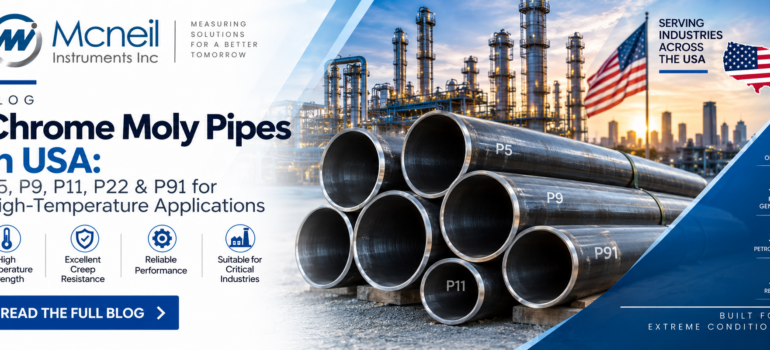
Chrome Moly Pipes in USA: P5, P9, P11, P22 & P91 for High-Temperature Applications

High-temperature industrial piping systems in the United States require materials capable of maintaining strength, dimensional stability and long-term performance under elevated temperature and pressure. Chrome Moly Pipes, manufactured from chromium-molybdenum alloy steel, are widely considered for demanding applications in power generation, refineries, petrochemical plants, boilers, steam systems, heat exchangers and high-temperature process equipment.

Mcneil Instrument supplies ASTM A335 / ASME SA335 Chrome Moly Pipes in P5, P9, P11, P22 and P91 grades for industrial requirements in the USA. These seamless alloy steel pipes are designed for applications where high temperature, pressure, thermal cycling, oxidation resistance and long-term mechanical performance are important.

What Are Chrome Moly Pipes?

Chrome Moly Pipes are chromium-molybdenum alloy steel pipes in which chromium and molybdenum are important alloying elements. Compared with conventional carbon steel, these alloy additions can provide improved high-temperature strength, oxidation resistance, creep resistance and thermal stability.

For industrial projects, ASTM A335 / ASME SA335 is the key specification associated with the seamless ferritic alloy steel pipes covered by the P5, P9, P11, P22 and P91 grades discussed here.

These pipes are particularly relevant when piping systems must operate for extended periods under combinations of:

  • High operating temperature
  • High internal pressure
  • Thermal cycling
  • Mechanical loading
  • Oxidizing environments
  • Long-term creep conditions
  • Demanding process conditions

The correct grade should always be selected according to the actual design temperature, pressure, process medium, applicable code, fabrication requirements and project specifications.

Why Are Chrome Moly Pipes Important for US Industries?

Industrial facilities throughout the USA operate sophisticated systems where piping can experience severe temperature and pressure conditions. Power generation, refining, petrochemical processing and industrial heating operations are examples where material selection directly influences reliability and service life.

Chromium-molybdenum alloy steel pipes are considered for these applications because their alloy composition contributes to:

  • High-temperature strength
  • Oxidation resistance
  • Creep resistance
  • Thermal stability
  • Pressure-handling capability
  • Long-term mechanical performance

ASTM A335 alloy steel pipes are used in applications such as power plants, boilers, refineries, petrochemical facilities, steam systems and other high-temperature process equipment.

ASTM A335 Chrome Moly Pipe Grades Available for USA Projects

Mcneil Instrument’s published Chrome Moly range includes:

  • ASTM A335 P5 Pipes
  • ASTM A335 P9 Pipes
  • ASTM A335 P11 Pipes
  • ASTM A335 P22 Pipes
  • ASTM A335 P91 Pipes

Each grade has a different alloy composition and therefore offers different characteristics for high-temperature service.

ASTM A335 P5 Chrome Moly Pipes

ASTM A335 P5 is a chromium-molybdenum alloy steel pipe grade intended for elevated-temperature service.

Mcneil Instrument’s published information gives P5 approximately 4–6% chromium and 0.45–0.65% molybdenum.

Typical P5 applications include:

  • Refineries
  • Heat exchangers
  • Boilers
  • Petrochemical plants
  • High-temperature process piping

P5 is particularly considered where high-temperature performance and oxidation resistance are important.

ASTM A335 P9 Chrome Moly Pipes

ASTM A335 P9 contains a higher chromium and molybdenum content than P5. Mcneil Instrument lists approximately 8–10% chromium and 0.90–1.10% molybdenum for P9.

This composition makes P9 suitable for demanding elevated-temperature environments.

Typical P9 applications include:

  • Power plants
  • Refineries
  • Petrochemical facilities
  • Steam systems
  • Industrial heaters
  • High-temperature piping

P9 can be considered when a project requires strong thermal and oxidation resistance.

ASTM A335 P11 Chrome Moly Pipes

ASTM A335 P11 is widely associated with boilers, steam systems and power-generation applications.

Mcneil Instrument’s published specifications identify approximately 1–1.5% chromium and 0.44–0.65% molybdenum for P11.

Common P11 applications include:

  • Industrial boilers
  • Power plants
  • Steam lines
  • Heat exchangers
  • Process piping
  • High-temperature utility systems

P11 is often evaluated where a combination of mechanical strength, thermal performance and fabrication requirements is needed.

ASTM A335 P22 Chrome Moly Pipes

ASTM A335 P22 is a chromium-molybdenum alloy steel grade used in systems requiring elevated-temperature strength and creep resistance.

Mcneil Instrument lists approximately 1.9–2.6% chromium and 0.87–1.13% molybdenum for P22.

P22 pipes are commonly considered for:

  • Power plants
  • Main steam systems
  • Reheaters
  • Boilers
  • Heat recovery units
  • Petrochemical facilities
  • High-temperature process piping

P22 is particularly relevant where long-term performance and creep resistance are important.

ASTM A335 P91 Chrome Moly Pipes

ASTM A335 P91 is a higher-performance chromium-molybdenum alloy steel grade intended for demanding high-temperature and high-pressure service.

Mcneil Instrument’s published composition identifies approximately 8–9.5% chromium and 0.85–1.05% molybdenum, together with additional alloying elements used in the grade.

Typical P91 applications include:

  • Supercritical power plants
  • Ultra-supercritical power plants
  • High-pressure steam systems
  • Advanced boiler systems
  • Superheated steam lines
  • Critical power-generation applications
  • Advanced energy systems

P91 offers high creep resistance and high-temperature performance, making appropriate manufacturing, heat treatment, welding and inspection especially important for critical applications.

P5 vs P9 vs P11 vs P22 vs P91 Chrome Moly Pipes

GradeKey CharacteristicTypical Applications
P5Heat and oxidation resistanceRefineries, heat exchangers, boilers
P9Higher chromium and thermal resistancePower and petrochemical systems
P11Balanced strength and thermal performanceBoilers, steam systems, power plants
P22High-temperature and creep resistancePower plants, steam systems, reheaters
P91High strength and advanced creep performanceCritical power and high-pressure steam systems

The highest alloy grade is not automatically the correct choice. Selection should be based on operating temperature, pressure, process conditions, design code, welding requirements and project specifications.

Seamless Chrome Moly Pipes for USA Industrial Projects

Mcneil Instrument’s published range covers seamless Chrome Moly and alloy steel pipes for high-temperature applications.

SpecificationDetails
ProductChrome Moly / Alloy Steel Pipes
StandardASTM A335 / ASME SA335
GradesP5, P9, P11, P22, P91
ConstructionSeamless
Size Range1/8″ NB to 24″ NB
ScheduleSCH 20 to SCH XXS
ApplicationsBoilers, power plants, refineries, petrochemical systems

Actual availability, dimensions, schedules and manufacturing requirements should be confirmed against the individual project or purchase order.

Chrome Moly Pipes for Power Plants in the USA

Power generation is one of the major application areas for Chrome Moly piping.

Power plants can contain piping systems exposed continuously to elevated temperatures and pressures. Depending on the operating conditions, Chrome Moly pipes may be used for:

  • Boilers
  • Main steam lines
  • Superheaters
  • Reheaters
  • Steam headers
  • High-pressure steam piping
  • Heat-recovery systems

P11, P22 and P91 are particularly associated with increasingly demanding steam and power-generation applications, with the final grade selected according to actual plant operating conditions.

Chrome Moly Pipes for Oil & Gas and Refining in the USA

The US oil and gas sector includes upstream, midstream and downstream facilities with different material requirements. In high-temperature sections of refineries, gas-processing plants and petrochemical facilities, Chrome Moly pipes can be considered where elevated-temperature mechanical performance is required.

Potential applications include:

  • Refinery process units
  • Gas processing plants
  • Petrochemical facilities
  • Steam systems
  • Heat exchangers
  • High-temperature utility systems
  • Industrial heating systems
  • Process piping

Material selection should be based on the actual process medium, operating temperature, pressure, corrosion environment and applicable engineering requirements.

Chrome Moly Boiler and Steam Pipes

Boiler and steam-generation systems require piping capable of maintaining mechanical performance under sustained heat and pressure.

Chrome Moly pipes are used in applications such as:

Boiler Piping

Used for selected high-temperature sections where alloy steel performance is required.

Superheater Systems

Superheaters expose piping to high-temperature steam, making appropriate material selection important.

Reheater Systems

Reheater circuits operate under demanding thermal conditions and can require alloy steel piping.

Steam Headers

Headers collect and distribute steam and can be exposed to significant temperature and pressure.

High-Pressure Steam Lines

High-pressure steam piping requires carefully specified materials, dimensions, welding procedures and inspection.

How to Select Chrome Moly Pipes for a USA Project

Choosing the right Chrome Moly pipe requires more than simply specifying P5, P9, P11, P22 or P91.

Before procurement, buyers should define:

1. ASTM/ASME Standard

Specify the applicable ASTM A335 / ASME SA335 requirements.

2. Grade

Select P5, P9, P11, P22 or P91 according to the engineering design.

3. Pipe Size

Define nominal pipe size, outside diameter and required wall thickness.

4. Schedule

Specify the required pipe schedule according to pressure and design calculations.

5. Operating Conditions

Review design temperature, operating pressure, thermal cycling and process medium.

6. Heat Treatment

Confirm applicable heat-treatment requirements for the selected grade.

7. Testing and Inspection

Define testing, inspection and certification requirements before placing the order.

8. Traceability and Documentation

For critical projects, establish requirements for marking, material certificates, traceability and project documentation.

Mcneil Instrument’s USA-specific information recommends identifying the standard, grade, dimensions, schedule, length, end preparation, heat treatment, testing, inspection, certification and traceability requirements during procurement.

Industries Using Chrome Moly Pipes in the USA

Chrome Moly Pipes can support a wide range of high-temperature industrial applications.

Power Generation

Used in boilers, steam lines, superheaters, reheaters and other high-temperature systems.

Oil & Gas

Applicable to selected high-temperature process and utility systems across refining and gas processing.

Petrochemical

Used in process systems, heaters, steam circuits and heat-transfer applications where alloy steel performance is required.

Refineries

P5 and P9, among other suitable grades, can be considered for elevated-temperature refinery applications.

Chemical Processing

Chrome Moly pipes can be evaluated for high-temperature process piping based on the process environment.

Boilers and Heat Exchangers

Alloy steel piping can be selected for systems involving elevated temperatures and pressure.

Why Choose Mcneil Instrument for Chrome Moly Pipes in USA?

Mcneil Instrument supplies ASTM A335 / ASME SA335 Chrome Moly Pipes in P5, P9, P11, P22 and P91 grades for high-temperature industrial requirements in the USA and international markets.

Key supply advantages include:

  • P5 to P91 grade availability
  • Seamless Chrome Moly pipe options
  • ASTM A335 / ASME SA335 compliance
  • Multiple sizes and schedules
  • Support for project-specific requirements
  • Testing and inspection support
  • Documentation and certification support
  • Applications across power, oil & gas, refining and petrochemical industries

For USA projects, customers can specify the required grade, size, schedule, testing, inspection, certification and other project-specific requirements.

Frequently Asked Questions

What are Chrome Moly Pipes?

Chrome Moly Pipes are chromium-molybdenum alloy steel pipes designed primarily for demanding elevated-temperature and high-pressure industrial applications.

Which Chrome Moly grades does Mcneil Instrument supply?

Mcneil Instrument’s published range includes ASTM A335 P5, P9, P11, P22 and P91 Chrome Moly pipe grades.

What standard covers P5, P9, P11, P22 and P91 pipes?

The grades discussed in this range are covered by ASTM A335 / ASME SA335, which specifies seamless ferritic alloy steel pipe for high-temperature service.

What are P11 pipes used for?

P11 pipes are commonly used in boilers, steam lines, power plants, heat exchangers and high-temperature process piping.

What are P22 pipes used for?

P22 pipes are used in applications such as power plants, reheaters, boilers, steam systems, heat-recovery units and high-temperature process piping where elevated-temperature strength and creep resistance are important.

What are P91 pipes used for?

P91 pipes are associated with demanding applications including supercritical and ultra-supercritical power plants, high-pressure steam systems, advanced boilers and critical high-temperature piping.

Are Chrome Moly Pipes available in seamless construction?

Yes. Mcneil Instrument’s published range includes seamless Chrome Moly and alloy steel pipes in P5, P9, P11, P22 and P91 grades.

What size range is available?

The published product information lists a size range of 1/8″ NB to 24″ NB, with schedules from SCH 20 to SCH XXS, subject to project requirements and availability.

Can Mcneil Instrument supply Chrome Moly Pipes for USA projects?

Yes. Mcneil Instrument provides USA-focused information for its Chrome Moly pipe range and supplies these products for international industrial requirements, including projects requiring delivery to the USA.

Conclusion

Chrome Moly Pipes in P5, P9, P11, P22 and P91 grades provide engineered material options for high-temperature industrial piping systems where conventional materials may not provide the required performance.

From boilers and steam systems to power plants, refineries and petrochemical facilities, ASTM A335 / ASME SA335 alloy steel pipes can provide the combination of high-temperature strength, oxidation resistance, creep resistance and long-term mechanical performance required for demanding service.

For USA industrial projects, selecting the correct grade should be based on actual operating temperature, pressure, process conditions, applicable design codes, fabrication requirements, inspection needs and expected service life.

Mcneil Instrument supplies ASTM A335 / ASME SA335 P5, P9, P11, P22 and P91 seamless Chrome Moly Pipes for industrial applications, with dimensions, schedules, testing, inspection and documentation requirements configurable according to project specifications.

Read More

ASME SA335 Alloy Steel Pipes (Grades P5, P9, P11, P22, P91): Dependable Flow for High-Temperature & High-Pressure Systems

In industries such as power generation, petrochemicals, oil & gas, chemical processing, and thermal utilities, steel pipes are the arteries that carry hot fluids, steam, hydrocarbons, and process media. While a pipeline’s layout, insulation, or supports may be carefully engineered, the right pipe material and grade are equally critical — especially under extreme temperatures and pressures.

Among the top performers in demanding environments are ASME SA335 alloy steel pipes, manufactured to stringent specifications. These pipes — available in grades P5, P9, P11, P22, and P91 — deliver strength, creep resistance, and lasting performance where lesser materials simply cannot keep pace.

Mcneil Instrument, a leading manufacturer, supplier, and exporter of ASME SA335 Alloy Steel Pipes, offers a comprehensive range of these high-performance pipes — engineered to meet global quality benchmarks and designed for critical applications worldwide.

What Are ASME SA335 Alloy Steel Pipes — and Why They Are Essential

ASME SA335 (also referred to as ASTM A335) covers seamless ferritic alloy steel pipes intended for high-temperature and high-pressure service. These pipes are often called “P-Grade” due to their designation system (P5, P9, P11, P22, P91).

The inclusion of alloying elements like chromium and molybdenum enhances creep resistance, mechanical strength, and oxidation resistance — making them suitable for boilers, heat exchangers, reheat lines, and other demanding process systems.

Key Advantages of Using ASME SA335 Alloy Steel Pipes

✔ Exceptional High-Temperature Performance

These pipes retain strength and structural integrity even at elevated temperatures, making them a top choice for boiler circuits, steam distribution, and power plant piping.

✔ Superior Creep & Oxidation Resistance

Grades like P91 are designed with enhanced creep strength and oxidation resistance — critical for long service life under sustained heat.

✔ Broad Application Range

From refineries and chemical plants to petrochemical complexes and thermal power stations, these pipes suit environments where stress, heat, and pressure converge.

✔ Excellent Fabrication & Weldability

ASME SA335 pipes are suitable for bending, welding, and forming operations — enabling reliable connection and installation.

Overview of Grades — Tailored to Industrial Needs

Here’s a look at the most widely used grades under ASME SA335 — how they differ and where they shine:

P5 & P9: Early Generation Chrome-Moly Pipes

  • Ideal for refinery and petrochemical applications where moderate high-temperature strength is needed.
  • These grades deliver balanced strength with good corrosion resistance.

P11: Workhorse for Power & Petrochemical Lines

  • Widely used in boilers, heat exchangers, and process piping for moderate high-temperature and pressure applications.
  • Offers improved tensile strength and oxidation resistance due to chrome-moly content.

P22: Higher Strength & Wider Temperature Range

  • A favoured choice where sustained performance under high heat is needed.
  • Enhanced creep resistance and thermal stability make it suitable for heavy industrial processes. 

P91: Premium Creep-Strength Enhanced Grade

  • Designed with significant chromium and molybdenum levels for superior high-temperature resilience and lifespan.
  • Used extensively in power generation (especially ultra-supercritical units), reformers, and petrochemical heaters. 

Each grade aligns with specific industry demands — from furnace outlet lines to superheated steam headers — enabling engineers to match performance with application. 

Why Material & Quality Matter in Critical Industrial Systems

In high-heat and high-pressure environments, material failure is not an option. Inferior or mismatched pipe grades can lead to:

⚠ Mechanical creep failure
⚠ Premature oxidation and corrosion
⚠ Leaks or ruptures
⚠ Unplanned downtime and financial losses

ASME SA335 alloy steel pipes are engineered to resist these risks, delivering longer lifecycle performance, enhanced reliability, and safer operation across industrial systems.

Mcneil Instrument: Your Trusted Supplier for Global Industrial Projects

As a specialist in ASME SA335 alloy steel pipes, Mcneil Instrument stands behind quality and compliance:

✔ Extensive Grade Range

From P5 and P9 to P11, P22, and P91 — covering applications from refinery systems to advanced power plants.

✔ International Quality Compliance

Manufactured to global standards for seamless alloy steel pipes, ensuring material traceability and performance.

✔ Strong Export Capability

Mcneil Instrument manages packaging, testing, and documentation — facilitating smooth export logistics for international buyers.

✔ Support Across Industries

Whether fuel lines, steam piping, or high-temperature services, Mcneil’s pipe solutions support diverse engineering needs. 

What Engineers Should Consider When Specifying ASME SA335 Pipes

Before selecting pipes for critical services, project planners should evaluate:

  1. Operating temperature & pressure conditions — match with the appropriate grade.
  2. Process media characteristics — corrosive or oxidising environments influence material choice.
  3. Compliance requirements — ensure conformity with ASME and industry codes.
  4. Manufacturing and test documentation (MTC) — vital for traceability and quality assurance.
  5. Long-term performance & maintenance planning — higher grades like P22 or P91 can reduce lifecycle costs.

Mcneil Instrument assists customers through specification, confirmation, and global delivery to ensure fit-for-purpose piping systems.

Conclusion — Investing in Quality Pipes Ensures Industrial Reliability

For systems where heat, pressure, and corrosive media are everyday challenges, choosing the right pipe grade is central to operational success. ASME SA335 alloy steel pipes provide:

🔹 Engineered performance at high temperatures
🔹 Strong resistance to creep and oxidation
🔹 Compatibility with welding and fabrication
🔹 Long service life under demanding conditions

Partnering with a trusted manufacturer like Mcneil Instrument helps industrial clients access pipes that meet both performance requirements and international standards — ensuring safe, reliable, and efficient systems.

Whether designing a refinery loop, power plant header, or petrochemical process line — quality ASME SA335 alloy steel pipes make the difference between durability and disruption.

Read More
Mcneil Instrument India manufactures and exports ASTM A335 Alloy Steel Pipes for high-temperature and pressure applications. We offer seamless ferritic alloy steel pipes in grades P1, P5, P9, P11, P22 & P91 — tested, certified, and globally delivered.

Mcneil Instrument India – Leading ASTM A335 Alloy Steel Pipe Manufacturer, Supplier & Exporter

Introduction

In industries where temperature, pressure, and performance define operational success, the reliability of the piping system becomes non-negotiable. At Mcneil Instrument India, we design and manufacture ASTM A335 Alloy Steel Pipes engineered to deliver consistent strength, heat resistance, and corrosion protection under extreme service conditions.

These seamless ferritic alloy steel pipes are specially developed for high-temperature applications such as power generation, refinery units, chemical plants, and process engineering systems, where both durability and material integrity are critical.

Our ASTM A335 Alloy Steel Pipes are available in multiple grades — including P1, P5, P9, P11, P22, and P91 — each optimized for specific mechanical and thermal performance needs. Whether the goal is to transport steam at 600°C or hydrocarbons under pressure, Mcneil Instrument ensures metallurgical precision that stands the test of time.


What Is ASTM A335 Alloy Steel Pipe?

ASTM A335, issued by the American Society for Testing and Materials (ASTM), is a specification for Seamless Ferritic Alloy-Steel Pipes intended for High-Temperature Service.

These pipes are made from chromium-molybdenum (Cr-Mo) alloy steel, known for their ability to resist creep deformation, oxidation, and thermal fatigue in elevated temperature conditions. The presence of Chromium enhances oxidation resistance, while Molybdenum contributes to tensile strength, hardness, and wear resistance — making A335 pipes indispensable in high-stress environments.

At Mcneil Instrument India, each ASTM A335 pipe is manufactured under strict metallurgical supervision to ensure uniform microstructure, dimensional accuracy, and surface integrity across the entire production run.


Grades Available under ASTM A335

Mcneil Instrument India offers a complete range of ASTM A335 alloy grades, each catering to unique industrial demands:

GradeChromium (%)Molybdenum (%)Typical Application
P10.440.65Low-pressure, heat exchanger systems
P55.00.5Refinery and petrochemical heaters
P99.01.0Steam pipelines, pressure vessels
P111.250.5Power plant superheaters and reheaters
P222.251.0Boiler and turbine piping
P919.01.0 + V, NbAdvanced high-temperature power systems

Each grade provides a distinct balance of strength, heat resistance, and creep performance, enabling engineers to select the ideal material for long-term stability and safety.


Key Features and Material Advantages

  • Exceptional Thermal Resistance: Capable of withstanding continuous service temperatures up to 600°C–650°C.
  • High Creep Strength: Resists deformation under constant thermal stress.
  • Oxidation and Scaling Resistance: Chromium-rich composition prevents surface degradation.
  • Weldability and Fabrication: Can be easily welded and machined without compromising strength.
  • Superior Pressure Handling: Designed for both low and high-pressure industrial systems.
  • Dimensional Precision: Seamless construction ensures uniform wall thickness and internal smoothness for optimal flow.

Manufacturing Process at Mcneil Instrument India

Our ASTM A335 Alloy Steel Pipes are produced using precision-controlled manufacturing lines that combine metallurgical expertise with advanced technology.

1. Raw Material Selection

We source premium-grade alloy billets from certified steel mills, ensuring purity and traceability.

2. Hot Forming & Piercing

Billets are heated and pierced into hollow shells using rotary piercing and hot extrusion processes to achieve consistent microstructure.

3. Cold Finishing

Pipes are cold drawn or cold rolled to refine wall thickness, improve surface finish, and enhance dimensional control.

4. Heat Treatment

Each pipe undergoes normalizing, tempering, or annealing to achieve desired mechanical properties and stress relief.

5. Non-Destructive Testing (NDT)

We perform ultrasonic, eddy current, and hydrostatic testing to confirm internal soundness and leak-proof integrity.

6. Surface Finishing

Pipes are finished with anti-rust oil, pickling, or black oxide coating for extended corrosion resistance during storage and transport.


Technical Specifications

  • Standard: ASTM A335 / ASME SA335
  • Type: Seamless, Ferritic Alloy Steel
  • Size Range: ½” NB to 36” NB
  • Wall Thickness: SCH 20 to SCH XXS or custom
  • Length: Single Random, Double Random, or Cut Length
  • Pipe Ends: Beveled, Plain, or Threaded
  • Delivery Condition: Normalized / Tempered / Annealed

Applications of ASTM A335 Alloy Steel Pipes

The superior material properties of ASTM A335 alloy steel make it the backbone of modern high-temperature industrial infrastructure.

Industrial Uses:

  • Power Generation Plants: Steam headers, boiler tubes, reheaters, and superheaters.
  • Oil & Gas Industry: Refineries, heat exchangers, and hydrocarbon process lines.
  • Petrochemical Sector: High-pressure piping systems handling aggressive media.
  • Thermal Power & Energy Systems: Turbine piping, condensers, and reheating lines.
  • Chemical & Fertilizer Plants: Corrosion-resistant transport for chemical mixtures.
  • Marine & Offshore Engineering: High-strength piping for harsh marine conditions.

Testing & Quality Assurance

Mcneil Instrument India maintains an ISO 9001:2015-certified quality system that ensures every ASTM A335 pipe meets the highest standards of safety and reliability.

Testing Includes:

  • Hydrostatic Pressure Test
  • Ultrasonic & Eddy Current Inspection
  • Flattening & Flaring Tests
  • Hardness & Tensile Testing
  • Impact (Charpy V-notch) Testing
  • Intergranular Corrosion (IGC) Test
  • PMI (Positive Material Identification)

We deliver pipes with full Mill Test Certificates (MTC) as per EN 10204 3.1 / 3.2, ensuring material traceability and customer confidence.


Why Choose Mcneil Instrument India

  • 🔹 Expertise Across Grades: Complete A335 family (P1–P91) under one roof.
  • 🔹 Custom Engineering: Made-to-order sizes, schedules, and surface finishes.
  • 🔹 Strict Compliance: Conforms to ASTM, ASME, DIN, and EN standards.
  • 🔹 Global Distribution: Supplying across Asia, Middle East, Europe, and Africa.
  • 🔹 End-to-End Support: Technical consulting, documentation, and logistics coordination.

At Mcneil Instrument India, we don’t just supply pipes — we deliver engineered reliability built to sustain demanding industrial lifecycles.


Maintenance & Handling Guidelines

  • Store pipes in a dry, shaded area to prevent surface oxidation.
  • Avoid chloride-based cleaning agents that can cause pitting.
  • Use proper alignment tools during installation to prevent stress cracking.
  • Inspect periodically for thermal fatigue, especially in cyclic systems.
  • Apply protective coatings for extended outdoor or offshore service.

Following these practices ensures that ASTM A335 Alloy Steel Pipes maintain their designed performance for decades.


Conclusion

ASTM A335 Alloy Steel Pipes represent the pinnacle of metallurgical engineering — combining heat strength, corrosion resistance, and structural stability in one durable solution.

For decades, Mcneil Instrument India has been at the forefront of producing precision-engineered alloy steel pipes that power the backbone of energy, oil, and process industries worldwide.

When performance under heat and pressure matters most, Mcneil Instrument is the trusted name that delivers consistency, quality, and endurance.


Frequently Asked Questions (FAQ)

1. What is ASTM A335 used for?
ASTM A335 pipes are used for high-temperature and high-pressure services such as boilers, heat exchangers, and refinery pipelines.

2. What are the common grades of ASTM A335?
Popular grades include P1, P5, P9, P11, P22, and P91 — each tailored for different temperature and pressure requirements.

3. What type of steel is used in ASTM A335 pipes?
They are made from ferritic alloy steel containing Chromium and Molybdenum for heat and oxidation resistance.

4. Can ASTM A335 pipes be welded?
Yes, these pipes offer excellent weldability using TIG, MIG, or SMAW techniques with preheat and post-weld heat treatment.

5. Does Mcneil Instrument India supply custom sizes?
Absolutely. Pipes can be supplied in custom diameters, lengths, and schedules with optional beveling and surface coatings.

Read More