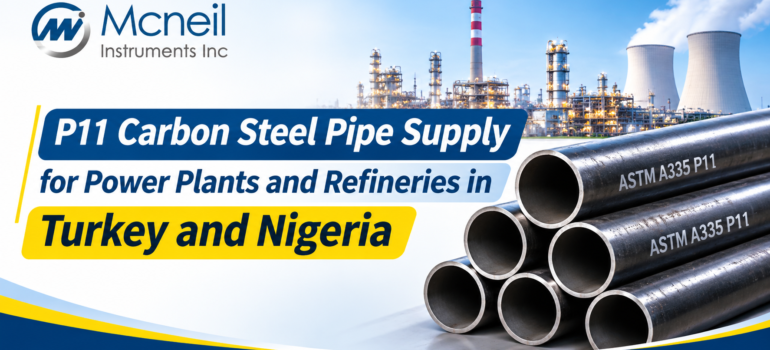
ASTM A335 P11 carbon steel pipes supplied by Mcneil Instruments Inc. for power plants and refineries in Turkey and Nigeria.

P11 Carbon Steel Pipe Supply for Power Plants and Refineries in Turkey and Nigeria

Power plants and refineries operate under demanding conditions where high temperatures, pressure and continuous operations place significant stress on piping systems. Selecting the right piping material is essential for maintaining operational safety, equipment reliability and long-term performance. ASTM A335 Grade P11 pipes are widely used in high-temperature industrial applications because of their strength, heat resistance and ability to perform in demanding service conditions.

At Mcneil Instrument, we understand the importance of supplying quality alloy steel piping solutions for critical industrial projects. We support industrial buyers, engineering contractors, distributors and project procurement teams looking for P11 alloy steel pipes for power generation, petrochemical and refinery applications in Turkey and Nigeria.

Understanding ASTM A335 Grade P11 Pipes

ASTM A335 Grade P11 is a chromium-molybdenum alloy steel pipe designed for high-temperature service. Although it is sometimes commercially searched for as P11 carbon steel pipe, P11 is technically classified as a low-alloy chrome-moly steel grade.

Its typical chemical composition includes approximately 1.00–1.50% chromium and 0.44–0.65% molybdenum. Chromium contributes to oxidation and corrosion resistance, while molybdenum improves high-temperature strength and creep resistance.

These properties make P11 pipes suitable for applications involving elevated temperatures, pressure and demanding operating conditions.

P11 pipes are commonly specified under ASTM A335, which covers seamless ferritic alloy-steel pipe intended for high-temperature service.

Why Choose P11 Pipes for Power Plants?

Power generation facilities require piping materials capable of handling elevated temperatures, steam pressure and continuous operating cycles. P11 alloy steel pipes are used in selected power plant applications where high-temperature mechanical properties are important.

Key benefits include:
High-Temperature Strength: Suitable for piping systems exposed to elevated operating temperatures.
Creep Resistance: Chromium-molybdenum alloy composition supports resistance to deformation under prolonged high-temperature stress.
Oxidation Resistance: Chromium helps improve resistance to oxidation at elevated temperatures.
Pressure Handling: Appropriate pipe dimensions, wall thickness and material properties support demanding pressure applications when correctly engineered.
Industrial Reliability: Suitable for properly designed steam, boiler and process piping systems.

Depending on the engineering design, P11 pipes may be specified for steam lines, boiler-related piping, superheater and reheater systems, and other high-temperature process applications.

Applications of P11 Alloy Steel Pipes in Refineries

Refineries require piping materials that can withstand elevated temperatures, pressure and challenging process environments. ASTM A335 P11 pipes are used in selected refinery and petrochemical applications where their high-temperature properties meet the design requirements.

Common applications include:

  1. Refinery Process Piping
    P11 pipes can be specified for high-temperature process lines in refinery installations, subject to operating conditions and engineering requirements.
  2. Heat Exchangers
    They may be used in associated high-temperature piping systems connected to heat exchangers and other thermal processing equipment.
  3. Petrochemical Plants
    Petrochemical facilities use alloy steel piping for process operations involving elevated temperatures and pressure.
  4. Steam Distribution Systems
    P11 pipes are suitable for selected steam piping applications where the required pressure and temperature ratings are satisfied.
  5. Industrial Heating Systems
    They can be used in high-temperature industrial piping systems where suitable material selection is essential for long-term service.

P11 Pipe Supply for Turkey’s Power and Refinery Industry

Turkey has an established industrial base covering power generation, petroleum refining, petrochemicals and manufacturing. These industries require dependable piping materials for new installations, plant upgrades, maintenance and expansion projects.

For industrial buyers in Istanbul, Ankara, Izmir, Kocaeli and other manufacturing and industrial regions, sourcing the correct alloy steel pipe grade is an important part of project procurement.

Mcneil Instruments Inc. supports international procurement requirements for P11 alloy steel pipes, helping buyers identify suitable material specifications for their applications.

When purchasing P11 pipes for projects in Turkey, buyers should consider:
ASTM A335 P11 material specifications
Required outside diameter and wall thickness
Pipe schedule and length requirements
Chemical composition and mechanical properties
Heat treatment and inspection requirements
Mill Test Certificates (MTC)
Export packaging and shipping documentation
Selecting a supplier that understands international material specifications helps streamline procurement and supports project quality requirements.

P11 Alloy Steel Pipe Supply for Nigeria’s Oil, Gas and Power Sector

Nigeria has significant oil and gas infrastructure, petroleum processing facilities and power generation requirements. These industries depend on reliable piping systems for high-temperature process operations, steam distribution and plant maintenance.

Industrial project buyers and contractors in Lagos, Port Harcourt, Abuja, Warri and other industrial locations may require alloy steel pipes for refinery projects, petrochemical facilities and power generation installations.

P11 alloy steel pipes can be considered for applications where their mechanical properties and temperature capabilities meet the project’s engineering specifications.

For Nigerian buyers, important procurement considerations include:
Compliance with ASTM A335 P11 requirements
Availability of the required pipe sizes and thicknesses
Material traceability and inspection documentation
Chemical and mechanical test reports
Third-party inspection, where specified
Export packing and delivery coordination

Working with an experienced international piping supplier can help procurement teams manage material specifications and sourcing requirements more efficiently.

Technical Specifications of ASTM A335 P11 Pipes

The following table provides a general overview of P11 alloy steel pipe specifications.
Parameter Details
Material Grade ASTM A335 Grade P11
Material Type Chromium-Molybdenum Alloy Steel
Product Type Seamless Alloy Steel Pipe
Chromium Content 1.00–1.50%
Molybdenum Content 0.44–0.65%
Standard ASTM A335 / ASME SA335
Manufacturing Seamless
Heat Treatment As specified by the applicable standard
Applications Power Plants, Refineries, Petrochemical Plants and High-Temperature Piping

Final chemical composition, mechanical properties, dimensions, heat treatment and inspection requirements should always be verified against the applicable standard edition and project specifications.

What to Consider When Purchasing P11 Pipes?

Choosing the right P11 pipe supplier involves more than comparing prices. Buyers should evaluate material quality, documentation, product specifications and export capabilities.

Material Compliance: Confirm that the pipes meet the specified ASTM A335 P11 requirements.
Material Traceability: Request Mill Test Certificates with heat numbers and relevant test results.
Dimensional Accuracy: Verify the outside diameter, wall thickness, schedule and length against project requirements.
Quality Inspection: Ensure that inspection and testing are carried out according to the purchase order and applicable standards.
Export Readiness: Confirm suitable packing, marking and shipping documentation for international deliveries.

These checks help reduce procurement risks and ensure that the supplied materials match the project’s engineering requirements.

Why Choose Mcneil Instrument for P11 Alloy Steel Pipe Supply?

At Mcneil Instrument., we focus on supplying industrial piping products and material solutions for demanding applications. We understand that every power plant, refinery and petrochemical project has specific technical and procurement requirements.

Our approach focuses on:
Material specifications aligned with project requirements
Alloy steel piping solutions for industrial applications
Support with technical documentation and material traceability
Coordination of inspection requirements
International supply and export support
Assistance with product selection based on application needs

Whether you are sourcing P11 alloy steel pipes for a power generation project in Turkey or a refinery application in Nigeria, selecting the correct material grade and specifications is essential.

Conclusion

ASTM A335 Grade P11 alloy steel pipes offer a combination of high-temperature strength, oxidation resistance and creep resistance that makes them suitable for selected power generation, refinery and petrochemical applications.

For buyers in Turkey and Nigeria, choosing the right supplier is an important part of maintaining material quality and meeting project specifications.

Mcneil Instrument supports industrial piping requirements with a focus on material specifications, documentation and dependable international supply solutions.

Contact our team to discuss your P11 alloy steel pipe requirements.

Looking for a Reliable P11 Alloy Steel Pipe Supplier?

Source ASTM A335 Grade P11 alloy steel pipes for power plants, refineries and petrochemical projects in Turkey and Nigeria.
Connect with Mcneil Instrument for product specifications, technical documentation and export supply enquiries.
Contact Us Today for a Competitive Quotation.
Website: https://mcneilinstrument.com

Frequently Asked Questions (FAQs)

  1. What is ASTM A335 Grade P11 pipe?
    ASTM A335 Grade P11 is a seamless chromium-molybdenum alloy steel pipe designed for high-temperature service. It is commonly used in power plants, refineries and petrochemical facilities.
  2. Is P11 a carbon steel or alloy steel pipe?
    P11 is technically a low-alloy chromium-molybdenum steel grade, not conventional carbon steel. It contains chromium and molybdenum to improve its high-temperature properties.
  3. What is the chemical composition of P11 pipe?
    P11 typically contains 1.00–1.50% chromium and 0.44–0.65% molybdenum, along with carbon, manganese, silicon and other elements within the specified limits.
  4. What is the difference between P11 and P22 pipes?
    Both are chromium-molybdenum alloy steel grades used in high-temperature applications. P11 generally contains 1.00–1.50% chromium and 0.44–0.65% molybdenum, while P22 contains approximately 1.90–2.60% chromium and 0.87–1.13% molybdenum. Their selection depends on design temperature, pressure and engineering requirements.
  5. Where are P11 alloy steel pipes commonly used?
    P11 pipes are used in selected steam piping systems, power plants, refineries, petrochemical facilities, heat exchanger connections and other high-temperature industrial applications.
  6. Are P11 pipes suitable for refinery applications in Nigeria?
    Yes, P11 pipes can be suitable for selected refinery and petrochemical applications in Nigeria when the material grade meets the project’s operating temperature, pressure, process conditions and engineering specifications.
  7. Can P11 pipes be supplied for industrial projects in Turkey?
    Yes, international suppliers can support P11 pipe procurement for power plants, refineries and industrial projects in Turkey, subject to required dimensions, specifications and delivery arrangements.
  8. What documents should be provided with P11 pipes?
    Typical documentation includes Mill Test Certificates (MTC), chemical composition reports, mechanical test results, heat treatment records and applicable inspection reports. Additional documentation depends on project and purchaser requirements.
  9. What sizes are available for ASTM A335 P11 pipes?
    P11 pipes are manufactured in different nominal pipe sizes, outside diameters and wall thicknesses. Availability depends on manufacturer capability and order requirements.
  10. How can I request a quotation for P11 alloy steel pipes?
    You can contact Mcneil Instrument with your required grade, pipe size, schedule, quantity, applicable standard, destination country and documentation requirements to request a quotation.
Read More
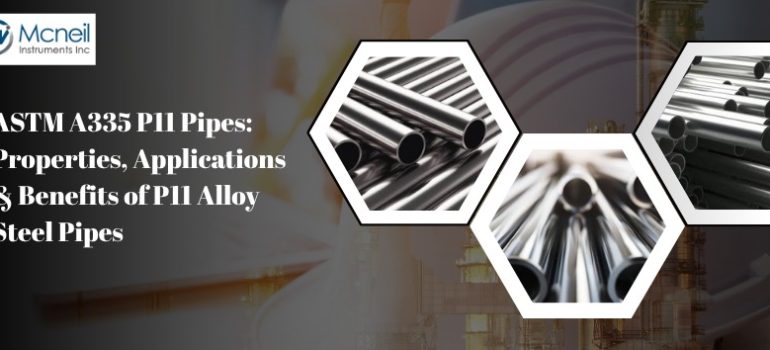
ASTM A335 P11 alloy steel pipes shown in various industrial pipe configurations with Mcneil Instruments Inc. branding.

ASTM A335 P11 Pipes: Properties, Applications & Benefits of P11 Alloy Steel Pipes

ASTM A335 P11 pipes are chromium-molybdenum alloy steel pipes designed for elevated-temperature and high-pressure service. They are widely used in power generation, petrochemical plants, refineries, boilers, steam systems, and heat-transfer applications where ordinary carbon steel may not provide the required high-temperature performance.
P11 is one of the most commonly specified Cr-Mo grades because it offers a practical balance of high-temperature strength, creep resistance, oxidation resistance, weldability, and cost.

What Is ASTM A335 P11 Pipe?

ASTM A335 P11 is a seamless ferritic alloy steel pipe grade intended for high-temperature service.
The material is commonly identified as:
ASTM A335 Grade P11
ASME SA335 Grade P11
P11 Alloy Steel Pipe
Chrome Moly P11 Pipe
1.25Cr-0.5Mo Pipe
The chromium-molybdenum chemistry gives P11 properties that make it suitable for piping systems exposed to elevated temperatures for extended periods.
P11 is particularly important in applications where piping must maintain mechanical integrity while exposed to heat, pressure, and thermal cycling.

ASTM A335 P11 Chemical Composition

The defining feature of P11 is its chromium-molybdenum alloy composition.
A typical ASTM A335 P11 chemical composition includes approximately:
Element P11 Composition
Carbon 0.05–0.15%
Manganese 0.30–0.60%
Silicon 0.50–1.00%
Chromium 1.00–1.50%
Molybdenum 0.44–0.65%
Phosphorus Max. 0.025%
Sulfur Max. 0.025%
The balance is iron.
The exact chemical limits should always be verified against the applicable edition of ASTM A335/A335M and the project’s material specification.
Why Chromium and Molybdenum Matter
Chromium contributes to oxidation resistance and high-temperature stability.
Molybdenum contributes to high-temperature strength and resistance to softening and creep.
Together, these elements make P11 more suitable for elevated-temperature service than many conventional carbon steel grades.

Mechanical Properties of ASTM A335 P11

P11 is designed to retain useful mechanical properties under elevated-temperature service.
Typical minimum room-temperature mechanical requirements associated with ASTM A335 P11 include:
Property Typical Minimum Requirement
Tensile Strength 415 MPa
Yield Strength 205 MPa
Elongation 30%*
*Elongation requirements can vary with pipe dimensions and applicable specification provisions.
The combination of strength and ductility makes P11 suitable for pressure-containing piping systems.
However, room-temperature tensile properties alone do not determine whether P11 is appropriate for a particular high-temperature application. Design temperature, allowable stress, creep behavior, thermal cycling, and fabrication requirements also need to be considered.

Heat Resistance of P11 Alloy Steel Pipes

One of the primary reasons P11 is used in industrial piping is its performance at elevated temperatures.
Carbon steel can lose strength as operating temperatures increase. The chromium-molybdenum alloying in P11 improves its ability to withstand elevated-temperature service.
P11 can provide:
Improved high-temperature strength
Better oxidation resistance
Greater resistance to thermal degradation
Improved creep resistance compared with conventional carbon steel
Stable performance during prolonged thermal exposure
This makes P11 particularly useful in steam, boiler, refinery, and petrochemical piping systems.

Creep Resistance of P11

Creep is the gradual deformation of a material under sustained stress at elevated temperature.
For power plants, refineries, and other high-temperature facilities, piping can remain under pressure and temperature for thousands of operating hours.
P11’s chromium-molybdenum composition provides improved resistance to creep and stress-related deformation compared with ordinary carbon steel in suitable temperature ranges.
This is one reason P11 is used in systems where long-term elevated-temperature service is expected.

Oxidation Resistance

High-temperature piping can experience oxidation and scaling when exposed to elevated temperatures.
The chromium in P11 helps improve oxidation resistance compared with plain carbon steel.
This does not mean P11 is immune to oxidation or corrosion. The actual performance depends on:
Temperature
Process medium
Exposure time
Atmosphere
Surface condition
Operating environment
For highly corrosive services, a different alloy may be required.

Why P11 Is Widely Used

P11 has become a popular alloy steel pipe grade because it provides a useful balance between performance and practicality.

  1. Good High-Temperature Strength
    P11 retains useful strength under elevated-temperature conditions.
  2. Improved Creep Resistance
    The Cr-Mo composition helps P11 resist long-term deformation under heat and stress.
  3. Good Oxidation Resistance
    Its chromium content provides improved resistance to oxidation at elevated temperatures.
  4. Suitable Weldability
    P11 can be welded using qualified procedures, although appropriate preheating, heat treatment, consumables, and post-weld requirements must be considered.
  5. Broad Industrial Availability
    P11 is a well-established material used throughout power and process industries.
  6. Practical Material Selection
    For many high-temperature applications, P11 provides a useful middle ground between conventional carbon steel and higher-alloy materials.

ASTM A335 P11 Pipes in Power Generation

Power generation is one of the most important application areas for P11 pipes.
Power plants contain numerous systems operating under elevated temperature and pressure.
P11 can be used in suitable applications involving:
Boiler piping
Steam lines
Superheater systems
Reheater systems
Heat-transfer piping
High-temperature utility systems
The specific grade must be selected according to the plant’s design temperature, pressure, applicable construction code, and service requirements.

P11 Pipes for Boilers

Boiler systems require materials that can withstand sustained exposure to elevated temperatures and pressures.
P11 is used in selected boiler and steam applications because its Cr-Mo chemistry provides improved high-temperature performance.
Potential applications include:
Boiler tubes and piping
Steam connections
High-temperature headers
Superheater-related piping
Reheater systems
For boiler applications, material selection must also consider the applicable boiler and pressure-vessel code, fabrication procedure, heat treatment, inspection, and service conditions.

P11 Pipes in Petrochemical Plants

Petrochemical facilities operate numerous high-temperature process systems.
P11 can be used for suitable:
Process piping
Steam lines
Furnace-related piping
Heat-transfer systems
High-temperature utility lines
Refinery piping
Its resistance to elevated-temperature degradation makes it useful in applications where the piping remains exposed to heat for long periods.
However, the process chemistry must always be reviewed before selecting P11.

P11 Pipes for Refineries

Refineries contain high-temperature equipment and piping throughout crude processing and downstream operations.
P11 can be considered for applications involving:
Steam
Hot process fluids
High-temperature utility systems
Heat exchangers
Furnace systems
Process piping
For refinery service, material selection should account for temperature, pressure, hydrogen exposure, sulfur-containing environments, process chemistry, and applicable refinery specifications.

P11 vs Carbon Steel Pipes

One of the reasons P11 is selected is its improved high-temperature capability compared with conventional carbon steel.
Property P11 Alloy Steel Carbon Steel
Chromium Approx. 1–1.5% Generally very low
Molybdenum Approx. 0.44–0.65% Generally very low
High-Temperature Strength Higher for suitable service Lower
Oxidation Resistance Improved Lower
Creep Resistance Improved Lower
Typical High-Temperature Use Boilers, steam, refinery General process and utility piping
Relative Cost Higher Lower
This does not mean P11 should replace carbon steel everywhere. If the service conditions do not require alloy steel, carbon steel can remain the more economical choice.

P11 vs P22 Pipes

P11 and P22 are both chromium-molybdenum alloy steel grades.
However, P22 contains higher chromium and molybdenum levels.
Feature P11 P22
Chromium 1.00–1.50% 1.90–2.60%
Molybdenum 0.44–0.65% 0.87–1.13%
Alloy Level Lower Higher
Typical Applications Boilers, steam, process piping Higher-demand power and process applications
The choice between P11 and P22 should be based on the actual design conditions and applicable engineering requirements rather than simply choosing the higher-alloy grade.

P11 Pipe Manufacturing

ASTM A335 P11 pipes are seamless alloy steel pipes.
The manufacturing process generally involves:
Steelmaking
Billet preparation
Hot working
Piercing
Rolling or drawing
Heat treatment
Sizing
Straightening
Surface inspection
Dimensional inspection
Testing
Marking and documentation
The exact manufacturing route depends on the pipe size, production method, and manufacturer’s process.
Heat treatment is particularly important for Cr-Mo alloy steel because it influences the final microstructure and mechanical properties.

Heat Treatment of P11 Pipes

Proper heat treatment is essential for ASTM A335 P11 pipes.
Depending on the applicable specification and manufacturing route, heat treatment may involve normalizing and tempering or other permitted heat-treatment conditions.
The objective is to obtain the required metallurgical structure and mechanical properties.
For critical applications, buyers should verify:
Heat-treatment temperature
Holding time
Cooling method
Heat-treatment records
Furnace traceability
Mechanical test results

ASTM A335 P11 Pipe Sizes

P11 pipes can be manufactured in a wide range of nominal sizes and wall thicknesses.
Depending on the supplier and project, specifications may include:
Nominal Pipe Size
Outside Diameter
Wall Thickness
Schedule
Length
End Finish
Seamless construction
Common end preparations include:
Plain ends
Beveled ends
Threaded ends where applicable
The exact available dimensions should be confirmed against the purchase specification and applicable dimensional standard.

ASTM A335 P11 Standards

When purchasing P11 pipes, several standards may be relevant depending on the application.
ASTM A335
Covers seamless ferritic alloy steel pipe intended for high-temperature service.
ASME SA335
The ASME specification corresponding to ASTM A335 for applications covered by the ASME Boiler and Pressure Vessel Code.
ASME B36.10
May be relevant for dimensional requirements for steel pipe where applicable.
The buyer should specify the complete standard and edition required by the project rather than relying only on the term “P11 pipe.”

Testing of ASTM A335 P11 Pipes

High-temperature pressure piping requires appropriate quality control.
Depending on the purchase specification, testing can include:
Chemical Analysis
Confirms the alloy composition meets the specified chemistry.
Tensile Testing
Determines tensile strength and yield strength.
Hardness Testing
Confirms hardness requirements.
Hydrostatic Testing
Checks pressure integrity where required.
Ultrasonic Testing
Can be used to identify certain internal or surface discontinuities.
Visual and Dimensional Inspection
Confirms surface condition, dimensions, straightness, and workmanship.
PMI
Positive Material Identification can be used to verify alloy chemistry, particularly for critical projects.
Heat-Treatment Verification
Ensures the pipe received the specified thermal treatment.

How to Select ASTM A335 P11 Pipes

Before purchasing P11 pipes, evaluate the complete service requirement.
Operating Temperature
Determine normal, maximum, and design temperatures.
Operating Pressure
Identify the design pressure and required wall thickness.
Process Medium
Understand the chemical composition of the fluid or gas.
Corrosion Environment
Check for conditions involving:
Sulfur
Hydrogen
Chlorides
Acids
Moisture
Other corrosive contaminants
Thermal Cycling
Frequent heating and cooling can affect material performance and should be considered.
Welding Requirements
Review the welding procedure, preheating, post-weld heat treatment, filler material, and applicable code requirements.
Inspection Requirements
Determine whether the project requires:
Hydrotesting
NDE
PMI
Third-party inspection
MTCs
Heat-treatment records

Benefits of ASTM A335 P11 Pipes

The major benefits of P11 can be summarized as follows:
High-temperature capability: Suitable for elevated-temperature pressure service.
Creep resistance: Better long-term resistance to deformation than conventional carbon steel in appropriate service ranges.
Oxidation resistance: Chromium improves resistance to high-temperature oxidation.
Mechanical strength: Provides the strength required for many industrial pressure applications.
Weldability: Can be fabricated using qualified procedures.
Versatility: Used across power, petrochemical, refinery, boiler, and steam applications.
Established industry grade: P11 is a widely recognized Cr-Mo material with established fabrication and procurement practices.

Limitations of P11 Pipes

P11 is not the correct material for every application.
Potential limitations include:
Higher cost than carbon steel
Requires controlled welding procedures
Heat treatment requirements can increase fabrication complexity
Not suitable for every corrosive environment
Higher-alloy grades may be required for more severe temperatures or process conditions
Material selection must account for long-term creep performance
The correct pipe grade should therefore be determined by engineering analysis rather than by material name alone.

Conclusion

ASTM A335 P11 pipes are widely used chromium-molybdenum alloy steel pipes for elevated-temperature and pressure applications.
Their combination of approximately 1–1.5% chromium and 0.44–0.65% molybdenum provides improved high-temperature strength, oxidation resistance, and creep performance compared with conventional carbon steel.
These characteristics make P11 suitable for many applications in power generation, boilers, steam systems, refineries, petrochemical plants, heat-transfer equipment, and high-temperature process piping.
The biggest advantage of P11 is its balance. It provides enhanced high-temperature performance without moving immediately to a much higher-alloy material.
For successful application, however, the grade must be evaluated alongside temperature, pressure, process chemistry, creep requirements, welding procedure, heat treatment, inspection requirements, and the applicable ASTM/ASME code.

Frequently Asked Questions

What is ASTM A335 P11 pipe?
ASTM A335 P11 is a seamless ferritic chromium-molybdenum alloy steel pipe intended for high-temperature service.
What is the composition of P11?
P11 typically contains approximately 1–1.5% chromium and 0.44–0.65% molybdenum, along with controlled amounts of carbon, manganese, silicon, phosphorus, and sulfur.
What are P11 pipes used for?
P11 pipes are commonly used in power plants, boilers, steam systems, refineries, petrochemical plants, heat-transfer systems, and high-temperature process piping.
Is P11 suitable for high-temperature applications?
Yes. P11 is specifically designed for elevated-temperature service and offers improved high-temperature strength and creep resistance compared with conventional carbon steel.
What is the difference between P11 and P22?
P22 contains higher chromium and molybdenum than P11, providing different high-temperature performance characteristics. The appropriate grade depends on the application’s design conditions.
Is ASTM A335 P11 seamless?
Yes. ASTM A335 covers seamless ferritic alloy steel pipe intended for high-temperature service.
Is P11 weldable?
Yes, but welding requires an appropriate qualified procedure. Preheating, filler selection, post-weld heat treatment, and inspection requirements should be determined according to the applicable code and project specification.
Which industries use P11 pipes?
Major industries include power generation, oil and gas, petrochemical, refining, chemical processing, and industrial steam systems.
Why is P11 preferred over carbon steel for some applications?
P11 provides better high-temperature strength, oxidation resistance, and creep resistance for suitable elevated-temperature applications.
What standard covers P11 pipes?
The primary material specification is ASTM A335, with ASME SA335 used where required by ASME code applications.

Read More

Chrome Moly Pipe Manufacturers, Suppliers & Exporters in India – Mcneil Instrument

Introduction

Chrome Moly Pipes are widely used in industries that demand exceptional strength, heat resistance, and long-lasting performance under extreme operating conditions. Manufactured using chromium and molybdenum alloy steel, these pipes are designed to withstand high pressure, elevated temperatures, and corrosive environments.

Mcneil Instrument is one of the trusted Chrome Moly Pipe manufacturers, suppliers, and exporters in India, delivering premium-quality alloy steel pipes that comply with international standards. Our Chrome Moly Pipes are extensively supplied to power plants, refineries, petrochemical industries, oil & gas projects, and heavy engineering sectors across India and global markets.


Why Chrome Moly Pipes are Preferred Across Industries

Chrome Moly alloy steel offers an ideal combination of mechanical strength, thermal stability, and corrosion resistance, making it suitable for demanding industrial applications.

Key Advantages

✔ Excellent high-temperature strength

✔ Superior pressure resistance

✔ Outstanding corrosion and oxidation resistance

✔ Longer operational life

✔ Excellent weldability and machinability

✔ Reduced maintenance requirements

These properties make Chrome Moly Pipes a preferred solution for critical piping systems operating under harsh conditions.


Features of Chrome Moly Pipes

Mcneil Instrument manufactures high-quality Chrome Moly Pipes engineered for reliability and durability.

Our pipes offer:

  • High tensile and yield strength
  • Excellent creep resistance
  • Smooth internal and external surface finish
  • Accurate dimensions and wall thickness
  • Leak-proof performance
  • Easy fabrication and installation
  • Suitable for high-pressure applications

Every product undergoes strict quality inspections before dispatch.


Available Chrome Moly Pipe Grades

We supply Chrome Moly Pipes in various internationally recognized grades, including:

  • ASTM A335 P5 Pipes
  • ASTM A335 P9 Pipes
  • ASTM A335 P11 Pipes
  • ASTM A335 P22 Pipes
  • ASTM A335 P91 Pipes
  • ASTM A213 Chrome Moly Tubes
  • Seamless Chrome Moly Pipes
  • Welded Chrome Moly Pipes

These grades are selected according to the temperature, pressure, and application requirements of each project.


Industrial Applications of Chrome Moly Pipes

Chrome Moly Pipes are used in numerous industrial sectors where high-performance materials are essential.

Industries Served

  • Oil & Gas Plants
  • Petroleum Refineries
  • Petrochemical Industries
  • Thermal Power Plants
  • Nuclear Power Stations
  • Chemical Processing Units
  • Fertilizer Plants
  • Boiler Manufacturing
  • Heat Exchangers
  • Pressure Vessel Manufacturing
  • Offshore Platforms
  • Marine Engineering
  • Steel Processing Plants
  • Heavy Engineering Industries

Our products are trusted for both domestic and international industrial projects.


Why High-Quality Chrome Moly Pipes Matter

Selecting premium-grade Chrome Moly Pipes ensures operational safety, efficiency, and long-term cost savings.

Benefits include:

✔ Reduced downtime

✔ Enhanced system reliability

✔ Better thermal performance

✔ Increased resistance to scaling and oxidation

✔ Lower maintenance costs

✔ Longer equipment lifespan

High-quality piping systems contribute significantly to plant productivity and operational efficiency.


Quality Standards Followed by Mcneil Instrument

As a leading Chrome Moly Pipe manufacturer in India, Mcneil Instrument follows rigorous manufacturing and quality control procedures.

Our quality commitment includes:

  • Premium raw materials
  • Precision manufacturing
  • International ASTM and ASME standards
  • Dimensional accuracy inspections
  • Hydrostatic testing
  • Chemical composition verification
  • Mechanical testing
  • Third-party inspection support

Every pipe is manufactured to deliver consistent performance in demanding environments.


Why Choose Mcneil Instrument for Chrome Moly Pipes in India

Mcneil Instrument has earned a strong reputation for supplying reliable industrial piping solutions across India and worldwide.

What Makes Us Different?

✔ Experienced Chrome Moly Pipe manufacturer

✔ Wide range of alloy steel pipe grades

✔ International quality standards

✔ Competitive pricing

✔ Timely nationwide and global delivery

✔ Customized sizes and specifications

✔ Expert technical support

✔ Strong focus on customer satisfaction

We provide dependable piping solutions tailored to diverse industrial requirements.


Benefits of Choosing Chrome Moly Pipes

Businesses across India prefer Chrome Moly Pipes because they offer:

📈 Exceptional strength under high temperatures

🔥 Superior heat resistance

⚙ Reliable performance in pressure applications

🌍 Excellent corrosion resistance

💰 Lower lifecycle costs

🚀 Increased operational efficiency

These advantages make Chrome Moly Pipes a valuable investment for modern industrial infrastructure.


Partner with Mcneil Instrument for Premium Chrome Moly Pipes in India

Looking for dependable Chrome Moly Pipe manufacturers, suppliers, or exporters in India?

Mcneil Instrument provides high-performance Chrome Moly Pipes engineered to meet the stringent requirements of industrial applications. Our commitment to quality, precision manufacturing, and timely delivery has made us a trusted partner for industries across India and overseas.

Company Name: Mcneil Instrument

Website: https://mcneilinstrument.com/chrome-moly-pipe.html

Phone: +91 9870883613

👉 Contact Mcneil Instrument today for expert guidance and a competitive quote on premium Chrome Moly Pipes for your industrial projects.


Frequently Asked Questions (FAQ)

1. What are Chrome Moly Pipes?

Chrome Moly Pipes are alloy steel pipes containing chromium and molybdenum, designed for high-temperature and high-pressure industrial applications.

2. Where are Chrome Moly Pipes commonly used?

They are widely used in power plants, oil & gas industries, refineries, petrochemical plants, boilers, heat exchangers, and chemical processing facilities.

3. What are the benefits of Chrome Moly Pipes?

These pipes offer high strength, excellent heat resistance, corrosion protection, long service life, and reliable performance under extreme operating conditions.

4. Does Mcneil Instrument supply Chrome Moly Pipes across India?

Yes. Mcneil Instrument supplies Chrome Moly Pipes to customers across India while also serving international markets through its export network.

5. Are custom sizes and specifications available?

Yes. We manufacture and supply Chrome Moly Pipes in various grades, sizes, schedules, and customized specifications to meet project requirements.

6. Why choose Mcneil Instrument for Chrome Moly Pipes?

Mcneil Instrument offers certified quality products, precision manufacturing, competitive pricing, timely delivery, and comprehensive technical support for industrial piping solutions.

Read More