Beyond Standard Flanges: Why ASTM A182 F5, F9, F11, F22 & F91 Alloy Steel Flanges Are Essential for High-Temperature Industrial Operations

Introduction

Industrial facilities operating under extreme temperatures and high-pressure conditions require piping components that deliver strength, reliability, and long-term performance. In sectors such as power generation, petrochemical processing, oil & gas refining, thermal power plants, LNG terminals, and chemical manufacturing, flange failures can lead to costly downtime and operational risks.

This is why ASTM A182 Alloy Steel Flanges remain one of the most preferred flange materials for critical industrial applications.

Manufactured from chromium-molybdenum alloy steel, ASTM A182 F5, F9, F11, F22, and F91 Alloy Steel Flanges are specifically engineered to withstand elevated temperatures, pressure fluctuations, thermal stress, and corrosive environments. These flanges are widely used for connecting pipes, valves, pumps, and pressure equipment where ordinary carbon steel components may not perform effectively.

At Mcneil Instrument, a comprehensive range of Alloy Steel Flanges is supplied to customers worldwide, supporting some of the most demanding industrial projects across the energy and process sectors.

Why Alloy Steel Flanges Matter in Critical Piping Systems

Industrial piping networks must withstand:

• High-pressure steam
• Extreme temperatures
• Thermal cycling conditions
• Corrosive process media
• Mechanical stress
• Continuous plant operation

ASTM A182 Alloy Steel Flanges provide:

• Excellent heat resistance
• Superior creep strength
• Outstanding oxidation resistance
• High tensile strength
• Long service life
• Reliable sealing performance

These advantages make Chrome Moly Flanges a preferred choice for critical service applications.

Mcneil Instrument: Trusted Supplier of ASTM A182 Alloy Steel Flanges

Mcneil Instrument is a leading manufacturer, supplier, exporter, stockist, and distributor of:

• ASTM A182 F5 Alloy Steel Flanges
• ASTM A182 F9 Alloy Steel Flanges
• ASTM A182 F11 Alloy Steel Flanges
• ASTM A182 F22 Alloy Steel Flanges
• ASTM A182 F91 Alloy Steel Flanges

The company manufactures flanges in accordance with ASME and international quality standards for use in power plants, refineries, petrochemical facilities, boilers, and pressure systems.

ASTM A182 F5 Alloy Steel Flanges

Reliable Oxidation Resistance for High-Temperature Service

ASTM A182 F5 Alloy Steel Flanges contain approximately 5% chromium and 0.5% molybdenum, providing excellent resistance against oxidation and elevated temperatures.

Key Benefits

• Excellent thermal stability
• Good corrosion resistance
• Strong mechanical properties
• Long-term durability

Applications

• Refineries
• Heat Exchangers
• Industrial Furnaces
• Process Piping Systems

ASTM A182 F9 Alloy Steel Flanges

Enhanced Strength for Severe Operating Conditions

ASTM A182 F9 Alloy Steel Flanges are designed for high-temperature and high-pressure service environments.

Advantages

• Superior creep resistance
• Enhanced mechanical strength
• Excellent oxidation resistance
• Improved thermal performance

Applications

• Thermal Power Plants
• Petrochemical Facilities
• High-Pressure Steam Systems
• Boiler Installations

ASTM A182 F11 Alloy Steel Flanges

The Industry’s Most Popular Chrome Moly Flange Grade

ASTM A182 F11 Alloy Steel Flanges are widely used due to their excellent combination of strength, weldability, and heat resistance.

Features

• Excellent weldability
• High tensile strength
• Reliable thermal stability
• Good corrosion resistance

Applications

• Power Generation Plants
• Steam Pipelines
• Petrochemical Units
• Pressure Vessels

ASTM A182 F22 Alloy Steel Flanges

Built for High-Pressure and High-Temperature Operations

ASTM A182 F22 Alloy Steel Flanges offer superior creep resistance and exceptional durability under elevated temperatures.

Benefits

• Outstanding pressure handling capability
• Excellent thermal stability
• Long operational life
• Reliable mechanical performance

Applications

• Boilers
• Heat Exchangers
• Steam Systems
• Refinery Processing Units

ASTM A182 F91 Alloy Steel Flanges

Advanced Alloy Steel Solution for Extreme Conditions

ASTM A182 F91 Alloy Steel Flanges are among the highest-performing chrome moly flanges available.

Containing approximately 9% chromium and 1% molybdenum with additional strengthening elements, F91 flanges are engineered for the most demanding industrial environments.

Advantages

• Exceptional creep resistance
• Superior heat resistance
• Outstanding mechanical strength
• Excellent thermal fatigue resistance

Applications

• Supercritical Power Plants
• Nuclear Facilities
• High-Temperature Steam Pipelines
• Petrochemical Refineries

Types of Alloy Steel Flanges Available

Mcneil Instrument supplies a complete range of Alloy Steel Flanges including:

Weld Neck Flanges

Ideal for high-pressure and high-temperature service.

Slip-On Flanges

Easy installation and cost-effective operation.

Blind Flanges

Used to isolate piping systems and pressure vessels.

Socket Weld Flanges

Suitable for smaller diameter high-pressure pipelines.

Threaded Flanges

Designed for systems where welding is not preferred.

Lap Joint Flanges

Ideal for systems requiring frequent maintenance and inspection.

Technical Specifications

SpecificationDetails
StandardASTM A182 / ASME SA182
GradesF5, F9, F11, F22, F91
Size Range½” to 48″
Pressure Class150# to 2500#
Flange TypesWeld Neck, Slip-On, Blind, Socket Weld, Threaded
StandardsASME B16.5, ASME B16.47

Industries Using ASTM A182 Alloy Steel Flanges

Power Generation Industry

Used in:

• Boilers
• Steam Pipelines
• Turbine Systems
• Heat Recovery Units

Oil & Gas Industry

Supports:

• Refineries
• Processing Facilities
• Pipeline Networks
• Offshore Installations

Petrochemical Industry

Provides reliable performance in:

• High-temperature processing units
• Chemical transfer systems
• Pressure equipment

LNG Industry

Used in:

• LNG Processing Facilities
• Storage Systems
• Cryogenic Infrastructure

Chemical Processing Industry

Supports corrosive and high-temperature operations.

Why Global Industries Choose Mcneil Instrument

Mcneil Instrument continues to supply Alloy Steel Flanges to customers across the Middle East, Asia, Europe, and Africa.

Key strengths include:

• ASTM and ASME compliant manufacturing
• Ready stock availability
• Extensive grade range
• International exports
• Advanced quality testing procedures
• Competitive project pricing

Conclusion

As industrial systems continue operating under higher temperatures and greater pressures, the demand for reliable flange solutions continues to grow.

Whether it is ASTM A182 F5 Alloy Steel Flanges, ASTM A182 F9 Alloy Steel Flanges, ASTM A182 F11 Alloy Steel Flanges, ASTM A182 F22 Alloy Steel Flanges, or ASTM A182 F91 Alloy Steel Flanges, these products deliver the strength, durability, and performance required for critical industrial applications.

With extensive manufacturing expertise and global supply capabilities, Mcneil Instrument remains a trusted partner for premium Alloy Steel Flanges serving the world’s most demanding industries.
Read More

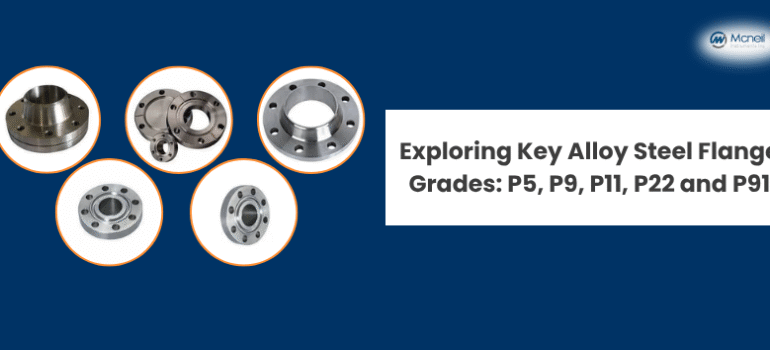
Exploring Key Alloy Steel Flange Grades: P5, P9, P11, P22 and P91

In industries that rely on high-temperature, high-pressure environments like oil & gas, petrochemical, thermal power, and refineries alloy steel flanges play a critical role in ensuring leak-proof connections and long-term structural integrity. Among the many options, grades P5, P9, P11, P22 and P91 stand out for their specific chemical compositions, performance under stress, and temperature resistance.

Mcneil Instrument, a leading entity in India, stands at the forefront as a premier manufacturer, supplier, and exporter of these specialized alloy steel flanges. We understand that selecting the correct flange grade is not merely a technicality; it’s a critical decision impacting system performance, safety, and longevity. This guide aims to demystify these key alloy steel flange grades, offering engineers and buyers comprehensive insights into their properties, applications, and the distinct advantages of partnering with a seasoned expert like Mcneil Instrument.

Whether you’re an engineer, procurement professional, or EPC contractor, understanding these alloy steel flange grades can help you make the right selection for your piping system avoiding material failures and costly downtime.

Why Alloy Steel for Flanges?

Alloy steel flanges are favored over carbon steel in applications where elevated temperatures and corrosive environments are involved. The addition of alloying elements like Chromium (Cr) and Molybdenum (Mo) enhances mechanical strength, creep resistance, and corrosion resistance properties that are essential for systems under prolonged thermal stress.

Overview of Grades: P5, P9, P11, P22 and P91

Each grade under the ASTM A182 / A336 / A234 / A387 or ASME SA series has its unique composition and use case. Here’s a breakdown of the most widely used ones:

These “P-grades” are part of the ASTM A182/ASME SA182 specification, which covers forged or rolled alloy-steel pipe flanges, forged fittings, and valves for high-temperature service. Each grade has a specific chemical composition that dictates its unique properties and suitability for different operational parameters.

Here’s a brief breakdown of each:

  • P5 Alloy Steel Flanges (5% Cr, 0.5% Mo):
    • Composition: Contains approximately 5% Chromium and 0.5% Molybdenum.
    • Characteristics: Offers good resistance to corrosion and oxidation at moderate-to-high temperatures. The Chromium provides better scaling resistance than lower alloy grades, while Molybdenum enhances high-temperature strength and creep resistance.
    • Typical Uses: Used in refineries, petrochemical plants, and power generation for systems dealing with less aggressive corrosive media but requiring elevated temperature service.
  • P9 Alloy Steel Flanges (9% Cr, 1% Mo):
    • Composition: Contains approximately 9% Chromium and 1% Molybdenum.
    • Characteristics: Provides significantly enhanced resistance to oxidation, corrosion, and hydrogen attack compared to P5. The higher Cr and Mo content boosts its high-temperature strength and creep rupture strength, extending its operating temperature range.
    • Typical Uses: Employed in more severe high-temperature applications within power plants (e.g., boiler components, superheater outlets) and advanced refinery units where higher resistance to sulfidation and hydrogen damage is required.
  • P11 Alloy Steel Flanges (1.25% Cr, 0.5% Mo):
    • Composition: Features about 1.25% Chromium and 0.5% Molybdenum.
    • Characteristics: A very popular and versatile grade offering excellent high-temperature strength, good creep resistance, and reasonable resistance to oxidation. It balances performance with cost-effectiveness for a wide range of applications.
    • Typical Uses: Widely used in conventional thermal power plants, industrial boilers, steam piping, and various parts of refinery and chemical processing units.
  • P22 Alloy Steel Flanges (2.25% Cr, 1% Mo):
    • Composition: Contains approximately 2.25% Chromium and 1% Molybdenum.
    • Characteristics: Offers superior creep rupture strength and high-temperature performance compared to P11. The increased Cr and Mo content further enhances its resistance to oxidation, sulfidation, and hydrogen attack. Designed for the most severe high-temperature and high-pressure applications.
    • Typical Uses: Crucial for critical components in modern ultra-supercritical power plants (e.g., main steam lines, headers, reheater sections), and highly demanding refinery applications.
  • P91 Alloy Steel Flanges (9% Cr, 1% Mo, V, Nb, N):
    • Composition: Contains approximately 8–9.5% Chromium, 0.85–1.05% Molybdenum, with additions of Vanadium (0.18–0.25%), Niobium (0.06–0.10%), and Nitrogen (0.03–0.07%). This complex chemistry enhances long-term strength and creep resistance.
    • Characteristics: P91 is a high-performance, creep-resistant alloy designed for supercritical and ultra-supercritical temperature service. It offers exceptional thermal fatigue resistance, long-term dimensional stability, and high creep rupture strength. Its fine microstructure, achieved through precise heat treatment, ensures durability under continuous high-temperature, high-pressure conditions.
    • Typical Uses: Extensively used in modern thermal and nuclear power plants, particularly for superheater and reheater tubes, steam headers, high-pressure pipelines, and refinery heat exchanger systems. Ideal for systems exposed to prolonged stress at elevated temperatures.

Comparison Table: Alloy Steel Grades P5, P9, P11, P22 and P91

GradeChromium (%)Molybdenum (%)Max TemperatureCommon Use
P54–60.4–0.6~590°CRefineries, Steam Lines
P98–100.9–1.1~600°CPower Plants, Superheated Systems
P111–1.50.4–0.6~570°CBoilers, Economizers
P222.0–2.50.87–1.13~600°CReheaters, High Pressure Systems
P91
8.0–9.5


0.85–1.05~650–670°CSupercritical Boilers, Long-Term High Temp Systems

Technical Specifications & Mechanical Properties

PropertyP5P9P11P22
Tensile Strength≥ 415 MPa≥ 585 MPa≥ 415 MPa≥ 415 MPa
Yield Strength≥ 205 MPa≥ 275 MPa≥ 205 MPa≥ 205 MPa
Elongation≥ 20%≥ 20%≥ 20%≥ 20%
Hardness≤ 197 HBW≤ 197 HBW≤ 197 HBW≤ 197 HBW

Certifications to Look For

When sourcing alloy steel flanges, especially for critical operations, certifications are non-negotiable.

CertificationRelevance
ASTM / ASME ComplianceProduct standard conformity
EN 10204 3.1 / 3.2Mill Test Certificate (MTC)
IBR CertificationFor Indian Boiler Regulations
ISO 9001:2015Quality Management Systems
NACE MR0175Sour service compatibility (optional)

Why Mcneil Instrument for Alloy Steel Flanges?

Mcneil Instrument is a leading manufacturer, supplier, and exporter of P5, P9, P11, P22 and P91 alloy steel flanges in India. Our reputation is built on precision, durability, and international-grade metallurgy. Here’s what makes us stand out:

  • Comprehensive Stock of alloy flanges in varied sizes, pressure ratings (Class 150 to 2500), and face types (RF, FF, RTJ).
  • In-house Testing: PMI, ultrasonic testing, hydro testing, and mechanical verification.
  • Global Export Network: Serving clients in Saudi Arabia, Qatar, Nigeria, Malaysia, Brazil, and Singapore.
  • Custom Orders for plant shutdowns, EPCs, and urgent replacement needs.

Conclusion: 

Choosing between P5, P9, P11, P22 and P91 alloy steel flange grades comes down to understanding operating temperatures, pressure ratings, and corrosive exposure. Whether you’re replacing components or designing new systems, the right flange material can extend service life and enhance system safety.

For guaranteed quality and expert guidance, trust Mcneil Instrument – your reliable partner in high-performance alloy steel flanges.

Read More