

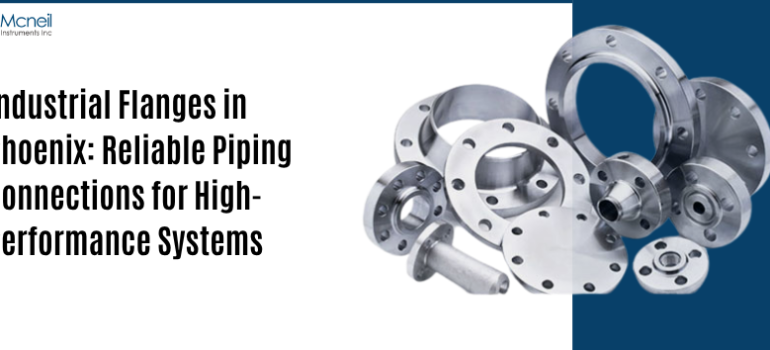
Industrial Flanges in Phoenix: Reliable Piping Connections for High-Performance Systems
Introduction: Why Flanges Matter in Industrial Piping
In any industrial setup, pipes alone don’t complete the system—it’s the connections that determine how reliable everything is. A weak joint can lead to leaks, downtime, or even safety risks.
That’s exactly where flanges come in. They provide a strong, detachable, and leak-proof connection between pipes, valves, and equipment, making maintenance and system control much easier.
In Phoenix, where industries like manufacturing, water treatment, construction, and energy operate in demanding conditions, industrial flanges are essential for ensuring durability, efficiency, and long-term system performance.
What Are Flanges?
Flanges are mechanical components used to connect pipes, valves, pumps, and other equipment, forming a secure and sealed piping system.
They are typically attached using bolts and gaskets, which help create a tight seal and prevent leakage while allowing easy disassembly when needed.
Key Functions
• Create leak-proof connections
• Allow easy maintenance and inspection
• Enable quick assembly and disassembly
• Ensure proper alignment of piping systems
Flanges are widely used in systems where reliability and access for maintenance are critical.
Types of Industrial Flanges
Different applications require different flange designs. Choosing the right type depends on pressure, temperature, and system requirements.
Weld Neck Flanges
• Designed for high-pressure and high-temperature systems
• Strongest type due to tapered hub design
• Ideal for critical applications
Slip-On Flanges
• Easy to install and align
• Cost-effective for low-pressure systems
Blind Flanges
• Used to seal pipeline ends
• Ideal for testing and maintenance
Socket Weld Flanges
• Suitable for small-diameter, high-pressure pipes
• Provides strong and reliable connections
Threaded Flanges
• No welding required
• Used in low-pressure applications
These flange types are commonly used across industrial piping systems depending on operational needs.
Materials Used in Flanges
Flanges are manufactured using different materials to suit specific environments and industries.
Common Materials
| Material | Application |
| Stainless Steel | Corrosion-resistant and hygienic environments |
| Carbon Steel | General industrial use |
| Alloy Steel | High-temperature and high-pressure systems |
| Duplex Steel | Marine and offshore environments |
| Nickel Alloys | Extreme corrosion resistance |
Material selection depends on pressure, temperature, and environmental conditions.
Technical Specifications of Flanges
| Specification | Details |
| Standards | ASME B16.5 / B16.47 |
| Size Range | ½″ to 48″ |
| Pressure Class | 150# to 2500# |
| Face Types | RF, FF, RTJ |
| Manufacturing | Forged / Machined |
Flanges are standardized globally to ensure compatibility and performance across piping systems.
Key Advantages of Flanges
Strong and Leak-Proof Connections
Flanges create secure joints that prevent leakage in high-pressure systems.
Easy Maintenance
They allow quick dismantling for repairs or inspections.
High Pressure & Temperature Handling
Designed to perform under extreme industrial conditions.
Flexibility in System Design
Available in multiple sizes, materials, and configurations.
Long Service Life
Durable and reliable for long-term industrial use.
Flanged connections are widely preferred because they combine strength with accessibility.
Industrial Applications of Flanges in Phoenix
Phoenix has a growing industrial landscape, including manufacturing, construction, and utilities. Flanges play a key role across these sectors.
Water Treatment Plants
Used in pipelines for clean water and wastewater systems.
Construction & Infrastructure
Used in HVAC systems, plumbing, and structural piping.
Manufacturing Industry
Supports machinery, fluid systems, and process piping.
Energy & Power Sector
Used in boilers, turbines, and heat exchangers.
Oil & Gas & Chemical Processing
Ensures safe handling of fluids under pressure.
Flanges are commonly used in industries where pipelines need strength, flexibility, and easy maintenance access.
How Flanged Connections Work
A typical flanged joint consists of:
• Two flanges
• A gasket placed between them
• Bolts and nuts to tighten the connection
This assembly creates a tight seal that prevents leakage while allowing disassembly when required.
Quality Testing of Flanges
To ensure performance and safety, flanges undergo strict quality checks:
• Chemical composition testing
• Mechanical strength testing
• Hydrostatic pressure testing
• Ultrasonic testing
• Radiographic inspection
• Dimensional inspection
These tests ensure flanges meet international standards and perform reliably in industrial environments.
Conclusion
Flanges are a critical part of any industrial piping system, providing strong, leak-proof, and maintainable connections between components.
In Phoenix, where industries demand reliability and efficiency, industrial flanges play a key role in ensuring smooth operations across sectors like water treatment, manufacturing, and energy.
With a wide range of types, materials, and specifications, flanges continue to be one of the most trusted solutions for modern piping infrastructure.


