

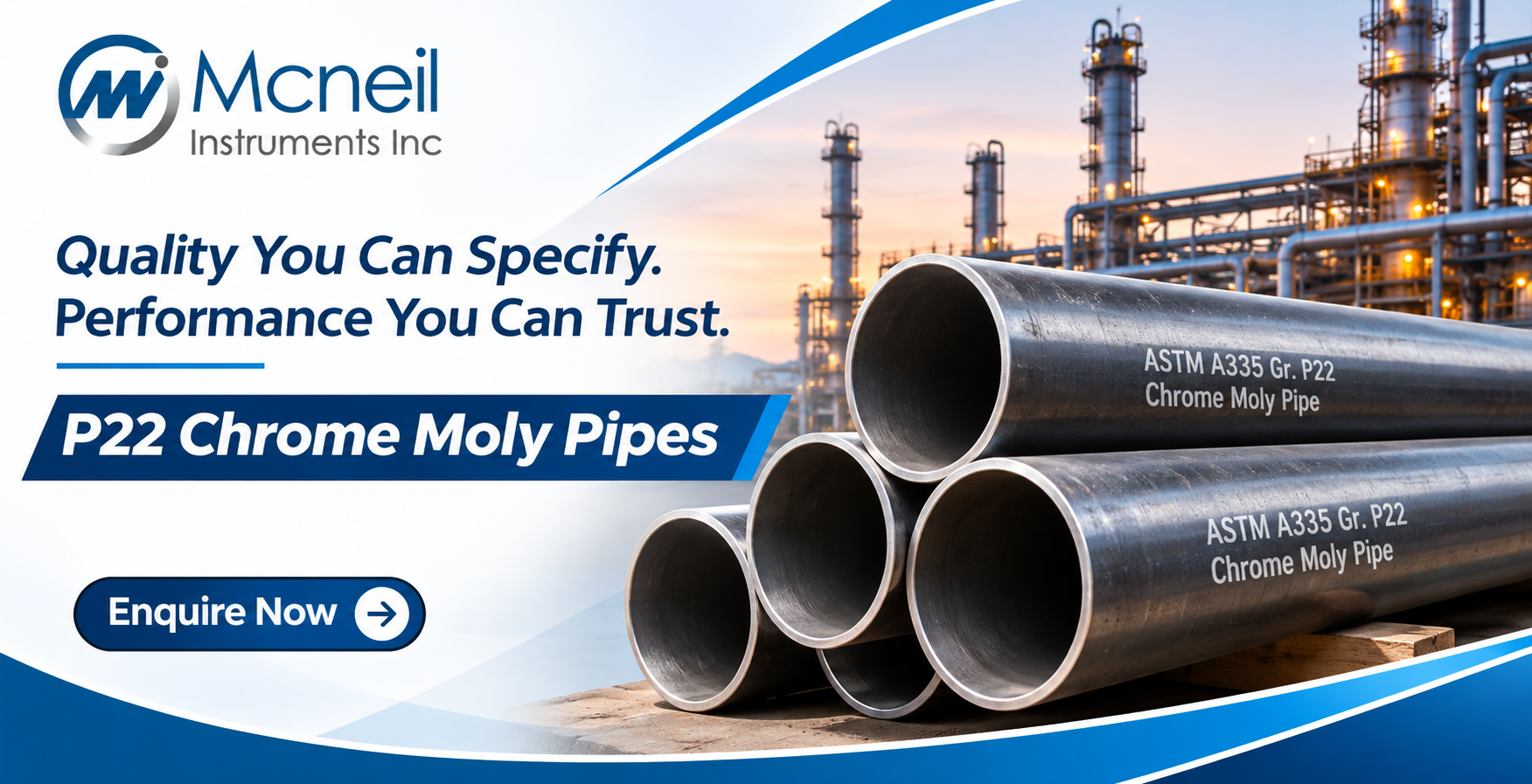
Industrial piping systems operating under high temperatures and pressure require materials that deliver strength, durability and dependable performance. Industries such as oil and gas, power generation, petrochemicals and refineries rely on specialized alloy steel pipes to maintain operational efficiency under demanding conditions. P22 Chrome Moly Pipes are widely used in these applications because of their chromium-molybdenum composition, high-temperature strength and resistance to oxidation.
At Mcneil Instrument, we understand that choosing the right piping material is essential for maintaining the safety and reliability of industrial operations. We focus on supplying quality-engineered P22 Chrome Moly Pipes that meet applicable industry standards and project specifications.
What Are P22 Chrome Moly Pipes?
P22 Chrome Moly Pipes are alloy steel pipes manufactured using a chromium-molybdenum steel composition. They are commonly associated with ASTM A335 Grade P22, a specification covering seamless ferritic alloy-steel pipe intended for high-temperature service.
P22 generally contains approximately 2.00–2.50% chromium and 0.87–1.13% molybdenum. These alloying elements improve high-temperature strength and oxidation resistance compared with conventional carbon steel.
P22 pipes are commonly used in steam lines, boilers, heat exchangers and industrial process piping systems where elevated-temperature performance is essential.
Key Properties of P22 Chrome Moly Pipes
- Excellent High-Temperature Strength
P22 alloy steel pipes are designed for elevated-temperature applications. Their chromium-molybdenum composition helps maintain mechanical strength under demanding operating conditions. - Chromium-Molybdenum Composition
Chromium improves oxidation resistance, while molybdenum contributes to strength and resistance to softening at elevated temperatures. - Resistance to Oxidation
The chromium content provides improved resistance to oxidation and scaling under suitable high-temperature operating conditions. - Good Creep Resistance
P22 pipes are used in applications where resistance to time-dependent deformation under sustained temperature and stress is important. - Reliable Performance in Pressure Systems
Their mechanical properties make them suitable for specified high-temperature pressure piping applications in industrial facilities. - Suitable for Industrial Fabrication
P22 pipes can be fabricated into industrial piping systems using appropriate welding, preheating and post-weld heat treatment procedures as required by applicable codes and project specifications.
Technical Specifications of ASTM A335 P22 Pipes
Understanding the technical specifications is important when selecting P22 Chrome Moly Pipes for industrial projects.
Parameter Specification
Material Grade P22
Standard ASTM A335
Material Type Chrome Moly Alloy Steel
UNS Number K21590
Chromium Content 2.00–2.50%
Molybdenum Content 0.87–1.13%
Manufacturing Process Seamless
Application High-temperature service
Product Form Alloy Steel Pipes
Note: Actual chemical composition, dimensions, mechanical properties and testing requirements should be verified against the applicable ASTM A335 edition and purchase specification.
Applications of P22 Chrome Moly Pipes
P22 Chrome Moly Pipes are widely used in industries where high-temperature strength, pressure resistance and long-term material reliability are essential.
- Power Generation Plants
Power plants use P22 pipes in selected steam piping, boiler and high-temperature utility systems. Their mechanical properties support applications involving elevated temperatures and operating pressure. - Oil and Gas Industry
Oil and gas processing facilities require piping materials that can handle demanding operating conditions. P22 pipes are used in suitable high-temperature process and utility lines. - Petrochemical Industry
Petrochemical plants use chrome-moly pipes in selected processing systems where temperature resistance and mechanical strength are important. - Refineries
Refineries require reliable piping materials for process operations involving elevated temperatures. P22 pipes are considered for suitable refinery applications. - Boiler and Heat Exchanger Systems
P22 alloy steel pipes are used in specified boiler components, heat exchanger systems and other equipment operating under elevated-temperature conditions. - Industrial Steam Pipelines
Steam distribution systems in industrial facilities may use P22 pipes where the design temperature, pressure and applicable engineering codes require this alloy grade.
Different Sizes and Forms of P22 Chrome Moly Pipes
P22 Chrome Moly Pipes are available in different dimensions and schedules to meet the requirements of industrial piping systems.
Common supply specifications include:
Outer Diameter: Available in different diameters according to project requirements.
Wall Thickness: Multiple schedules and wall thicknesses for different pressure and temperature requirements.
Pipe Length: Standard and customized lengths as per customer specifications.
Manufacturing: Seamless pipes manufactured according to ASTM A335 requirements.
Surface Finish: Suitable surface finishes according to project and inspection requirements.
Testing: Chemical, mechanical, dimensional and other specified inspection tests.
Customers should confirm the required pipe size, schedule, length, quantity and applicable technical standards before ordering.
Quality and Inspection Requirements for P22 Pipes
Quality assurance is an important part of selecting alloy steel pipes for critical industrial applications. At Mcneil Instrument, we understand the importance of material verification and specification compliance.
Important inspection requirements include:
Chemical Composition Testing: Verifies chromium, molybdenum and other alloying elements.
Mechanical Testing: Checks tensile strength, yield strength and elongation.
Hardness Testing: Confirms compliance with applicable material requirements.
Hydrostatic Testing: Checks pipe integrity according to the applicable specification.
Non-Destructive Testing: Ultrasonic, eddy-current or other specified examination methods.
Dimensional Inspection: Verifies outer diameter, wall thickness and length.
Material Traceability: Ensures heat number identification and documentation.
Material Test Certificate: Provides information about chemical composition and mechanical test results.
The exact inspection requirements depend on the applicable ASTM specification, purchase order and project standards.
P22 vs P11 vs P91 Chrome Moly Pipes: Understanding the Difference
P22, P11 and P91 are commonly used chromium-molybdenum alloy steel grades for high-temperature industrial applications. However, their chemical compositions and mechanical characteristics differ.
Parameter P11 P22 P91
Chromium 1.00–1.50% 2.00–2.50% 8.00–9.50%
Molybdenum 0.44–0.65% 0.87–1.13% 0.85–1.05%
Material Type Cr-Mo Steel Cr-Mo Steel 9Cr-1Mo-V Steel
Typical Application High-temperature piping Boilers and steam piping Advanced high-temperature pressure systems
P11 is commonly selected for moderate high-temperature service, while P22 offers a higher chromium content and is used in demanding elevated-temperature applications. P91 is a more highly alloyed material used in applications requiring advanced creep strength.
The final grade selection should be based on design temperature, pressure, material properties, applicable codes and engineering requirements.
Why Choose Mcneil Instrument for P22 Chrome Moly Pipes?
Selecting the right supplier is important for maintaining product quality, material consistency and project timelines. At Mcneil Instrument, we focus on supplying industrial piping products that meet customer specifications and quality expectations.
Our key advantages include:
Supply of ASTM A335 P22 Chrome Moly Pipes.
Different sizes, schedules and dimensions.
Quality-focused material sourcing.
Support for project-specific technical requirements.
Material documentation and traceability as specified.
Supply solutions for oil and gas, petrochemical and power generation industries.
Assistance for domestic and international customers.
We understand that every industrial project has different requirements. Our team works to support customers with suitable piping products for their operating conditions and technical specifications.
Conclusion
P22 Chrome Moly Pipes are an important solution for industrial piping systems that operate under elevated temperatures and pressure. Their chromium-molybdenum composition, high-temperature strength and creep resistance make them suitable for selected applications in power plants, refineries, petrochemical facilities and boiler systems.
Choosing the correct material grade, dimensions and manufacturing standard is essential for ensuring reliable performance.
At Mcneil Instrument, we are committed to supplying quality-focused P22 Chrome Moly Pipes that meet industrial project requirements. Contact our team to discuss your specifications and explore suitable alloy steel piping solutions.
Looking for Reliable ASTM A335 P22 Chrome Moly Pipes?
Choose Mcneil Instrument for quality-focused alloy steel piping solutions designed for demanding industrial applications.
We support P22 pipe requirements for power plants, refineries, petrochemical facilities and oil and gas industries.
Contact our team today to discuss your pipe specifications and request a competitive quotation.
Website: https://www.mcneilinstrument.com/
Frequently Asked Questions (FAQs)
- What are P22 Chrome Moly Pipes?
P22 Chrome Moly Pipes are seamless alloy steel pipes made with chromium and molybdenum. They are generally manufactured according to ASTM A335 Grade P22 and are designed for high-temperature service. - What is the ASTM standard for P22 pipes?
The applicable standard is ASTM A335, which covers seamless ferritic alloy-steel pipes intended for high-temperature service. - What is the chemical composition of P22 pipes?
P22 generally contains 2.00–2.50% chromium and 0.87–1.13% molybdenum, along with controlled amounts of carbon, manganese, silicon, phosphorus and sulphur. - What is the UNS number of ASTM A335 P22?
The UNS designation for ASTM A335 Grade P22 is K21590. - Where are P22 Chrome Moly Pipes used?
They are used in power generation plants, boilers, refineries, petrochemical facilities, heat exchangers and industrial steam piping systems. - What is the difference between P11 and P22 pipes?
P11 contains approximately 1.00–1.50% chromium and 0.44–0.65% molybdenum, whereas P22 contains approximately 2.00–2.50% chromium and 0.87–1.13% molybdenum. P22 has a higher alloy content and is selected for applications with different temperature and material performance requirements. - Are ASTM A335 P22 pipes seamless?
Yes. ASTM A335 P22 pipes are specified as seamless ferritic alloy-steel pipes for high-temperature applications. - What sizes are available in P22 Chrome Moly Pipes?
P22 pipes are available in different outer diameters, wall thicknesses, schedules and lengths. Availability depends on supplier stock and project specifications. - What testing is required for P22 pipes?
Testing may include chemical analysis, tensile testing, hardness testing, hydrostatic testing, dimensional inspection and specified non-destructive examinations. - Can P22 pipes be welded?
Yes. P22 pipes can be welded using suitable welding procedures. Preheating and post-weld heat treatment may be required depending on pipe thickness, welding procedure, service conditions and applicable codes. - What is the difference between P22 and P91 pipes?
P22 is a 2.25Cr-1Mo alloy steel, while P91 is a modified 9Cr-1Mo-V alloy steel. P91 has a significantly higher chromium content and is designed for applications requiring higher creep strength. - Where can I buy ASTM A335 P22 Chrome Moly Pipes?
You can contact Mcneil Instruments for P22 Chrome Moly Pipe enquiries, including sizes, schedules, technical specifications and project-specific supply requirements.


