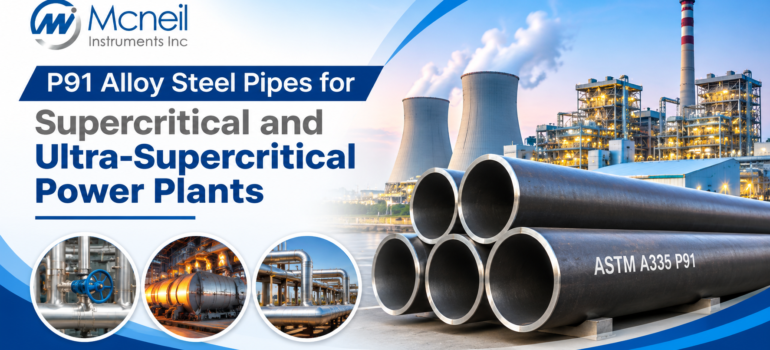
P91 Alloy Steel Pipes for Supercritical and Ultra-Supercritical Power Plants
Introduction
The demand for higher power generation efficiency and improved thermal performance has increased the adoption of supercritical and ultra-supercritical technologies in modern power plants. These advanced power generation systems operate at extremely high temperatures and pressures, requiring specialised materials that can withstand demanding operating conditions over extended periods.
Among the materials used in high-temperature power plant applications, P91 alloy steel pipes play an important role. Manufactured from chromium-molybdenum-vanadium alloy steel, P91 offers excellent high-temperature strength, creep resistance, and oxidation resistance when properly manufactured, heat-treated, and installed.
P91 pipes are widely used in critical power plant components such as main steam pipelines, hot reheat lines, headers, and other high-temperature pressure-containing systems.
At Mcneil Instrument, we understand the importance of selecting the right piping materials for demanding industrial applications. In this blog, we explore the properties, applications, advantages, manufacturing requirements, and important purchasing considerations associated with P91 alloy steel pipes for supercritical and ultra-supercritical power plants.
What Are P91 Alloy Steel Pipes?
P91 is a high-temperature ferritic-martensitic alloy steel commonly specified under ASTM A335 Grade P91 for seamless alloy steel pipe used in high-temperature service.
It is also associated with the designation 9Cr-1Mo-V-Nb steel because its composition includes approximately 9% chromium, 1% molybdenum, vanadium, and niobium, along with controlled quantities of other alloying elements.
The combination of these elements provides a high-strength tempered martensitic microstructure that offers improved creep strength and resistance to high-temperature degradation.
P91 pipes are particularly suitable for power generation systems where conventional carbon steel and lower-alloy steel grades may not provide sufficient performance under demanding temperature and pressure conditions.
Why Are P91 Alloy Steel Pipes Used in Supercritical Power Plants?
Supercritical and ultra-supercritical power plants operate at higher steam temperatures and pressures than conventional subcritical power plants. These conditions improve thermal efficiency but also increase the mechanical and thermal demands placed on piping systems.
P91 alloy steel is selected for suitable high-temperature applications because of several important properties:
High creep rupture strength at elevated temperatures.
Good resistance to high-temperature oxidation.
Excellent mechanical strength after appropriate heat treatment.
Improved performance in demanding steam service.
Suitable properties for high-temperature pressure piping.
Reduced wall thickness potential compared with some lower-strength materials, subject to design calculations.
P91 is not automatically suitable for every high-temperature application. The final material selection must consider design temperature, pressure, service conditions, applicable codes, fabrication requirements, and long-term operating life.
Key Properties of P91 Alloy Steel Pipes
Understanding the material properties of P91 is essential when selecting pipes for critical power generation applications.
- High-Temperature Strength
P91 alloy steel provides high strength at elevated temperatures, making it suitable for pressure-containing piping systems exposed to demanding steam conditions.
Its alloy composition and tempered martensitic microstructure help maintain mechanical strength during high-temperature operation. - Excellent Creep Resistance
Creep is the gradual deformation of a material when subjected to sustained stress at elevated temperatures.
Power plant piping systems operate under continuous pressure and temperature conditions, making creep resistance an important material requirement.
P91 offers improved creep strength compared with conventional lower-alloy steels, helping it perform in suitable high-temperature service applications. - Oxidation Resistance
High-temperature steam and oxygen exposure can cause oxidation and material degradation.
The chromium content in P91 helps form a protective oxide layer, improving its resistance to oxidation under suitable operating conditions. - Mechanical Strength
P91 provides a combination of tensile strength, yield strength, and high-temperature mechanical properties that makes it suitable for demanding industrial piping systems.
However, these properties depend on the correct manufacturing process, heat treatment, and compliance with the applicable material specification. - Thermal Performance
P91 is designed for high-temperature applications where thermal stability and resistance to long-term degradation are important.
Its performance makes it a preferred material for many critical steam piping applications in modern thermal power plants.
Common Applications of P91 Alloy Steel Pipes in Power Plants
P91 alloy steel pipes are used in several critical areas of supercritical and ultra-supercritical power generation facilities.
- Main Steam Pipelines
Main steam pipelines transport high-temperature, high-pressure steam from the boiler or superheater system towards the steam turbine.
P91 pipes are used in suitable main steam applications because of their high-temperature strength and creep resistance. - Hot Reheat Pipelines
Hot reheat pipelines carry reheated steam from the boiler reheater section towards the intermediate-pressure turbine.
These pipelines experience demanding thermal and mechanical conditions, making appropriate alloy steel selection essential. - Boiler Headers
P91 alloy steel may be used in selected boiler headers and high-temperature pressure components where the design temperature, pressure, and applicable material specifications permit its use. - High-Temperature Steam Lines
Power plants require specialised piping materials for transporting steam under continuous high-temperature operating conditions.
P91 is suitable for specified high-temperature steam piping applications where its mechanical and thermal properties meet the design requirements. - Power Generation and Industrial Boilers
Apart from large thermal power plants, P91 alloy steel pipes are also used in selected industrial boiler and high-temperature process applications.
The final application depends on engineering design calculations, operating conditions, and applicable pressure piping codes.
P91 vs P11 vs P22 Alloy Steel Pipes: Understanding the Differences
Different alloy steel grades are selected for power plant piping depending on operating pressure, temperature, and engineering requirements.
Property P11 P22 P91
Chromium Approx. 1.0–1.5% Approx. 1.9–2.6% Approx. 8–9.5%
Molybdenum Approx. 0.44–0.65% Approx. 0.87–1.13% Approx. 0.85–1.05%
Other alloying elements Primarily Cr-Mo Primarily Cr-Mo Cr-Mo-V-Nb
Creep strength Moderate Higher than P11 in suitable conditions High
Typical application High-temperature piping Boiler and steam piping Advanced high-temperature steam systems
Note: The figures are approximate composition ranges. Actual chemical limits and mechanical requirements must be checked against the applicable ASTM A335 specification and its latest applicable edition.
Which grade should you choose?
P11: Suitable for certain moderate high-temperature applications.
P22: Used in applications requiring higher-temperature performance than many P11 applications.
P91: Preferred for suitable demanding high-temperature applications requiring enhanced creep strength.
The correct grade should always be determined through engineering assessment rather than simply selecting the highest-strength material.
Important Manufacturing and Quality Requirements for P91 Pipes
P91 alloy steel pipes require strict manufacturing and quality control because their performance depends heavily on chemical composition, microstructure, and heat treatment.
- Seamless Pipe Manufacturing
ASTM A335 Grade P91 pipes are specified as seamless alloy steel pipes for high-temperature service.
The manufacturing process must ensure that the pipe meets the specified dimensional, mechanical, and material requirements. - Normalising and Tempering
P91 requires controlled heat treatment to achieve its intended tempered martensitic microstructure.
Normalising and tempering are essential manufacturing stages that influence its strength, toughness, creep resistance, and long-term performance.
Incorrect heat treatment can negatively affect the material’s mechanical properties and service reliability. - Chemical Composition Verification
Chemical analysis is necessary to verify that the supplied material meets the specified P91 composition requirements.
Particular attention should be given to chromium, molybdenum, vanadium, niobium, carbon, and other controlled alloying elements. - Mechanical Testing
Mechanical testing verifies whether the pipe meets the required material properties.
Relevant tests may include:
Tensile Strength Test.
Yield Strength Test.
Elongation Test.
Hardness Test.
Impact Testing, where specified. - Non-Destructive Examination
Non-destructive examination helps identify defects without damaging the pipe.
Depending on the applicable specification and purchase requirements, inspections may include ultrasonic testing, radiographic examination, or other specified methods. - Dimensional Inspection
Dimensional inspection verifies the pipe’s outside diameter, wall thickness, length, straightness, and other specified tolerances.
Accurate dimensions are important for fabrication, welding, installation, and compatibility with the piping system.
Important Standards for P91 Alloy Steel Pipes
Before purchasing P91 alloy steel pipes, buyers should understand the applicable material and design standards.
Standard Description
ASTM A335 / ASME SA-335 Seamless ferritic alloy steel pipe for high-temperature service
ASME B31.1 Power piping design and construction
ASME Section II Material specifications and related requirements
ASME Section V Non-destructive examination requirements
ASME Section IX Welding and brazing qualifications
ASTM A999 General requirements for alloy and stainless steel pipe, where applicable
The relevant standards and editions should be confirmed against the project specifications and applicable construction code.
10 Factors to Consider Before Purchasing P91 Alloy Steel Pipes
Selecting the correct P91 pipe requires more than confirming its material grade. Buyers and project engineers should evaluate the following factors.
- Material Specification: Confirm that the pipe complies with ASTM A335 Grade P91 or the specified equivalent requirement.
- Pipe Dimensions: Verify the required outside diameter, wall thickness, schedule, and length.
- Operating Temperature: Check that the selected grade is suitable for the design and operating temperature.
- Design Pressure: Ensure that the material and pipe dimensions meet the applicable pressure design calculations.
- Heat Treatment: Verify that the required normalising and tempering procedures have been completed.
- Chemical Composition: Review the material analysis to confirm the specified alloying elements.
- Mechanical Properties: Check tensile strength, yield strength, elongation, and hardness requirements.
- Material Test Certificate: Request the appropriate MTC with heat number and test results for traceability.
- Inspection and Testing: Confirm the required dimensional inspection, NDT, and other specified quality checks.
- Supplier Reliability: Choose a supplier capable of supporting technical specifications, material documentation, and project delivery requirements.
Why Choose Mcneil Instrument for P91 Alloy Steel Pipes?
At Mcneil Instrument, we understand the technical requirements involved in sourcing alloy steel pipes for demanding industrial applications.
Selecting the right material for high-temperature steam pipelines requires careful attention to material grades, manufacturing specifications, dimensional requirements, and quality documentation.
We support customers with industrial piping and alloy steel product requirements, helping them identify suitable materials according to their project specifications.
Our focus is on providing quality-oriented sourcing support, relevant technical documentation, and assistance with industrial piping requirements.
Whether you are sourcing materials for thermal power plants, boiler systems, petrochemical facilities, or other high-temperature industrial applications, Mcneil Instruments can assist with your requirements.
We serve customers across India and international markets, including the UAE, Saudi Arabia, and other GCC countries.
Conclusion
P91 alloy steel pipes are important materials in modern supercritical and ultra-supercritical power plants, where high temperatures, elevated pressures, and long operating cycles demand specialised piping solutions.
Their high creep strength, oxidation resistance, and mechanical performance make them suitable for several critical steam piping applications.
However, achieving reliable performance requires proper material selection, controlled heat treatment, manufacturing quality, welding procedures, and inspection.
At Mcneil Instrument, we believe that choosing the right piping material is essential for maintaining industrial reliability and long-term operational performance.
If you are planning a power generation or high-temperature piping project, make sure to evaluate the material specifications and quality requirements before purchasing P91 alloy steel pipes.
Looking for Reliable P91 Alloy Steel Pipes for Your Power Plant Project?
Choose Mcneil Instrument for industrial piping and alloy steel product requirements.
We assist customers with material specifications, technical requirements, and relevant quality documentation for demanding industrial applications.
Whether you require P91 pipes for supercritical power plants, ultra-supercritical boilers, or high-temperature steam pipelines, our team is ready to assist.
Contact Mcneil Instrument today to discuss your requirements and request a quotation.
Website: https://mcneilinstrument.com/
Frequently Asked Questions (FAQs)
- What are P91 alloy steel pipes?
P91 alloy steel pipes are high-temperature seamless alloy steel pipes manufactured according to ASTM A335 Grade P91. They contain approximately 9% chromium and 1% molybdenum, along with vanadium and niobium, providing excellent creep strength and high-temperature performance. - Why are P91 pipes used in supercritical power plants?
P91 pipes are used because of their high creep strength, mechanical properties, and oxidation resistance. These characteristics make them suitable for demanding high-temperature and high-pressure steam applications. - What is the ASTM standard for P91 alloy steel pipes?
ASTM A335 Grade P91 is the commonly specified material standard for seamless ferritic alloy steel pipes intended for high-temperature service. - What is the chemical composition of P91 alloy steel?
P91 typically contains approximately 8–9.5% chromium, 0.85–1.05% molybdenum, 0.18–0.25% vanadium, and 0.06–0.10% niobium. Other elements are also controlled according to the applicable material specification. - What is the difference between P91 and P22 alloy steel pipes?
P91 contains significantly more chromium and includes additional alloying elements such as vanadium and niobium. It offers higher creep strength than P22 in many relevant high-temperature service conditions, making it suitable for certain more demanding power plant applications. - What are the common applications of P91 pipes?
P91 pipes are commonly used in main steam lines, hot reheat pipelines, selected boiler headers, high-temperature steam systems, and other pressure-containing components in thermal power plants. - Why is heat treatment important for P91 pipes?
Heat treatment develops the required tempered martensitic microstructure and mechanical properties. Proper normalising and tempering are essential for achieving the intended strength, toughness, and creep resistance. - What tests should be performed on P91 alloy steel pipes?
Relevant tests include chemical composition analysis, tensile testing, hardness testing, dimensional inspection, and applicable non-destructive examination. Additional tests depend on the product specification and purchase order. - What documents should buyers request when purchasing P91 pipes?
Buyers should request Material Test Certificates, chemical analysis reports, mechanical test results, heat treatment records, dimensional inspection reports, and applicable NDT reports as specified in the purchase order. - Can P91 pipes be welded?
Yes. P91 pipes can be welded using qualified welding procedures. However, welding requires specialised controls, including suitable preheating, consumable selection, interpass temperature control, and post-weld heat treatment as required by the applicable code and procedure. - Are P91 pipes suitable for ultra-supercritical power plants?
Yes. P91 is used in selected high-temperature piping applications in ultra-supercritical power plants. The suitability of the grade depends on the specific design temperature, pressure, component requirements, and engineering calculations. - What is the difference between P91 and P92 alloy steel pipes?
Both are advanced high-chromium creep-resistant alloy steels. P92 contains additional alloying elements, particularly tungsten, and has different composition and design properties. The appropriate grade depends on the operating conditions and engineering specifications. - How can I identify genuine P91 alloy steel pipes?
Check the pipe markings, material grade, heat number, Material Test Certificate, chemical composition, mechanical properties, and heat treatment documentation. PMI can also help verify the alloy composition.