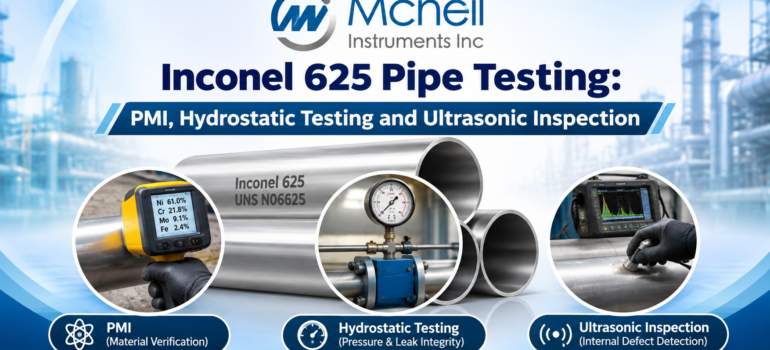
Inconel 625 Pipe Testing: PMI, Hydrostatic Testing and Ultrasonic Inspection
Introduction
Inconel 625 is a high-performance nickel-based alloy widely used in industries where corrosion resistance, mechanical strength and reliability are essential. Its excellent resistance to oxidation, pitting, crevice corrosion and chloride-induced stress corrosion cracking makes it suitable for demanding applications in oil and gas, petrochemical, marine, offshore and chemical processing industries.
However, supplying high-quality Inconel 625 pipes is not just about selecting the correct material grade. Proper inspection and testing are equally important to ensure that pipes meet project specifications, applicable standards and operational requirements.
Three important inspection and testing methods used for Inconel 625 pipes are Positive Material Identification (PMI), Hydrostatic Testing and Ultrasonic Testing (UT). These tests help verify material composition, pressure integrity and internal material quality.
At Mcneil Instrument, we understand the importance of material verification and quality assurance in industrial piping applications. This blog explains how these three testing methods work and why they are important when sourcing Inconel 625 pipes.
Understanding Inconel 625 Pipes
Inconel 625 is a nickel-chromium-molybdenum-niobium alloy identified by UNS N06625. It is designed to provide excellent corrosion resistance, high strength and good fabrication characteristics across a wide range of industrial environments.
Its chemical composition typically includes:
Nickel: 58% minimum
Chromium: 20–23%
Molybdenum: 8–10%
Niobium plus Tantalum: 3.15–4.15%
Iron: 5% maximum
The combination of these elements provides resistance to various corrosive environments, including chloride-containing media and seawater.
Inconel 625 pipes are commonly used in:
Offshore oil and gas pipelines.
Chemical processing plants.
Marine engineering systems.
Heat exchangers and condensers.
Seawater handling systems.
Power generation equipment.
Petrochemical processing facilities.
High-pressure industrial piping systems.
Because these applications often involve high pressure, corrosive fluids and demanding operating conditions, proper material testing and inspection are essential.
What Is PMI Testing for Inconel 625 Pipes?
Positive Material Identification (PMI) is a material verification process used to confirm whether a metal component contains the expected alloying elements.
For Inconel 625 pipes, PMI helps verify that the material composition is consistent with the specified alloy grade, UNS N06625.
PMI is particularly important in industries where different nickel alloys and stainless steel grades may look similar but have significantly different chemical compositions and performance characteristics.
How Is PMI Testing Performed?
PMI is generally performed using two common techniques:
- X-Ray Fluorescence (XRF) Testing
XRF is a widely used non-destructive testing method for identifying alloying elements in metal products.
A handheld XRF analyser is placed against the pipe surface. The instrument detects characteristic fluorescent X-rays emitted by the material and identifies elements such as nickel, chromium, molybdenum and niobium.
XRF is useful for identifying alloy grades and detecting material mix-ups.
However, conventional XRF cannot reliably measure carbon and certain light elements, including nitrogen, so it should not be treated as a complete chemical analysis. - Optical Emission Spectroscopy (OES)
OES uses an electrical spark to analyse the chemical composition of a metal sample. Depending on the instrument and method, it can measure elements that conventional XRF cannot adequately determine, including carbon.
OES is useful when more comprehensive chemical verification is required.
Why Is PMI Testing Important?
Confirms the identity of the supplied alloy.
Helps prevent material mix-ups.
Verifies key alloying elements.
Supports quality control and traceability.
Helps meet project-specific inspection requirements.
PMI is particularly valuable for Inconel 625 pipes used in offshore platforms, chemical processing equipment and critical industrial piping systems.
What Is Hydrostatic Testing for Inconel 625 Pipes?
Hydrostatic testing is a pressure testing method used to evaluate the pressure integrity of pipes by filling them with water or another suitable liquid and applying a specified test pressure.
For Inconel 625 pipes, hydrostatic testing helps identify leakage and verify the pressure integrity of the pipe under the prescribed test conditions.
How Is Hydrostatic Testing Performed?
The general hydrostatic testing procedure includes the following steps:
Preparation: The pipe is inspected for visible defects, dimensional issues and surface damage.
End Closure: Suitable test fittings or closures are installed to seal both ends of the pipe.
Filling: The pipe is filled with clean, suitable testing liquid, typically water, while trapped air is removed.
Pressurisation: Pressure is gradually increased to the specified test pressure.
Pressure Holding: The required pressure is maintained for the specified duration.
Inspection: The pipe is checked for leakage, pressure loss and visible signs of failure.
Documentation: Test results are recorded in the inspection and test documentation.
Why Is Hydrostatic Testing Important?
Hydrostatic testing provides several quality assurance benefits:
Verifies pressure integrity under specified test conditions.
Helps identify leaks and through-wall defects.
Supports compliance with applicable product specifications.
Improves confidence in piping system reliability.
Provides documented evidence of pressure testing.
The test pressure and holding duration must follow the applicable product standard, purchase order and project specifications. Hydrostatic testing does not establish the complete structural integrity or fatigue life of a pipe.
What Is Ultrasonic Testing (UT) for Inconel 625 Pipes?
Ultrasonic Testing (UT) is a non-destructive testing technique that uses high-frequency sound waves to examine the internal condition of metal materials.
For Inconel 625 pipes, ultrasonic inspection can help detect internal discontinuities, including laminations, inclusions and certain types of cracks, depending on the inspection method and procedure.
Unlike destructive testing, UT allows inspection without cutting or damaging the pipe.
How Is Ultrasonic Testing Performed?
The general UT inspection process involves:
Surface Preparation: The pipe surface is cleaned to ensure proper contact between the probe and material.
Couplant Application: A suitable couplant, such as gel or liquid, is applied to transmit ultrasonic waves.
Probe Placement: An ultrasonic transducer is positioned on the pipe surface.
Sound Wave Transmission: High-frequency sound waves travel through the pipe material.
Signal Analysis: Reflected sound waves are analysed to identify internal discontinuities.
Result Evaluation: Detected indications are assessed against the applicable acceptance criteria.
Reporting: Inspection findings are recorded in the ultrasonic testing report.
Types of Ultrasonic Testing
Conventional Ultrasonic Testing: Uses ultrasonic sound waves to identify internal discontinuities.
Phased Array Ultrasonic Testing (PAUT): Uses multiple transducer elements to steer and focus sound beams for more detailed inspection.
Automated Ultrasonic Testing: Uses automated scanning systems for consistent inspection of suitable pipe products.
Benefits of Ultrasonic Inspection
Detects certain internal material discontinuities.
Supports inspection without damaging the product.
Helps evaluate material quality.
Can inspect selected areas or the full pipe length, depending on the procedure.
Provides recorded inspection results.
For nickel-based alloys such as Inconel 625, the inspection technique, calibration and procedure must be appropriately qualified for the material, dimensions and expected discontinuities.
PMI vs Hydrostatic Testing vs Ultrasonic Testing
Although all three methods are used for quality assurance, each inspection method serves a different purpose.
Testing Method Primary Purpose What It Verifies
PMI Testing Material identification Chemical composition and alloy identity
Hydrostatic Testing Pressure integrity Leakage and pressure containment
Ultrasonic Testing Internal inspection Internal discontinuities within the material
These testing methods complement each other. PMI verifies whether the correct alloy has been supplied, hydrostatic testing evaluates pressure integrity, and UT helps identify certain internal material defects.
One test cannot replace another because each addresses a different quality requirement.
Applicable Standards for Inconel 625 Pipe Testing
Inconel 625 pipes may be manufactured, inspected and tested according to different ASTM, ASME and project-specific requirements.
Some relevant specifications include:
ASTM B444: Specification covering nickel-chromium-molybdenum-columbium alloys, including seamless pipe and tube.
ASTM B829: General requirements for nickel and nickel-alloy seamless pipe and tube.
ASTM B704: Specification covering welded nickel-alloy pipe.
ASTM B705: Specification covering welded nickel-alloy pipe.
ASME BPVC Section V: Provides requirements for non-destructive examination methods.
ASME BPVC Section VIII: Includes pressure vessel construction requirements, where applicable.
The applicable standard depends on the product form, manufacturing method, dimensions, service conditions and project requirements. PMI, hydrostatic testing and UT are not automatically mandatory for every Inconel 625 pipe order; their applicability and acceptance criteria should be defined in the purchase specification and inspection and test plan.
What Documents Should Buyers Request When Purchasing Inconel 625 Pipes?
When procuring Inconel 625 pipes for industrial applications, buyers should verify the material documentation and inspection records.
Important documents may include:
Mill Test Certificate (MTC): Provides chemical composition and mechanical test results.
PMI Report: Records material identification and alloy verification results.
Hydrostatic Test Report: Documents the applied pressure, test duration and test results.
Ultrasonic Test Report: Records UT inspection procedures, findings and acceptance results.
Dimensional Inspection Report: Confirms pipe dimensions, wall thickness and length.
Heat Number Traceability: Helps trace the material back to its manufacturing and testing records.
Certificate of Conformity: Confirms compliance with specified purchase and product requirements, where applicable.
Proper documentation helps procurement teams, quality inspectors and project engineers verify that supplied products meet their specified requirements.
Why Choose Mcneil Instrument for Inconel 625 Pipe Requirements?
At Mcneil Instrument, we understand that industrial projects require reliable piping materials supported by proper technical specifications and quality documentation.
We focus on supplying industrial piping and instrumentation products for applications across oil and gas, petrochemical, chemical processing, marine and other engineering industries.
Our product portfolio includes nickel alloys, stainless steel, duplex and super duplex materials, along with industrial piping components.
When sourcing Inconel 625 pipes, buyers should pay attention to:
Correct UNS N06625 material identification.
Applicable ASTM and ASME specifications.
Chemical and mechanical test documentation.
PMI and NDT requirements.
Hydrostatic testing requirements.
Dimensional accuracy and heat number traceability.
Our team can assist with product enquiries and material requirements based on your project specifications.
Conclusion
Quality testing plays an important role in ensuring the reliability of Inconel 625 pipes used in demanding industrial environments.
PMI testing verifies material identity and helps prevent alloy mix-ups. Hydrostatic testing evaluates pressure integrity and identifies leakage. Ultrasonic testing helps detect internal material discontinuities without damaging the pipe.
Together, these inspection methods provide valuable quality assurance throughout the procurement and supply process.
At Mcneil Instruments, we understand the importance of material specifications, inspection requirements and documentation for industrial piping applications. Contact our team to discuss your Inconel 625 pipe requirements.
Looking for Quality Inconel 625 Pipes?
Choose Mcneil Instruments for your industrial piping and nickel alloy product requirements.
We support demanding industrial applications with quality-focused material solutions and attention to technical specifications, inspection requirements and product documentation.
Get in touch with our team today for Inconel 625 pipe enquiries and quotations.
Industrial Piping Solutions
Nickel Alloy Products
Website: https://www.mcneilinstrument.com/m/
Frequently Asked Questions (FAQs)
- What is PMI testing for Inconel 625 pipes?
Positive Material Identification (PMI) is a non-destructive testing method used to verify the chemical composition of Inconel 625 pipes. It helps confirm the presence of key alloying elements such as nickel, chromium, molybdenum and niobium. - Why is hydrostatic testing important for Inconel 625 pipes?
Hydrostatic testing verifies the pressure integrity of pipes by filling them with liquid and applying a specified pressure. It helps identify leakage and confirms that the pipe meets the applicable pressure testing requirements. - What is ultrasonic testing in pipe inspection?
Ultrasonic Testing (UT) is a non-destructive inspection method that uses high-frequency sound waves to detect internal discontinuities such as cracks, laminations and inclusions in suitable inspection conditions. - Is PMI testing mandatory for Inconel 625 pipes?
PMI testing requirements depend on project specifications, purchase orders and applicable quality standards. It is commonly requested in critical oil and gas, petrochemical and chemical processing projects to verify material identity. - Which standards apply to Inconel 625 pipes?
ASTM B444 is an important specification for seamless nickel-chromium-molybdenum-columbium alloy pipes and tubes, including UNS N06625. Other applicable requirements may include ASTM B829, ASTM B704, ASTM B705 and relevant ASME inspection standards, depending on the product. - Can ultrasonic testing detect internal defects in Inconel 625 pipes?
Yes. Ultrasonic testing can detect certain internal discontinuities, including laminations, inclusions and cracks. The detection capability depends on the inspection technique, material properties, pipe dimensions and qualified testing procedure. - What is the difference between PMI and ultrasonic testing?
PMI verifies the chemical composition and material identity of a pipe, whereas ultrasonic testing examines the internal material condition for discontinuities. Both methods serve different purposes in industrial quality inspection. - What documents should be checked when purchasing Inconel 625 pipes?
Buyers should check the Mill Test Certificate (MTC), chemical composition report, mechanical test results, PMI report (if specified), hydrostatic test report, ultrasonic inspection report (if specified) and dimensional inspection records. - Is hydrostatic testing a destructive or non-destructive test?
Hydrostatic testing is generally classified as a non-destructive pressure test when the pipe passes the specified test without damage. It is used to evaluate pressure integrity under controlled conditions. - Which industries require tested Inconel 625 pipes?
Inconel 625 pipes are used in oil and gas, offshore engineering, marine applications, chemical processing, petrochemical plants, power generation and seawater handling systems.