

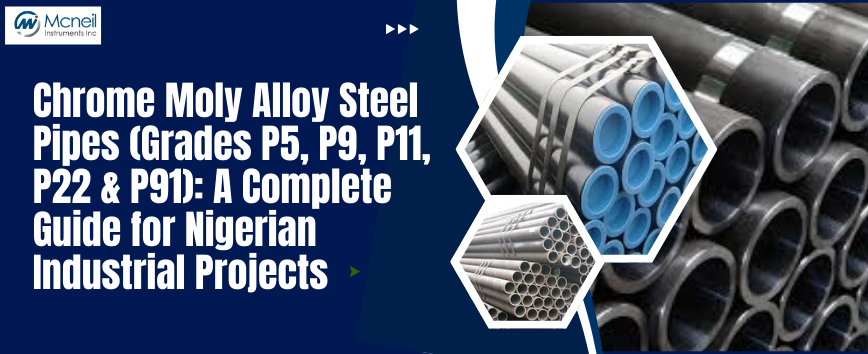
Introduction: Strength, Heat Resistance, and Industrial Reliability
Nigeria’s industrial landscape is both dynamic and demanding. From oil and gas refineries in Port Harcourt and Lagos, to power generation stations, petrochemical facilities, fertilizer plants, and large-scale manufacturing hubs, critical piping systems must perform reliably under high pressures, elevated temperatures, and corrosive environments.
In such conditions, standard carbon steel often falls short. Instead, engineers turn to Chrome Moly Alloy Steel Pipes — premium, heat-resistant, and high-strength solutions that are engineered for extreme service. These pipes, specified under ASTM A335 / ASME SA335 standards in grades P5, P9, P11, P22, and P91, deliver superior mechanical performance and long service life.
As a trusted manufacturer, supplier, and exporter, Mcneil Instrument supplies Chrome Moly pipes that meet stringent international standards and are widely used by industrial integrators and project teams across Nigeria.
This blog provides a comprehensive overview of Chrome Moly alloy steel pipes — what they are, how they perform, where they are used, and why Nigerian industries rely on them.
Understanding Chrome Moly Alloy Steel Pipes
Chrome Moly pipes are high-temperature, high-pressure alloys primarily alloyed with Chromium (Cr) and Molybdenum (Mo). These elements greatly enhance:
- Oxidation resistance
- Creep resistance at elevated temperatures
- Mechanical strength and toughness
- Corrosion resistance to aggressive service environments
The ASTM A335 / ASME SA335 specification covers seamless ferritic alloy steel pipes intended for use in high-temperature applications, such as steam lines, superheaters, reheaters, and refinery process systems.
Each grade — P5, P9, P11, P22, and P91 — offers a unique balance of properties, enabling engineers to match the right material with specific operational demands.
Alloy Steel Pipe Grades Explained
P5 Alloy Steel Pipes
Composition: Approximately 5% Chromium, 0.5% Molybdenum
Characteristics: Good oxidation and scaling resistance; higher strength than carbon steel
Typical Nigerian Applications: Refinery heater tubes, moderate-temperature steam systems
P9 Alloy Steel Pipes
Composition: Around 9% Chromium, 1% Molybdenum
Characteristics: Enhanced resistance to oxidation, sulfidation, and hydrogen attack
Typical Nigerian Applications: Petrochemical high-temperature process lines, steam networks
P11 Alloy Steel Pipes
Composition: ~1.25% Chromium, 0.5% Molybdenum
Characteristics: Versatile grade with balanced performance and cost-effectiveness
Typical Nigerian Applications: Thermal power plant piping, boiler feed systems
P22 Alloy Steel Pipes
Composition: ~2.25% Chromium, 1% Molybdenum
Characteristics: Better creep resistance and mechanical performance than P11
Typical Nigerian Applications: Superheaters, reheaters, high-pressure steam circuits
P91 Alloy Steel Pipes
Composition: ~9% Chromium, ~1% Molybdenum, with additions like Vanadium (V) & Niobium (Nb)
Characteristics: Creep-strength-enhanced; excellent long-term high-temperature performance
Typical Nigerian Applications: Ultra-supercritical boilers, high-pressure steam headers, refinery critical piping
Material Standards & Why They Matter in Nigeria
Chrome Moly pipes for industrial use in Nigeria must comply with internationally recognized standards to ensure safety, performance, and seamless integration in large systems.
| Standard | Description |
| ASTM A335 / ASME SA335 | Seamless ferritic alloy steel pipes for high-temperature service |
| ASME B31.1 | Power piping design and installation |
| ISO / API Standards | Applicable for oil & gas and export projects |
| EN / BS Standards | Optional European or British norms for certain applications |
Compliance with these specifications ensures materials are robust, traceable, and suitable for Nigerian EPC and industrial requirements.
Technical Specifications of Chrome Moly Pipes
| Parameter | Details |
| Grades Available | P5, P9, P11, P22, P91 |
| Standard | ASTM A335 / ASME SA335 |
| Manufacturing | Seamless |
| Size Range | 1/8″ NB to 24″ NB (custom sizes available) |
| Wall Thickness | SCH 20 to SCH XXS |
| Ends | Beveled, Plain |
| Surface | Black, Painted, Pickled |
| Testing | Hydrostatic, PMI, NDT |
Mechanical Properties (Typical by Grade)
| Property | P5 | P9 | P11 | P22 | P91 |
| Tensile Strength | ≥ 415 MPa | ≥ 415 MPa | ≥ 415 MPa | ≥ 520 MPa | ≥ 585 MPa |
| Yield Strength | ≥ 205 MPa | ≥ 205 MPa | ≥ 205 MPa | ≥ 310 MPa | ≥ 415 MPa |
| Elongation | ~30% | ~30% | ~30% | ~30% | ~20% |
| Hardness | ≤ 95 HRB | ≤ 95 HRB | ≤ 95 HRB | ≤ 95 HRB | ≤ 250 HB |
| Creep Resistance | Moderate | High | Moderate | High | Very High |
Note: Specific mechanical values are confirmed via Mill Test Certificates (MTCs) provided with every batch.
Why Chrome Moly Pipes Are Critical for Nigerian Projects
Power Generation
Nigeria’s power plants, whether thermal or hybrid systems, require piping that withstands repeated thermal cycles, high steam pressure, and constant operational stress — making grades like P22 and P91 ideal for superheater and reheater applications.
Oil & Gas and Petrochemical
Jurong Island equivalents in Nigeria’s industrial zones rely on high-temperature process lines, where P9 and P11 pipes provide exceptional mechanical stability and oxidation resistance.
Refineries and Process Fabrication
Chrome Moly pipes handle hot process flow lines and feedstock connections that demand both strength and high thermal endurance for stability and safety.
High-Pressure Steam Systems
Across large industrial plants, steam piping must resist creep deformation over long service lives — a key advantage of P22 and P91 alloys.
How to Choose the Right Chrome Moly Grade
Selecting the right grade depends on:
- Operating temperature and pressure
- Type of media (steam, hydrocarbons, corrosive fluids)
- Mechanical load and service duration
- Cost and lifecycle maintenance expectations
For moderate temps and pressures, P5 and P9 suffice. For high-cycle, high-pressure environments, P22 and P91 are preferred due to superior creep resistance and long-term reliability.
Quality Assurance, Testing & Certification
Mcneil Instrument ensures premium quality through:
- Hydrostatic and pneumatic testing
- Non-Destructive Testing (NDT) such as ultrasonic and radiography
- Positive Material Identification (PMI)
- Dimensional & visual inspection
- Mill Test Certificates (EN 10204 3.1 / 3.2)
- ISO 9001:2015 certified manufacturing facilities
These protocols ensure that every shipment of Chrome Moly pipes delivered to Nigeria meets international compliance and project requirements.
Why Nigerian Industries Choose Mcneil Instrument
Global Manufacturing Excellence
Products are engineered per ASTM / ASME standards with traceable quality and global acceptance.
Diverse Grade Coverage
From P5 to high-performance P91, Mcneil Instrument provides the full range needed for industrial and energy projects.
Reliable Export Capabilities
Efficient logistics, documentation support, and export management ensure secure delivery to Nigerian ports and project sites.
Technical Consultation
Experts guide project teams on material selection, design criteria, and installation best practices.
Full Documentation and Traceability
Comprehensive quality reports, test certificates, and material traceability support compliance and audit requirements.
Conclusion: Performance, Durability & Compliance for Nigeria
Chrome Moly Alloy Steel Pipes (grades P5, P9, P11, P22, and P91) are engineered to meet the toughest demands of Nigeria’s industrial, power, and petrochemical sectors. With excellent temperature tolerance, mechanical strength, creep resistance, and compliance with international standards, these pipes ensure safety, reliability, and long service life.
As a trusted manufacturer, supplier, and exporter, Mcneil Instrument delivers high-quality Chrome Moly pipes designed for performance and optimized for Nigeria’s infrastructure needs — from energy and oil & gas to manufacturing and industrial fabrication.


