

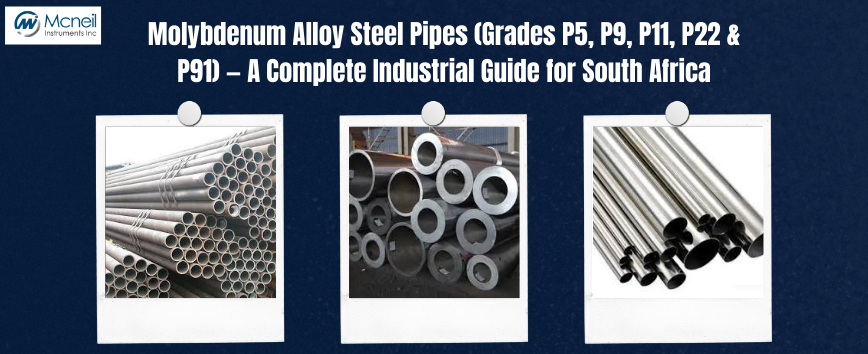
Introduction: Strength and Reliability for South African Industrial Pipelines
South Africa’s industrial landscape is grounded in heavy-duty infrastructure — from coal-fired and renewable power plants to petrochemical refineries, chemical processing units, mining operations, and critical water-treatment systems. Piping networks in these sectors must handle high temperatures, elevated pressures, corrosive environments, and long operational lifetimes.
In such demanding conditions, molybdenum alloy steel pipes — specifically those conforming to ASME SA335 / ASTM A335 grades P5, P9, P11, P22, and P91 — offer the mechanical strength, creep resistance, weldability, and thermal stability that industrial engineers depend on.
As a trusted manufacturer, supplier, and exporter in India, Mcneil Instrument delivers molybdenum alloy steel pipes engineered and certified for global industrial standards, and well suited to South African projects where performance and reliability are critical.
This blog explains:
- What these alloy grades mean
- How they compare technically
- Their specific uses in South Africa
- A specification table for quick engineering reference
What Are Molybdenum Alloy Steel Pipes?
Molybdenum alloy steel pipes are high-strength ferritic steels that include chromium and molybdenum as key alloying elements. These chemical additions enhance:
- Resistance to oxidation
- Creep strength at elevated temperatures
- Scaling resistance
- Mechanical durability under pressure
They are most often manufactured as seamless pipes — which deliver superior structural integrity compared to welded alternatives — and are widely used in high-temperature, high-pressure services.
In South Africa’s industrial environments, these pipes are commonly found in:
- Thermal power plant steam lines
- Petrochemical refinery heaters and reactors
- Pressure vessels and heat exchangers
- Mining processing fluids
- Fertilizer and chemical plant piping
Understanding the differences between each grade helps engineers choose the optimal material for their specific service conditions.
Understanding the ASME SA335 / ASTM A335 Grades
Each alloy steel grade has been developed to balance performance, ductility, weldability, and resistance to deformation under heat and pressure.
ASME SA335 Grade P5 Alloy Steel Pipes
Designed with approximately 5% chromium and 0.5% molybdenum, P5 provides:
- Moderate corrosion and oxidation resistance
- Enhanced strength above carbon steels
- Good mechanical stability
Typical applications in South Africa: refinery heater lines, moderate-pressure steam piping, industrial boilers.
ASME SA335 Grade P9 Alloy Steel Pipes
With ~9% chromium and ~1% molybdenum, P9 offers improved oxidation resistance and creep strength.
Typical applications in South Africa: petrochemical process lines, high-temperature steam systems, heavy-duty pressure headers.
ASME SA335 Grade P11 Alloy Steel Pipes
One of the most widely used grades, balancing strength and cost. It contains ~1.25% chromium and 0.5% molybdenum.
Typical applications in South Africa:
- Power plant steam pipelines
- Standard-temperature petrochemical loops
- Boiler feed lines
ASME SA335 Grade P22 Alloy Steel Pipes
With ~2.25% chromium and ~1% molybdenum, P22 delivers better mechanical properties and creep resistance, making it suitable for more extreme thermal cycles.
Typical applications in South Africa:
- Superheater and reheater sections
- High-pressure steam distribution
- Refinery fluid transport systems
ASME SA335 Grade P91 Alloy Steel Pipes
A high-performance creep-strength-enhanced ferritic alloy containing ~9% chromium, ~1% molybdenum, and small additions of vanadium and niobium. P91 is ideal for extreme conditions where prolonged high temperature and pressure are present.
Typical applications in South Africa:
- Ultra-supercritical power plant steam loops
- High-pressure feedwater trains
- Niche petrochemical and refinery services
Technical Specifications — Overview and Comparison
Understanding the technical properties of each grade is essential for proper selection and engineering.
Specification Table: Grades P5, P9, P11, P22 & P91
| Feature / Grade | P5 | P9 | P11 | P22 | P91 |
| Standard | ASME SA335 / ASTM A335 | ASME SA335 / ASTM A335 | ASME SA335 / ASTM A335 | ASME SA335 / ASTM A335 | ASME SA335 / ASTM A335 |
| Cr (%) | ~5 | ~9 | ~1.25 | ~2.25 | ~9 |
| Mo (%) | ~0.5 | ~1 | ~0.5 | ~1 | ~1 |
| Typical Tensile Strength | ≥ 415 MPa | ≥ 415 MPa | ≥ 415 MPa | ≥ 520 MPa | ≥ 585 MPa |
| Typical Yield Strength | ≥ 205 MPa | ≥ 205 MPa | ≥ 205 MPa | ≥ 310 MPa | ≥ 415 MPa |
| Elongation (%) | ~30 | ~30 | ~30 | ~30 | ~20 |
| Hardness (HRB / HB) | ≤ 95 | ≤ 95 | ≤ 95 | ≤ 95 | ≤ 250 |
| Creep Resistance | Moderate | High | Moderate | Higher | Very High |
| Best for | Moderate steam / refinery lines | High temp steam / corrosion | Standard power plant piping | Severe pressure & thermal cycles | Extreme temp & pressure |
Dimensions & Manufacturing Details
All molybdenum alloy steel pipes supplied by Mcneil Instrument conform to recognized dimensions that make them suitable for common South African industrial specs:
| Specification | Details |
| Size Range | 1/8″ NB to 24″ NB (Nominal Bore) |
| Wall Thickness (Schedules) | SCH 20 to SCH XXS |
| Manufacturing Type | Seamless |
| End Type | Beveled, Plain |
| Surface Finish | Black / Painted / Pickled |
These specifications align with ASME and ASTM tolerances and ensure compatibility with standard industrial piping systems and spool assemblies.
Mechanical Properties by Grade (Typical)
The table below summarizes typical mechanical properties that engineers refer to when specifying these pipes:
| Property | P5 / P9 | P11 / P22 | P91 |
| Tensile Strength (min) | ≥ 415 MPa | ≥ 415 to ≥ 520 MPa | ≥ 585 MPa |
| Yield Strength (min) | ≥ 205 MPa | ≥ 205 to ≥ 310 MPa | ≥ 415 MPa |
| Elongation (min) | ~30% | ~30% | ~20% |
| Hardness | ≤ 95 HRB | ≤ 95 HRB | ≤ 250 HB |
Actual values vary slightly depending on mill testing results and material heat treatments. Full Mill Test Certificates (MTCs) are provided with every order.
Why These Materials Matter for South African Projects
South Africa’s industrial sectors often operate under conditions that demand both mechanical reliability and thermal endurance:
Power Generation
Coal-fired and renewable hybrid plants require steam pipelines, superheater loops, and high-pressure feedwater circuits that must endure prolonged temperature cycles.
Oil & Gas and Petrochemical
Refinery piping, heater coils, and processing loops are subject to corrosive feedstocks and high-temperature operations.
Mining and Materials Processing
Pipelines carrying process fluids, abrasive slurries, and thermal transfer media demand durability and performance.
Heavy Industrial
Pressure vessels, boilers, and heat exchangers in large manufacturing units need pipes that resist creep and scaling at elevated temperatures.
Molybdenum alloy steel pipes — with their enhanced creep strength and oxidation resistance — are engineered for such conditions.
Quality Assurance and Certification
Pipes from Mcneil Instrument are produced under rigorous quality control protocols to ensure full compliance with international and project specifications:
- ASTM / ASME compliance
- Hydrostatic pressure testing
- Non-destructive examination (NDE) — ultrasonic / radiographic
- Chemical and mechanical testing
- Positive Material Identification (PMI)
- Mill Test Certificates (EN 10204 3.1 / 3.2)
This ensures both traceability and performance data for critical industrial applications.
Why Choose Mcneil Instrument — Manufacturer, Supplier & Exporter
1. Global Technical Compliance
Engineering and manufacturing conform to international standards suitable for South African industrial norms.
2. Wide Range of Alloy Grades
From moderate service (P5) to extreme duty (P91), Mcneil Instrument offers comprehensive molybdenum alloy steel pipe options.
3. Seamless Pipe Quality
Seamless construction provides superior pressure containment and uniform mechanical properties.
4. Custom Sizes and Provisioning
Pipes can be supplied in different schedules and lengths — including project-ready cut lengths.
5. Export-Ready Supply Chain
Efficient logistics, packaging, and export documentation streamline delivery to South African ports and project sites.
Conclusion: Industrial Strength and Performance for South Africa
When industrial systems in South Africa require piping that can withstand severe temperature and pressure environments, molybdenum alloy steel pipes — especially grades P5, P9, P11, P22, and P91 — provide a proven solution.
Whether for power generation, refinery process loops, petrochemical installations, or heavy manufacturing, these pipes deliver:
- Exceptional mechanical strength
- High creep resistance
- Superior oxidation tolerance
- Long service life
As a trusted manufacturer, supplier, and exporter, Mcneil Instrument delivers certified, high-performance alloy steel pipes tailored for industrial requirements in South Africa and beyond — ensuring reliability, compliance, and project success.


